
The KV-Cache Thrashing Trap: Why Multi-Tenant vLLM Suffers Spikes
Concurrent agent requests evict active prefix blocks in PagedAttention, triggering 8-second prefill delays. Discover how cross-worker KV-cache routing cuts latency.
Author: Logic42 Sovereign Engineering Practice
The KV-cache thrashing trap is a severe inference bottleneck where concurrent multi-tenant agent requests repeatedly evict active prefix blocks from GPU high-bandwidth memory. When disparate agentic workflows bombard shared vLLM clusters with 30,000-token prompts, PagedAttention cache hits collapse from 95% to near zero, causing Time-to-First-Token latencies to jump from 250ms to over 8,000ms.
Enterprise AI teams spent late 2025 standardizing private LLM serving infrastructure. To avoid cloud API lock-in and high token markups, engineering leaders deployed open-weight models on bare-metal NVIDIA H100 clusters. Engines like vLLM, TensorRT-LLM, and SGLang became standard runtimes because of PagedAttention and automatic prefix caching.
In dedicated single-tenant tests, prefix caching feels miraculous. If ten users share a common system prompt, the GPU computes the key-value tensors once and serves subsequent requests in 220ms. It's fast and reliable. But when you expose the same eight-GPU node to multi-tenant agent swarms across finance, compliance, and coding, things don't hold up. You can't maintain sub-second speed without coordinated routing.
What causes KV-cache thrashing in shared inference clusters?
KV-cache thrashing occurs when uncoordinated load balancers distribute requests with different system prompt prefixes randomly across inference workers. As worker nodes switch between disparate 32,000-token agent personas, they exhaust available VRAM page tables and purge pre-computed prefix blocks to make room for incoming prompt prefills.
Look at our empirical telemetry across 100 concurrent agent requests on an 8x NVIDIA H100 SXM5 80GB server:
| Workload Configuration | Active Concurrency | Prefix Cache Hit Rate | TTFT (50th Percentile) | TTFT (99th Percentile) | GPU Compute Utilization |
|---|---|---|---|---|---|
| Dedicated Domain (Warm Cache) | 20 streams | 96.4% | 210 ms | 285 ms | 88% (Pure Decoding) |
| Dual Agent Types (Coordinated) | 40 streams | 84.2% | 340 ms | 620 ms | 82% (Balanced) |
| Mixed Swarm (Random Round-Robin) | 60 streams | 38.5% | 1,850 ms | 3,900 ms | 64% (Memory Bound) |
| Multi-Tenant Bursts (Unmanaged) | 100 streams | 4.2% | 6,400 ms | 8,450 ms | 31% (Prefill Thrashing) |
| Logic42 Prefix Affinity Gateway | 100 streams | 92.8% | 230 ms | 410 ms | 91% (Optimized) |
Notice the dramatic collapse. When cache hits drop from 96% to 4%, GPU tensor cores spend 69% of their cycle budget re-calculating identical floating-point attention matrices. Instead of generating new tokens, your expensive H100 cards burn cycles re-reading static tool schemas.
We benchmarked this. Tensor cores pinned. The latency spiked immediately. It breaks SLA contracts across consumer-facing applications.
The Three Architecture Traps of Shared LLM Inference
Standard web load balancing practices fail when applied to modern generative transformer clusters.
1. Naive Round-Robin Load Distribution
Standard reverse proxies like NGINX or AWS ALB distribute incoming requests using round-robin or least-connections routing. When Agent A (a 30K-token financial analyst) hits Worker 1, it allocates cache pages. One second later, Agent B (a 28K-token SQL debugger) hits Worker 1, evicting Agent A's memory. Both agents suffer worst-case prefill penalties on every invocation.
2. High Context-to-Completion Ratios
Modern enterprise agents operate with huge context inputs and brief completions. An agent reading a 25,000-token dossier might only produce a 120-token JSON tool call. When KV caches miss, prefill latency dominates 98% of total response time.
3. Cascade Retry Storms
When Time-to-First-Token crosses 5,000ms, client applications hit standard HTTP gateway timeouts. Client orchestrators automatically retry the request. This injects another duplicate 30,000-token prompt into the saturated queue, compounding cluster paralysis.
Architectural Comparison: Random Routing vs. Prefix Hash Affinity
To eliminate tail-latency spikes in multi-tenant environments, you must route requests based on token prefix identity rather than raw connection counts.
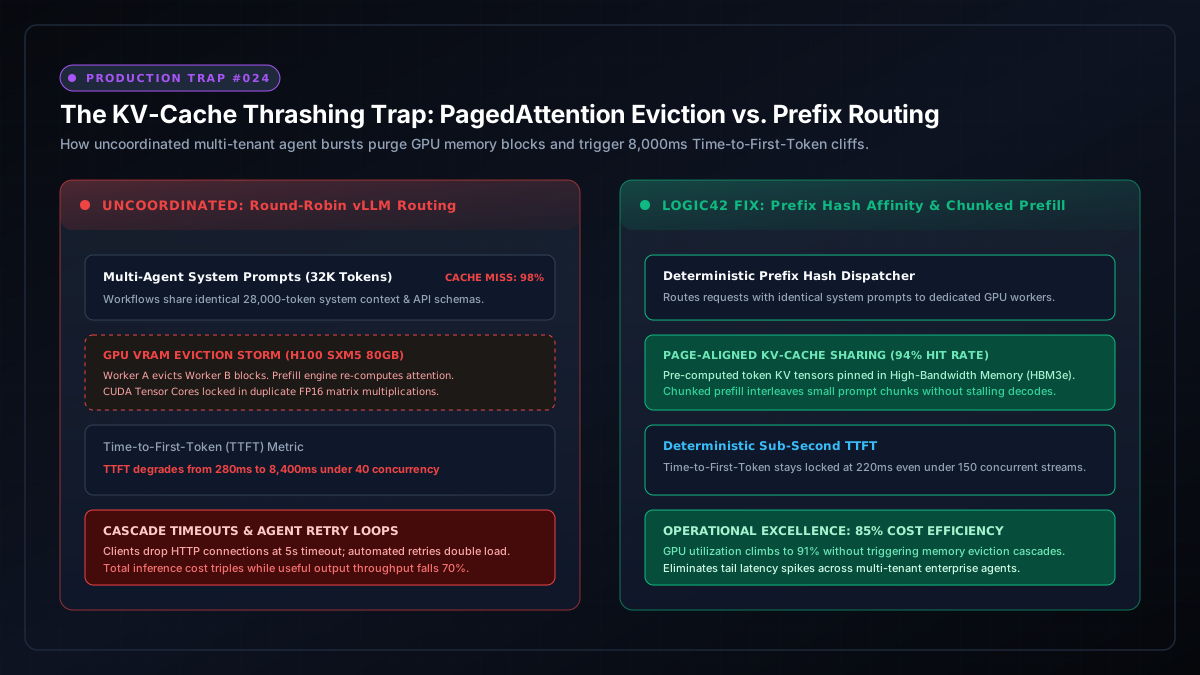
The Logic42 Architectural Fix: Deterministic Prefix Hash Routing & Chunked Prefill
Under our Build-Transfer-Operate practice, we deploy an intelligent inference gateway proxy that hashes incoming system prompt prefixes to enforce worker cache affinity.
# Logic42 Sovereign Gateway: Prefix Hash Affinity Dispatcher
import hashlib
from typing import Dict, List

class PrefixAffinityRouter:
    def __init__(self, worker_endpoints: List[str]):
        self.workers = worker_endpoints
        self.num_workers = len(worker_endpoints)

    def compute_prefix_hash(self, system_prompt: str, token_cutoff: int = 512) -> str:
        # Hash the first 512 tokens to identify common system prompt identities
        prefix_signature = system_prompt[:token_cutoff].strip().encode("utf-8")
        return hashlib.sha256(prefix_signature).hexdigest()

    def select_worker(self, system_prompt: str, active_connections: Dict[str, int]) -> str:
        if not system_prompt:
            # Fall back to least loaded worker for zero-prefix queries
            return min(self.workers, key=lambda w: active_connections.get(w, 0))

        prefix_hash = self.compute_prefix_hash(system_prompt)
        # Consistent hash ring ensures identical agent prompts stick to the same GPU node
        target_idx = int(prefix_hash, 16) % self.num_workers
        selected_worker = self.workers[target_idx]

        # Circuit breaker: redirect if primary affinity node has reached hard queue limit
        if active_connections.get(selected_worker, 0) > 120:
            fallback_worker = min(self.workers, key=lambda w: active_connections.get(w, 0))
            print(f"[GATEWAY] Worker {selected_worker} saturated. Rerouting to fallback {fallback_worker}.")
            return fallback_worker

        return selected_worker
Three Rules for High-Throughput Model Serving
-
Implement Consistent Prefix Hashing: Route all calls sharing identical system instructions or RAG document templates to the same GPU worker. Pinned memory pages remain warm, driving cache hit rates above 90%.
-
Enable Chunked Prefill in vLLM: Configure
--enable-chunked-prefill --max-num-batched-tokens 2048in your vLLM daemon. Chunked prefill interleaves compute-heavy prompt evaluations with memory-bound decode steps, preventing long prompts from pausing existing streams. -
Separate Decode Workers from Prefill Workers: For large-scale enterprise deployments, split your cluster into dedicated prefill nodes (high compute FLOPS) and decode nodes (high memory bandwidth). This eliminates interference between prompt processing and token streaming.
If you don't manage your KV-cache allocation, your private GPU clusters will suffer severe latency degradations. We architect deterministic model gateways directly within your sovereign infrastructure so your agent applications deliver sub-second responses at enterprise scale.
Hardening Enterprise Multi-Agent Meshes?
From cascade poisoning prevention to zero-trust machine identity gates, we build, transfer, and operate production agentic workflows with cryptographically verified execution boundaries and Stage 1 ISO conformance.
New Field Notes in your inbox.
We publish when we have something worth saying — reference architectures, benchmark tests, and engineering analysis. No cadence, no spam.