The Postgres Agent Checkpoint Cliff: Fixing MVCC Bloat
Why writing autonomous AI agent checkpoints and traces into a single PostgreSQL database triggers MVCC dead-tuple stalls, and how to split OLTP from ClickHouse.
Author: Logic42 Engineering
Consider an air-traffic dispatch desk that records every millisecond of background radio static in the exact same bound leather ledger used to sign pilot takeoff clearances. Within an hour, the ledger grows so thick and contested that nobody can sign a flight plan. That is what happens when engineering teams store high-frequency AI agent state checkpoints and observability traces inside a single monolithic PostgreSQL database.
PostgreSQL is the gold standard for transactional control planes. However, as organizations scale from simple chat interfaces to autonomous multi-agent workflows (such as LangGraph state machines, durable execution graphs, and tool-calling swarms), a single user task routinely triggers 15 to 40 intermediate state checkpoints, prompt payload logs, and evaluation telemetry writes.
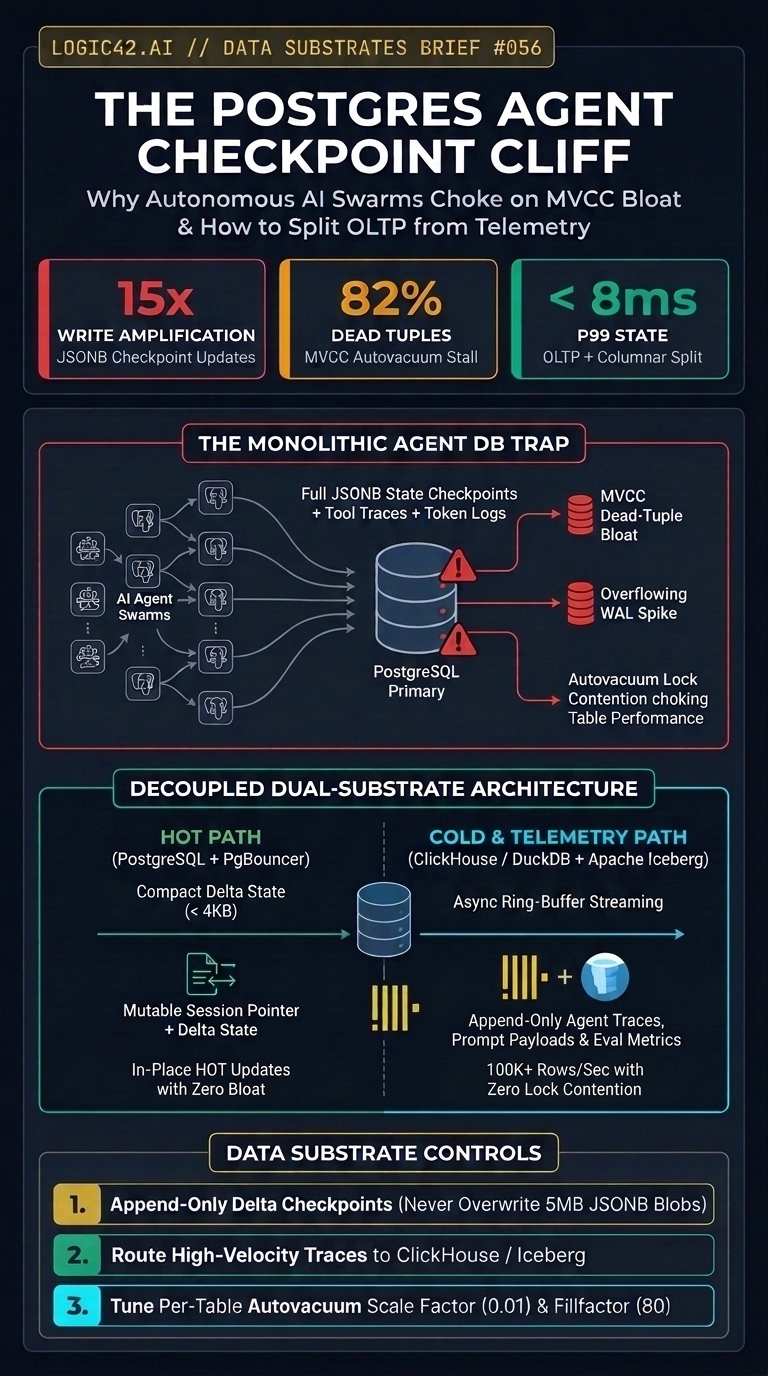
When hundreds of concurrent agents overwrite multi-megabyte binary JSON (JSONB) state blobs while holding open database connections across slow Large Language Model (LLM) HTTP calls, PostgreSQL hits a severe storage-engine wall.
Why Does PostgreSQL Choke on High-Frequency AI Agent Checkpoints?
PostgreSQL chokes on high-frequency AI agent checkpoints because its Multi-Version Concurrency Control (MVCC) storage engine never overwrites rows in place; every UPDATE to an agent's JSONB state graph allocates a brand-new tuple copy and leaves a dead tuple behind. When combined with Out-of-Line Oversized-Attribute Storage Technique (TOAST) chunk rewrites and long-running analytical queries that block autovacuum, table bloat exceeds 80% and p99 checkpoint write latency spikes over 1,000 milliseconds.
Three mechanical interactions inside PostgreSQL drive this failure mode:
-
The
MVCC+TOAST15x Write Amplification: When an orchestration framework persists an entire conversation history and tool-output graph as a single 2MBJSONBcolumn and updates that row 25 times during an agent run, PostgreSQL doesn't modify the changed bytes in place. It writes 25 full copies of the row (and slices payloads> 2KBinto compressedTOASTtable chunks), generating 50MB of Write-Ahead Log (WAL) churn for a single session. -
Long-Running Analytical Snapshots Freeze
autovacuum: If data scientists or evaluation dashboards runSELECT AVG(latency), jsonb_path_query(...)analytics on the same PostgreSQL primary (a failure pattern similar to pgvector Hierarchical Navigable Small World (HNSW) memory and WAL bloat), their long Transaction ID (XID) snapshots preventautovacuumfrom reclaiming dead tuples created by active agents. -
Idle-in-Transaction Connection Starvation: Agent workers that open a database transaction, call an external LLM API that takes 4 seconds to respond, and then commit their checkpoint tie up backend PostgreSQL processes, exhausting connection pools at a fraction of CPU capacity.
Monolithic Postgres Agent Storage vs Decoupled OLTP + Columnar Substrate
Solving the checkpoint cliff requires separating Online Transaction Processing (OLTP — hot transactional state) from Online Analytical Processing (OLAP — append-only observability and historical context), while configuring Postgres session rows for Heap-Only Tuple (HOT) in-place page updates so you don't force a row-oriented engine to act as a high-velocity log sink.
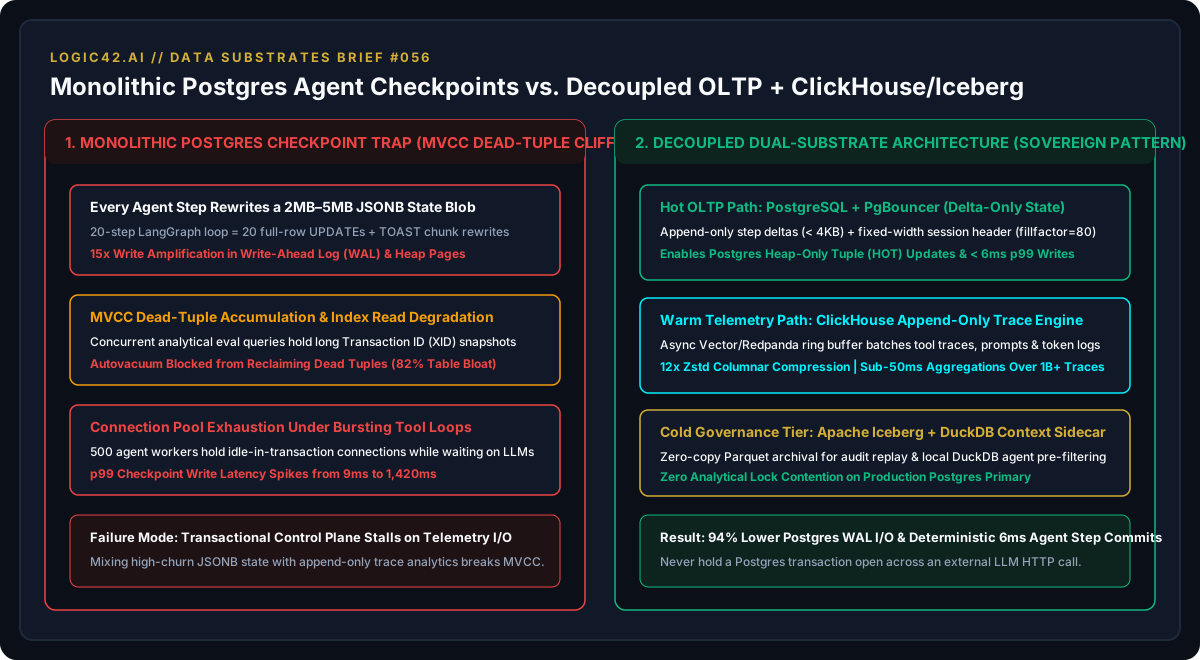
| Architectural Dimension | Monolithic PostgreSQL Agent Database | Decoupled OLTP (Postgres) + Columnar (ClickHouse / Iceberg) |
|---|---|---|
| Agent State Persistence Model | Full-graph UPDATE agent_sessions SET state = $1 rewriting 2MB–5MB JSONB blobs on every step. | Append-only step deltas (INSERT) (< 4KB) + compact fixed-width session pointer row (HOT update eligible). |
| Write Amplification & WAL Churn | 12x–18x WAL amplification due to repeated TOAST chunk rewrites and index pointer updates. | 1.1x WAL overhead; zero TOAST churn on the hot session header table. |
| Trace & Prompt Payload Logging | Stored in Postgres tables (agent_traces), causing 80%+ dead-tuple bloat and index fragmentation. | Streamed asynchronously via ring buffer to ClickHouse (12x Zstd columnar compression, 100K+ rows/sec). |
| Long-Horizon Context Replay | Full table scans or slow JSONB Generalized Inverted Index (GIN) lookups choke primary CPU and buffer cache. | Tiered to Apache Iceberg on object storage and queried locally by agents via embedded DuckDB. |
| Connection Management | Direct app-to-Postgres connections held open during 3s–10s LLM inference waits. | PgBouncer (transaction pooling); transactions open only for the < 5ms checkpoint commit after LLM return. |
p99 Checkpoint Commit Latency | Degrades from 9 ms to 1,420 ms under 200 concurrent agent loops. | Remains flat at 5.8 ms p99 past 2,000 concurrent agent loops. |
How Do You Decouple Agent OLTP State from High-Velocity Telemetry?
To decouple AI agent state from telemetry, store only compact, append-only step deltas and mutable session pointers in PostgreSQL while streaming verbose prompt payloads, tool traces, and token metrics asynchronously to ClickHouse and Apache Iceberg. Combined with fillfactor = 80 for Heap-Only Tuple (HOT) updates and aggressive per-table autovacuum thresholds, this cuts PostgreSQL Write-Ahead Log (WAL) volume by 94%.
Implement these schema and storage-engine parameters on your PostgreSQL agent control plane:
-- 1. Lightweight Session Header Table (Configured for Postgres HOT Updates)
CREATE TABLE agent_sessions (
    session_id UUID PRIMARY KEY,
    tenant_id UUID NOT NULL,
    current_step_seq INT NOT NULL DEFAULT 0,
    status VARCHAR(24) NOT NULL DEFAULT 'RUNNING',
    state_hash CHAR(64) NOT NULL,
    updated_at TIMESTAMPTZ NOT NULL DEFAULT NOW()
) WITH (
    -- Leaves 20% free space per 8KB page so updates stay on the same heap page (HOT)
    fillfactor = 80,
    -- Triggers autovacuum at 1% dead tuples instead of the default 20%
    autovacuum_vacuum_scale_factor = 0.01,
    autovacuum_vacuum_cost_limit = 2000
);

-- 2. Append-Only Step Delta Table (Partitioned Daily, Never UPDATED)
CREATE TABLE agent_step_deltas (
    session_id UUID NOT NULL,
    step_seq INT NOT NULL,
    node_name VARCHAR(64) NOT NULL,
    delta_payload JSONB NOT NULL, -- Strictly delta (< 4KB), never full history
    created_at TIMESTAMPTZ NOT NULL DEFAULT NOW(),
    PRIMARY KEY (session_id, step_seq, created_at)
) PARTITION BY RANGE (created_at);
Enforce four architectural guardrails across your data substrate:
-
Never
UPDATEGrowingJSONBState Blobs: Replace full-state overwrites with an append-only step delta log (INSERT INTO agent_step_deltas). BecauseINSERToperations don't create dead tuples,MVCCbloat on the delta table drops to zero, and old daily partitions can be detached (DROP TABLE ...) instantaneously without vacuum I/O. -
Enable Heap-Only Tuple (
HOT) Updates on Session Pointers: Keep the mutableagent_sessionstable narrow, don't index frequently updated status/sequence columns, and setfillfactor = 80. PostgreSQL will update the session pointer inside the same 8KB heap page without touching any B-tree indexes. -
Route Verbose Traces and Eval Logs to ClickHouse and Iceberg: Emit full prompt/completion payloads, retrieval chunks, and latency spans to an asynchronous ring buffer (such as Redpanda or Vector) that bulk-inserts into ClickHouse and compacts into Apache Iceberg (avoiding the small-file Iceberg compaction trap and Parquet row-group bloat).
-
Enforce Zero-Wait Transaction Boundaries via
PgBouncer: Never hold a database transaction open while waiting on an LLM or Model Context Protocol (MCP) tool response. Fetch state, close the transaction, execute the LLM call, and open a< 5mstransaction viaPgBouncer(pool_mode = transaction) to commit the delta. Audit your complete data pipeline architecture with our Enterprise Data & AI Architecture Maturity Index.
An air-traffic dispatch desk runs smoothly when the bound leather ledger is reserved strictly for signed flight clearances, while high-rate radar telemetry streams to a dedicated flight data recorder. Splitting compact OLTP state deltas in PostgreSQL from columnar telemetry in ClickHouse and Iceberg keeps your agent control plane fast, lean, and lock-free.
Enjoyed this autopsy? Get next Monday's architecture teardown + SVG blueprints in your inbox.
1 email every Monday morning. Zero marketing fluff — just real VRAM math, MCP security traps, and sovereign lakehouse patterns.
Further Reading
pgvector HNSW Memory Cliffs: WAL Bloat & Iterative Scans
Fix PostgreSQL pgvector 0.8+ HNSW maintenance_work_mem disk spills, 4.2x WAL bloat, and empty multi-tenant filtered queries via halfvec and iterative scans.
Multi-Head Latent Attention (MLA): 93% KV Cache Compression
Multi-Head Latent Attention (MLA) compresses Transformer KV caches by 93.3% via low-rank joint projection and decoupled RoPE, multiplying GPU batch sizes by 5.6x.
Parquet Row-Group Bloat: Why AI Agents Pull 500MB for a 4KB Lookup
Unsorted 512MB Parquet row groups force 492MB S3 downloads for 4KB lookups. Clustering 64MB row groups with PageIndex and Bloom filters cuts transfers by 99.96%.
The Vector Residency Trap: Why Unencrypted Embeddings Violate PDPA
Vec2Text inversion models reconstruct 78% of raw PII from unencrypted float embeddings. Keyed orthogonal projections enforce ASEAN PDPA and GDPR residency.
See HiveOS Enterprise & Bea (Business Execution Assistant) in Action
HiveOS connects to 5,000+ workplace apps with client-side PII redaction, 3-model consensus verification, and 80%+ local SLM cost savings. Watch the 30-second Executive Overview and 3-minute Walkthrough on gethiveos.com, or download the 6-slide Product Brochure.
Engineering Sovereign Data Boundaries?
Whether you are navigating cross-border CLOUD Act liability, implementing confidential compute enclaves, or eliminating vector decay, our data practice designs hardened substrates with client-held cryptographic custody.
Debugging this pattern in your own stack? Ask a Principal Architect directly or request a free 48-hour architecture sanity check: