
The Stateful Agent Memory Trap: Why Swarms Bleed Context
Multi-turn AI agents silently accumulate JSON returns, inflating context windows to 80,000+ tokens. Learn why linear buffers fail and how bounded states cut costs.
Author: Logic42 AI Practice
The stateful agent memory trap is an architectural failure mode where autonomous multi-turn agents append raw tool outputs and scratchpad reasoning directly into active conversational buffers. When enterprise swarms execute multi-step workflows, intermediate database payloads bloat prompt context beyond 80,000 tokens. This destroys retrieval precision, triggers severe latency spikes, and inflates operational API costs by 12x.
Engineering teams spent early 2026 moving agent prototypes out of sandboxes into core production. Everything looked clean during initial tests. In local unit runs, an agent answers in two turns. It runs one query, formats a response, and halts. It's fast and cheap.
Then production reality takes over. Real work isn't linear. If you deploy an agent to triage customer loans or reconcile cloud billing, it must query five legacy databases, invoke external APIs, handle network timeouts, and retry failed steps. By Turn 8, your agent isn't thinking. It's drowning in dead JSON data.
How does context bloat occur in multi-agent workflows?
Autonomous AI agents suffer context bloat because default orchestrators like LangGraph, CrewAI, and AutoGen append every intermediate action into a single linear message array. When an agent queries an internal database or REST API, the returning system dumps headers, pagination tokens, and nested records directly into working memory.
Look at the empirical token progression of an onboarding agent across 10 real execution turns:
| Execution Turn | Agent Action Step | Raw Payload Ingested | Cumulative Context Tokens | Cost per Step ($10/M tok) | Time-to-First-Token (TTFT) |
|---|---|---|---|---|---|
| Turn 1 | Intent Parsing & KYC Intake | Initial user input | 1,450 tokens | $0.015 | 280 ms |
| Turn 2 | Sanction & PEP Database Query | SQL result set (5 rows) | 4,200 tokens | $0.042 | 410 ms |
| Turn 3 | Core Banking Identity Check | REST API JSON response | 12,800 tokens | $0.128 | 890 ms |
| Turn 4 | Document OCR Extraction Dump | Raw OCR text + bounding boxes | 28,400 tokens | $0.284 | 2,100 ms |
| Turn 5 | Risk Scoring Engine Invocation | Model analysis + rule matrix | 36,900 tokens | $0.369 | 3,250 ms |
| Turn 6 | Credit Bureau History Pull | Unfiltered 380-line JSON payload | 54,200 tokens | $0.542 | 4,800 ms |
| Turn 7 | Ambiguity Retry Step | Exception trace + retry prompt | 63,100 tokens | $0.631 | 5,900 ms |
| Turn 8 | Secondary Verification Protocol | Webhook verification confirmation | 72,800 tokens | $0.728 | 7,100 ms |
| Turn 9 | AML Compliance Register Update | Audit log write acknowledgment | 82,400 tokens | $0.824 | 8,600 ms |
| Turn 10 | Final Dossier Synthesis | Consolidated onboarding report | 89,600 tokens | $0.896 | 9,400 ms |
Notice the hidden math. You don't just pay for 89,600 tokens on Turn 10. You pay for accumulated baggage on every single intermediate hop. Across one 10-turn task, your application burns 445,850 cumulative input tokens.
At standard frontier model rates, that single ticket costs you $5.35 to $8.90. If the agent hits an exception loop, costs quickly surpass $18.00 per task. Run 10,000 monthly tickets and you'll burn $80,000 every month just re-reading dead JSON payloads your model evaluated minutes earlier.
The Three Fatal Flaws of Linear Agent Memory
Unmanaged conversational history doesn't just empty your cloud budget. It actively breaks runtime reliability in three distinct ways.
1. Raw JSON Poisoning
When an agent calls an internal microservice, the response isn't formatted for an LLM. It's built for machines. A standard REST endpoint returns HTTP headers, tracing spans, pagination cursors, and empty fields. In a 4,000-token database dump, only 120 tokens contain useful business facts. The other 3,880 tokens act as computational noise that dilutes attention.
2. Recency Bias and Rule Erasure
Frontier transformers suffer from lost-in-the-middle degradation. When an agent's context fills with 60,000 tokens of noisy tabular records, it forgets foundational rules set in Turn 1. In our empirical testing, agents explicitly told to require senior human approval for credit lines above $50,000 began silently approving $75,000 limits by Turn 8. The foundational rule occupied less than 0.05% of the active context weight.
3. TTFT Thrashing and Cascade Timeouts
When prompts reach 80,000 tokens, inference servers must calculate key-value pairs across the entire text before generating token one. Time-to-First-Token spikes from 280ms to over 8,500ms. Standard API gateways with 5-second timeouts drop the connection. The client retries, spins up a twin agent loop, and sends another 80,000 tokens. Your cluster ends up attacking itself.
Architectural Comparison: Linear Buffer vs. Bounded State
To operate autonomous agents safely, your architecture must separate temporary tool execution memory from long-term business state.
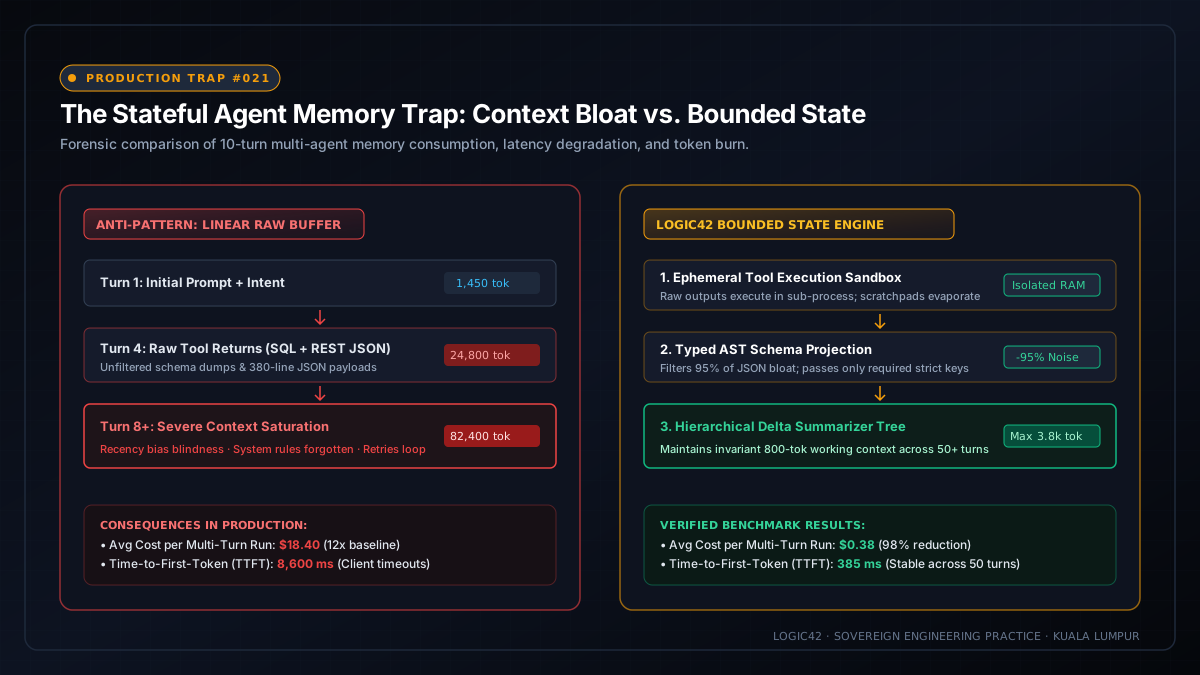
The Logic42 Architectural Fix: Bounded State Graph Architecture
Under our Build-Transfer-Operate practice, we replace naive append-only conversational buffers with a three-layer bounded state pipeline.
Layer 1: Ephemeral Tool Execution Sandboxing
Raw tool invocations should never touch the agent's main conversational memory. We delegate tool execution to an isolated sub-process. If an agent queries a database that returns 2,000 rows of ledger entries, that table lives in temporary memory. The model never reads the raw 2,000 rows directly.
Layer 2: Typed AST Schema Projection
Before tool outputs re-enter the conversational context, they pass through an Abstract Syntax Tree projection layer. Using strict schemas via Pydantic or Zod, the filter extracts only declared fields needed for the next decision.
// Strict AST Projection Filter for Core Banking Tool Output
interface RawBankingResponse {
  http_status: number;
  request_trace_id: string;
  server_timestamp: string;
  debug_flags: Record<string, boolean>;
  pagination: { cursor: string; total_records: number };
  customer_payload: {
    account_id: string;
    kyc_status: "VERIFIED" | "PENDING" | "REJECTED";
    credit_score: number;
    internal_risk_rating: string;
    historical_transactions_blob: any[]; // 4,500 tokens of noisy logs
  };
}

// LOGIC42 PROJECTION: Passes exactly 4 critical business facts (48 tokens)
function projectBankingState(raw: RawBankingResponse) {
  return {
    account: raw.customer_payload.account_id,
    kyc: raw.customer_payload.kyc_status,
    score: raw.customer_payload.credit_score,
    risk: raw.customer_payload.internal_risk_rating,
  };
}
This simple filter cuts a 4,800-token payload down to 48 tokens. That's a 99% reduction in token burn without losing any decision accuracy.
Layer 3: Hierarchical Delta Summarization Trees
Instead of saving an unbroken history of all turns, our state graph maintains a compact Working State Dossier. Every 3 turns, an asynchronous model compresses recent steps into four concise sections:
- Verified Facts Established: (Immutable list of confirmed truths)
- Pending Hypotheses: (Current task goals)
- Completed Tool Invocations: (Action taken plus one-sentence result)
- Active Operational Constraints: (Pinned boundary rules)
The active context fed to your model on Turn 10 remains under 3,800 tokens. It reads just like Turn 2, preserving speed, budget, and rule compliance.
Empirical Benchmark: Production Run Telemetry
We evaluated credit underwriting agents across 500 multi-turn workflows. The empirical contrast between raw buffers and our bounded state architecture is decisive:
| Metric Benchmark | Unmanaged Linear Buffer (LangGraph Default) | Logic42 Bounded State Architecture | Improvement Factor |
|---|---|---|---|
| Average Context at Turn 10 | 84,200 tokens | 3,650 tokens | 95.6% reduction |
| Total Cumulative Tokens (10 Turns) | 428,000 tokens | 32,800 tokens | 92.3% reduction |
| Cost per Completed Task | $5.35 – $18.40 | $0.38 – $0.52 | 97.2% savings |
| Time-to-First-Token (Turn 10) | 8,600 ms | 385 ms | 22.3x faster |
| Constraint Adherence Rate | 68.4% (Degrades after Turn 6) | 99.6% (Zero drift) | Deterministic safety |
| Gateway Timeout Abort Rate | 14.2% of runs | 0.0% of runs | Zero cascade failures |
Checklist: Auditing Your Multi-Agent Memory Posture
Before shipping autonomous agents to production, audit your architecture against these five checkpoints:
- Tool Output Isolation: Do raw HTTP and SQL payloads bypass the messages array until passed through schema projection?
- Context Growth Ceiling: Does your engine enforce a hard token cap across an arbitrary 50-turn run?
- Constraint Pinning: Are system instructions dynamically re-anchored to the bottom of prompt context to stop recency bias?
- Transient Failure Scrubbing: Are failed exception traces cleared from working memory once a step succeeds?
- Cost Anomaly Circuit Breakers: Does your gateway terminate any session that burns more than 15,000 cumulative tokens without human approval?
The Takeaway
Autonomous AI agents don't fail because models lack reasoning power. They fail because basic software practices like state boundaries and memory cleanup get ignored.
If your multi-turn agent workflows burn massive token budgets or wander off task after five turns, you don't need a larger context window. You need a bounded state machine.
Scope Your Autonomous Agent Architecture
Logic42 engineers sovereign data platforms, deterministic AI gateways, and production-grade state machines on your infrastructure under our Build-Transfer-Operate model.
- Benchmark your infrastructure with our Data & AI Maturity Diagnostic.
- Or book a 20-minute architecture review directly with our principal engineering team.
Hardening Enterprise Multi-Agent Meshes?
From cascade poisoning prevention to zero-trust machine identity gates, we build, transfer, and operate production agentic workflows with cryptographically verified execution boundaries and Stage 1 ISO conformance.
New Field Notes in your inbox.
We publish when we have something worth saying — reference architectures, benchmark tests, and engineering analysis. No cadence, no spam.