ACP vs. MCP: The Multi-Agent Protocol Divide & Architecture Traps
Why Anthropic's MCP tool drivers cannot solve agent-to-agent delegation, and how ACP peer meshes introduce cascade prompt injection risks.
Author: Logic42 Sovereign Engineering Practice
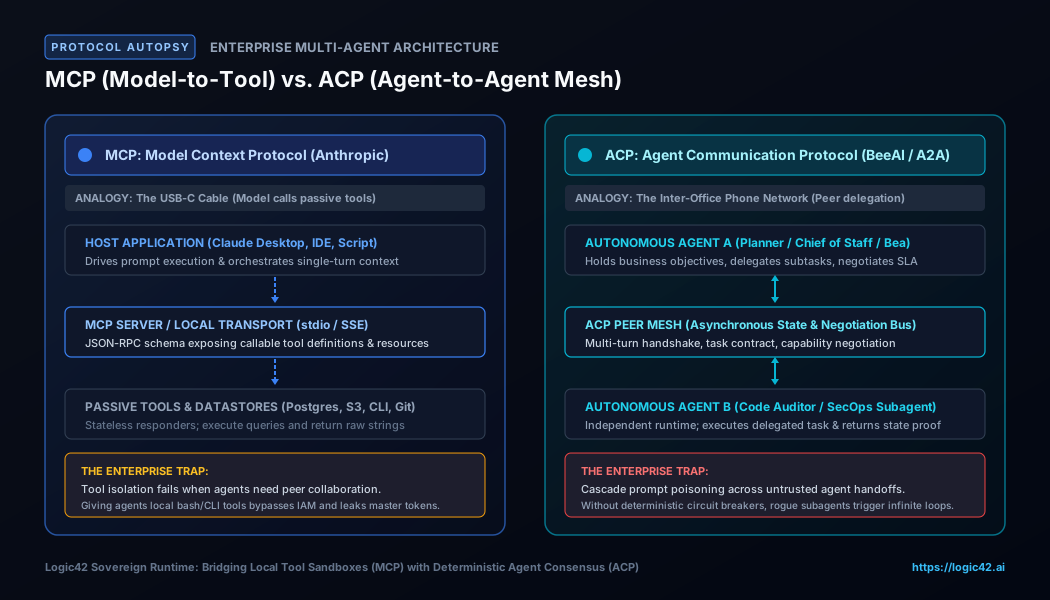
Think of the Model Context Protocol (MCP) like a USB-C port on your laptop: it gives a single machine a standard plug to talk to passive accessories like keyboards and external drives. The Agent Communication Protocol (ACP) is like an inter-office telephone system: it lets two independent executives in different branches negotiate terms, delegate assignments, and pass work back and forth. You can't fix a broken delegation chain by buying a faster USB cable.
As enterprise engineering teams move from isolated single-prompt copilots to autonomous multi-agent meshes, a fundamental protocol divide has emerged. Anthropic's open standard, the Model Context Protocol (MCP), standardizes how a host model reads local files, queries databases, and triggers stateless tools. Meanwhile, emerging specifications like the Agent Communication Protocol (ACP)—advancing through initiatives like the Linux Foundation's BeeAI and Agent-to-Agent (A2A) workgroups—standardize how independent, autonomous agents communicate, negotiate task scopes, and coordinate execution.
Confusing these two layers is currently breaking enterprise swarms in production. When architects attempt to force MCP into multi-agent workflows, they encounter severe context serialization stalls and static privilege leaks. Conversely, teams that deploy un-sandboxed ACP meshes expose their infrastructure to cascading prompt injections and runaway delegation loops.
Below is the architectural autopsy of both protocols, their distinct failure modes, and the sovereign bridge pattern required to run them safely in enterprise production.
1. Architectural Anatomy: Tool Driver vs. Negotiation Mesh
Understanding the divide requires looking past marketing buzzwords and examining the low-level communication topologies of both protocols:
| Architectural Dimension | Model Context Protocol (MCP) | Agent Communication Protocol (ACP) |
|---|---|---|
| Primary Topology | Hub-and-Spoke (Hierarchical) | Peer-to-Peer or Directed Mesh (Distributed) |
| Communication Abstraction | Model-to-Tool / Model-to-Data | Agent-to-Agent (A2A) Collaboration |
| Execution State | Stateless request-response execution | Stateful multi-turn task negotiation |
| Transport Layer | Standard I/O (stdio) or Server-Sent Events (SSE) | HTTP/2, WebSockets, or gRPC message brokers |
| Security Boundary | Tool sandbox permissions and file access control | Cryptographic agent identity and task attestation |
| Core Vulnerability | Local CLI privilege escalation & static key theft | Cascade prompt poisoning & runaway delegation loops |
How MCP Operates Under the Hood
In the MCP specification, the host application (such as an IDE, terminal runner, or Claude Desktop) acts as the central client. The client initiates a transport session over stdio or HTTP Server-Sent Events (SSE) to an external MCP server.
The server exposes callable schemas formatted in JSON-RPC. When the model needs to query a database or inspect a repository, it emits a structured tool call. The MCP server executes the command locally and returns raw text. The tool has zero autonomy; it doesn't reason, negotiate, or delegate. It's a passive peripheral.
How ACP Operates Under the Hood
In contrast, ACP governs interactions between two or more fully autonomous agents, each equipped with its own internal reasoning loop, memory store, and specialized role.
Instead of simple function calls, ACP defines multi-turn conversational handshakes: capability discovery, task contract negotiation, intermediate progress telemetry, and cryptographic verification of finished work. Agent A doesn't execute code on Agent B; Agent A asks Agent B to achieve an outcome under strict operational constraints.
2. The Three Production Traps of the Protocol Divide
When enterprise platforms conflate tool connectivity with agent coordination, three catastrophic failure modes emerge:
Trap 1: The "Fat Tool" Monolith (Misusing MCP for Agent Coordination)
Many teams attempt to build multi-agent swarms by treating subagents as MCP tools. A master planner calls an MCP tool named run_security_audit_agent.
Because MCP is designed for lightweight function execution, the host model must serialize its entire conversation history and pass it down the stdio pipe. The subagent processes the request in isolation, dumps 4,000 tokens of raw reasoning back through the pipe, and blows out the master agent's context window. This causes severe context bloat, prompt caching invalidation, and runaway inference costs.
Trap 2: Cascade Prompt Poisoning in ACP Meshes
In a distributed ACP network, Agent A delegates a task to Agent B, which subsequently delegates sub-tasks to external partner agents.
If Agent B retrieves an adversarial document containing hidden zero-font prompt injection text, Agent B's reasoning loop becomes compromised. Under standard ACP, Agent B forwards the poisoned instructions as "verified task output" to Agent A. Without deterministic input firewalls between agent boundaries, the injection cascades across the entire corporate swarm.
Trap 3: The Static Credential Bypass
When developers configure MCP servers to connect to cloud infrastructure, they often hardcode long-lived administrative tokens into local configuration files (claude_desktop_config.json).
Because MCP servers run locally with the host process's full user privileges, an agent executing an arbitrary bash tool can inspect its own configuration environment, extract the master keys, and bypass corporate Single Sign-On (SSO) and Cloud IAM boundaries entirely.
3. Comparative Schemas: JSON-RPC vs. Task Handoff
The fundamental difference is visible in the protocol message schemas themselves:
MCP: Stateless Tool Call (JSON-RPC 2.0)
An MCP message is a direct, imperative instruction to execute a specific function:
{
  "jsonrpc": "2.0",
  "method": "tools/call",
  "params": {
    "name": "query_customer_records",
    "arguments": {
      "tenant_id": "T_9812",
      "limit": 5
    }
  },
  "id": 42
}
ACP: Autonomous Task Delegation Contract
An ACP message is a declarative contract that negotiates an outcome between autonomous peers:
{
  "protocol": "acp/1.0",
  "action": "task/delegate",
  "sender": "agent://chief-of-staff/bea",
  "recipient": "agent://secops/code-auditor",
  "contract": {
    "objective": "Verify PR #412 for zero-day privilege escalation",
    "sla_seconds": 60,
    "max_cost_cents": 25,
    "required_attestation": "sha256_merkle_proof"
  },
  "context_pills": [
    "vault://token/pr_metadata",
    "vault://token/threat_feed"
  ]
}
4. Five Sovereign Rules for Enterprise Multi-Agent Deployment
To safely combine tool execution with multi-agent orchestration, engineering teams must enforce five architectural safeguards:
-
1. Use MCP for Tools, Use ACP for Agents: Enforce a strict architectural boundary. If an entity is a passive database, file reader, or API wrapper, connect it exclusively via MCP. If an entity maintains its own reasoning loop, memory, or planning capabilities, interface it over ACP.
-
2. Sandbox Local MCP Servers in Ephemeral MicroVMs: Never run local MCP servers directly on developer workstations or shared production hosts. Isolate MCP processes inside ephemeral, single-task microVMs (such as Firecracker) with eBPF-filtered network sockets to prevent local credential harvesting.
-
3. Enforce Deterministic Boundary Firewalls Between ACP Peers: Never allow raw text handoffs between autonomous agents. Every message passed over ACP must pass through an in-memory structural parser that strips executable prompt injection syntax before delivering context to the recipient agent.
-
4. Implement On-Behalf-Of (OBO) Ephemeral Token Exchange: Disallow static API keys in MCP server configurations. When an agent invokes a tool, require an OAuth 2.1 On-Behalf-Of (OBO) token exchange that generates a scoped, 60-second token tied strictly to the originating user's identity.
-
5. Deploy Consensus Circuit Breakers on Agent Delegation Trees: Bound ACP delegation depth to a hard limit (e.g., maximum 3 tiers). If an agent chain attempts recursive self-delegation or spend exceeds pre-allocated budget thresholds, trigger an automated hardware circuit breaker.
Frequently Asked Questions
What is the difference between MCP and ACP?
The Model Context Protocol (MCP) connects an individual AI model to passive tools and local data sources through structured JSON-RPC function calls. The Agent Communication Protocol (ACP) connects independent, autonomous AI agents to each other, enabling multi-agent coordination, negotiation, task handoffs, and state synchronization across distributed systems.
Can an AI system use both MCP and ACP together?
Yes, and production systems should use both in a tiered architecture. Autonomous agents use ACP to negotiate workflows, delegate complex assignments, and coordinate with peer agents. When an individual agent needs to access a local file, execute a shell script, or query an internal database, it invokes a local, sandboxed MCP server as a passive tool.
What is the biggest security risk in multi-agent ACP networks?
The primary risk is cascading prompt poisoning. If an external or worker agent ingests malicious input, its unverified task output can compromise the reasoning loops of higher-level planning agents. To prevent this, enterprise architectures require deterministic input sanitization and cryptographic attestation between every agent-to-agent message handoff.
Benchmark Your Multi-Agent Governance & Security
Are your agent tool integrations and multi-agent meshes protected against privilege escalation and cascade poisoning? Benchmark your architecture in 3.5 minutes:
- Enterprise AI Security & Adversarial Red-Team Audit: Audit prompt gateways, microVM agent isolation, and MCP server sandboxes.
- ISO/IEC 42001:2023 AI Management System (AIMS) Diagnostic: Benchmark multi-agent governance, accountability boundaries, and automated audit trails.
- Explore All Sovereign Assessments: Boardroom-ready diagnostics with zero vendor lock-in.
Enjoyed this autopsy? Get next Monday's architecture teardown + SVG blueprints in your inbox.
1 email every Monday morning. Zero marketing fluff — just real VRAM math, MCP security traps, and sovereign lakehouse patterns.
Further Reading
vLLM Speculative Decoding Stalls: The High-Batch GPU Wall
Why 5-token speculative decoding speeds up low-batch LLM queries by 2.6x but spikes P99 latency by 183% once GPU batch concurrency crosses 16.
Google Elephant-Goldfish Model (EGM): Prompts & Python Code
Copy-pasteable system prompts, SKILL.md plugins, and Python code for Google's Elephant-Goldfish Model (EGM)—cutting AI agent defects by 90%.
RAG PII Egress & Policy Drift: Edge Token Vaults & 3-Model Consensus
Standard RAG pipelines leak raw PII to cloud LLM logs and misread 18.4% of multi-clause policies. Edge token vaults and 3-model consensus stop both.
Constrained Decoding Grammar Stalls in vLLM and TensorRT-LLM
Dynamic JSON schemas with deep $ref unions add 1,180ms CPU grammar stalls in vLLM. Pre-warmed flat FSM bitmasks restore 165ms TTFT at 100% batch throughput.
See HiveOS Enterprise & Bea (Business Execution Assistant) in Action
HiveOS connects to 5,000+ workplace apps with client-side PII redaction, 3-model consensus verification, and 80%+ local SLM cost savings. Watch the 30-second Executive Overview and 3-minute Walkthrough on gethiveos.com, or download the 6-slide Product Brochure.
Hardening Enterprise Multi-Agent Meshes?
From cascade poisoning prevention to zero-trust machine identity gates, we build, transfer, and operate production agentic workflows with cryptographically verified execution boundaries and Stage 1 ISO conformance.
Debugging this pattern in your own stack? Ask a Principal Architect directly or request a free 48-hour architecture sanity check: