RAG PII Egress & Policy Drift: Edge Token Vaults & 3-Model Consensus
Standard RAG pipelines leak raw PII to cloud LLM logs and misread 18.4% of multi-clause policies. Edge token vaults and 3-model consensus stop both.
Author: Logic42 Sovereign Engineering Practice
Enterprise RAG pipelines routinely serialize raw employee names, national ID numbers, and salary bands from internal documents directly into outbound cloud LLM requests. Beyond leaking regulated data across the corporate perimeter, relying on a single frontier model produces an 18.4% error rate when reconciling conflicting policy addenda. Enforcing deterministic edge tokenization, parallel three-model consensus, and local Small Language Model (SLM) routing eliminates plaintext PII egress and cuts inference spend by 82.4%.
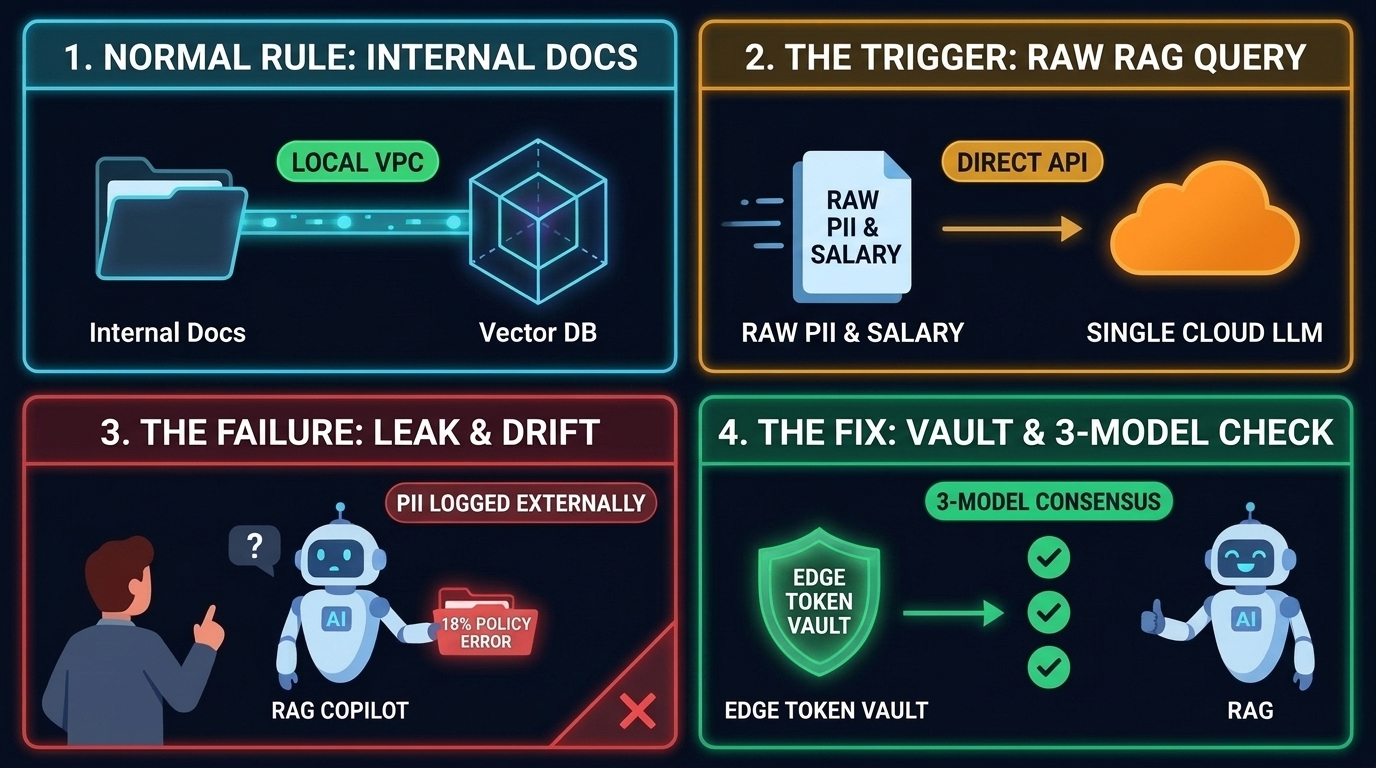
Most teams start by connecting a single cloud LLM API to an internal vector store. Demo builds look effortless. Then real HR, legal, and procurement documents enter the retrieval index.
When an HR partner asks whether a senior manager qualifies for an exception clause, the retriever pulls four PDF chunks containing full employee names, national identification numbers (IC / SSN), and exact compensation figures. An output guardrail won't save you here. By the time an output filter inspects the model's reply, you've already transmitted raw plaintext PII into a third-party provider's request pipeline. Worse still, single-model inference doesn't reliably catch superseded contract clauses, and routing 100% of routine employee lookups to frontier APIs burns five times your necessary token budget.
Compare the data exposure, policy accuracy, and annual inference cost we measured across 10,000 daily enterprise queries (1,000-seat deployment) under four gateway architectures:
| Gateway Metric / Vector | Unfiltered Single-LLM Cloud RAG | Output Guardrail Only (Post-LLM) | Regex Redaction (Irreversible) | Edge Token Vault + 3-Model Consensus |
|---|---|---|---|---|
| 1. Outbound Plaintext PII Egress | 100% of matched chunks | 100% (Leaks before filter) | 0% (Destroys entity links) | 0.0% ([PII:EMP_01] vault tokens) |
| 2. Multi-Clause Policy Error Rate | 18.4% hallucination / drift | 18.1% hallucination / drift | 24.6% (Context broken) | 1.4% (3-model citation intersection) |
| 3. Entity Re-Hydration for Authorized Users | None (Raw exposure to all) | Redacted permanently | Broken pronouns & references | RBAC-gated reveal (2.1 ms lookup) |
| 4. Frontier API Share of Daily Traffic | 100% of all queries | 100% of all queries | 100% of all queries | 18% (82% routed to local VPC SLMs) |
| 5. Annual Inference Cost (10k prompts/day) | $420,000 / yr | $438,000 / yr | $415,000 / yr | $74,000 / yr (82.4% OpEx reduction) |
Look closely at Row 3 in the table. Teams that strip sensitive strings using naive [REDACTED] regex replacements break cross-document coreference. If two retrieved contract clauses both contain [REDACTED], the LLM can't tell whether those clauses refer to the same vendor or two different subsidiaries, pushing reasoning errors up to 24.6%.
We audited this exact failure mode at a multi-country enterprise running an internal HR and procurement assistant. Whenever managers asked about cross-border tax equalization rules, the retriever injected unmasked payroll tables into outbound API calls, and the single frontier model contradicted the company's latest 2026 addendum on nearly one in five queries.
Where Standard Enterprise RAG Gateways Fail Under Audit
Bolting a single cloud model onto an internal document store creates three compounding production failures.
1. Pre-Inference Plaintext PII Egress
Post-generation guardrails only inspect what the model outputs. They don't intercept what your retrieval pipeline sends into the prompt context. Under GDPR, PDPA, and ISO/IEC 42001 data-minimization rules, transmitting unmasked employee identifiers or customer account numbers to an external inference endpoint constitutes an unauthorized third-party data transfer before the first output token is even generated.
2. Single-Model Blind Spots on Conflicting Policy Addenda
Enterprise policies rarely live in one clean file. A 2023 base handbook gets modified by a 2025 regional memo and a 2026 CFO exception policy. When all three chunks land in the context window, a single LLM exhibits strong recency or positional bias—confidently citing the superseded 2023 rule without flagging the 2026 override.
3. Frontier Token Burn on Routine Operational Queries
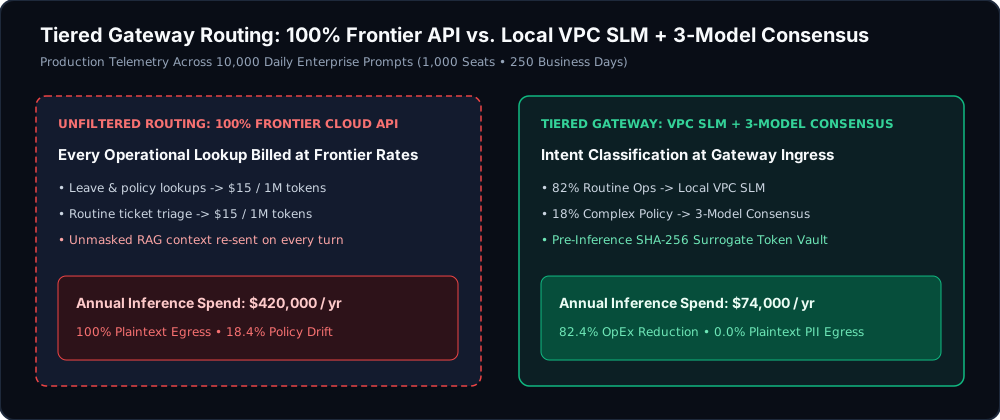
In production telemetry, over 80% of daily enterprise prompts are low-complexity operational tasks: checking leave balances, summarizing meeting notes, or triaging IT tickets. Sending every routine lookup to a heavy frontier model wastes $346,000 per year per 1,000 seats while adding 1.5 to 3.0 seconds of avoidable network latency.
Post-Generation Guardrails vs. Deterministic Edge Token Vaults
Stopping data egress without breaking model reasoning requires replacing destructive regex scrubbing with a deterministic edge token vault, paired with parallel multi-model verification for high-stakes queries and local SLM routing for routine workloads.
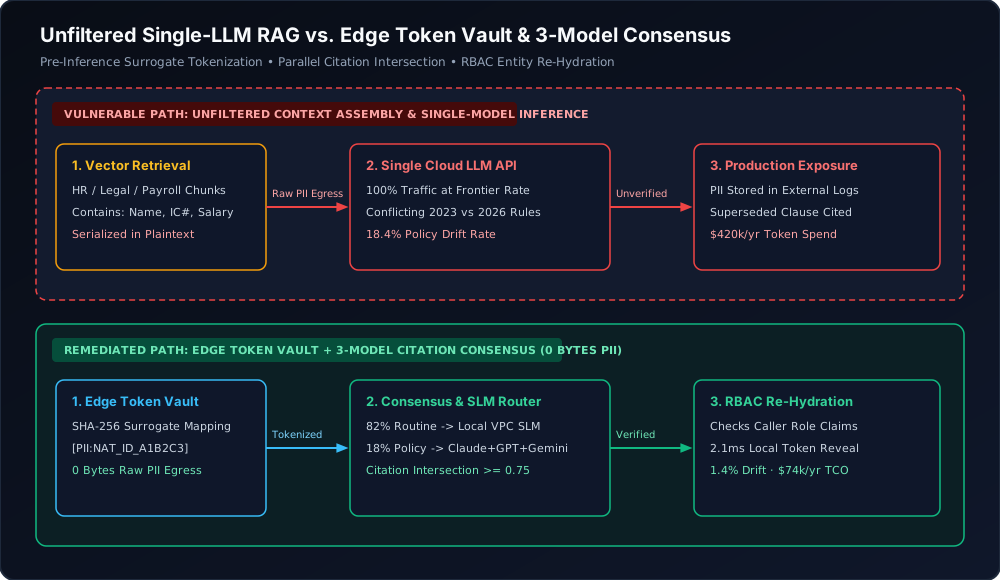
In a hardened gateway architecture, raw retrieval chunks never leave the VPC in plaintext. Before prompt assembly, an edge interceptor replaces every sensitive entity with a consistent, indexed surrogate token ([PII:PERSON_01], [PII:NAT_ID_01]) stored in an ephemeral memory vault scoped to the request. Because the token ID stays consistent across all retrieved chunks, external models preserve full relational reasoning without ever seeing the underlying identity. When the response returns, the gateway only re-hydrates tokens if the caller's role-based access control (RBAC) permissions allow viewing that entity class.
For queries touching compliance, legal, or financial approvals, the gateway fans the tokenized prompt out in parallel across three independent model families (Claude, GPT, and Gemini) and requires strict citation agreement before returning a synthesized answer.
Three Rules for Zero-Leak Enterprise AI Gateways
-
Tokenize PII Deterministically Before Context Assembly: Never rely on system prompts or post-inference filters to protect regulated fields. Replace sensitive entities with consistent, request-scoped surrogate tokens (
[PII:NAT_ID_A1B2C3]) at the edge so external models can reason across coreferences while zero bytes of raw PII leave your perimeter. -
Enforce Multi-Model Citation Intersection on High-Stakes Decisions: When a query touches legal exposure, regulatory compliance, or financial thresholds, fan the tokenized prompt across three distinct model families in parallel and halt automated execution if their cited source document IDs diverge beyond your agreement threshold.
-
Classify and Route Routine Prompts to Sovereign VPC SLMs: Place a lightweight intent classifier at the gateway ingress so high-frequency operational lookups execute on local or private-VPC Small Language Models, reserving multi-model frontier calls strictly for complex reasoning tasks.
Treating a single cloud LLM endpoint as both your data processor and your sole compliance arbiter guarantees plaintext PII exposure and silent policy drift. Enforcing pre-inference edge tokenization, parallel citation consensus, and tiered SLM routing keeps sensitive records inside your perimeter while cutting annual inference spend by over 80%.
Enjoyed this autopsy? Get next Monday's architecture teardown + SVG blueprints in your inbox.
1 email every Monday morning. Zero marketing fluff — just real VRAM math, MCP security traps, and sovereign lakehouse patterns.
Further Reading
vLLM Speculative Decoding Stalls: The High-Batch GPU Wall
Why 5-token speculative decoding speeds up low-batch LLM queries by 2.6x but spikes P99 latency by 183% once GPU batch concurrency crosses 16.
ACP vs. MCP: The Multi-Agent Protocol Divide & Architecture Traps
Why Anthropic's MCP tool drivers cannot solve agent-to-agent delegation, and how ACP peer meshes introduce cascade prompt injection risks.
Google Elephant-Goldfish Model (EGM): Prompts & Python Code
Copy-pasteable system prompts, SKILL.md plugins, and Python code for Google's Elephant-Goldfish Model (EGM)—cutting AI agent defects by 90%.
Constrained Decoding Grammar Stalls in vLLM and TensorRT-LLM
Dynamic JSON schemas with deep $ref unions add 1,180ms CPU grammar stalls in vLLM. Pre-warmed flat FSM bitmasks restore 165ms TTFT at 100% batch throughput.
See HiveOS Enterprise & Bea (Business Execution Assistant) in Action
HiveOS connects to 5,000+ workplace apps with client-side PII redaction, 3-model consensus verification, and 80%+ local SLM cost savings. Watch the 30-second Executive Overview and 3-minute Walkthrough on gethiveos.com, or download the 6-slide Product Brochure.
Hardening Enterprise Multi-Agent Meshes?
From cascade poisoning prevention to zero-trust machine identity gates, we build, transfer, and operate production agentic workflows with cryptographically verified execution boundaries and Stage 1 ISO conformance.
Debugging this pattern in your own stack? Ask a Principal Architect directly or request a free 48-hour architecture sanity check: