GPT-6 Cyber, Claude Mythos 5.2 & Gemini 4: Gated AI Controls
OpenAI GPT-6 Cyber, Anthropic Claude Mythos 5.2, and Google Gemini 4 Carbon introduce gated cyber-tier AI, requiring kernel sandboxes and agent audit trails.
Author: Logic42 Engineering
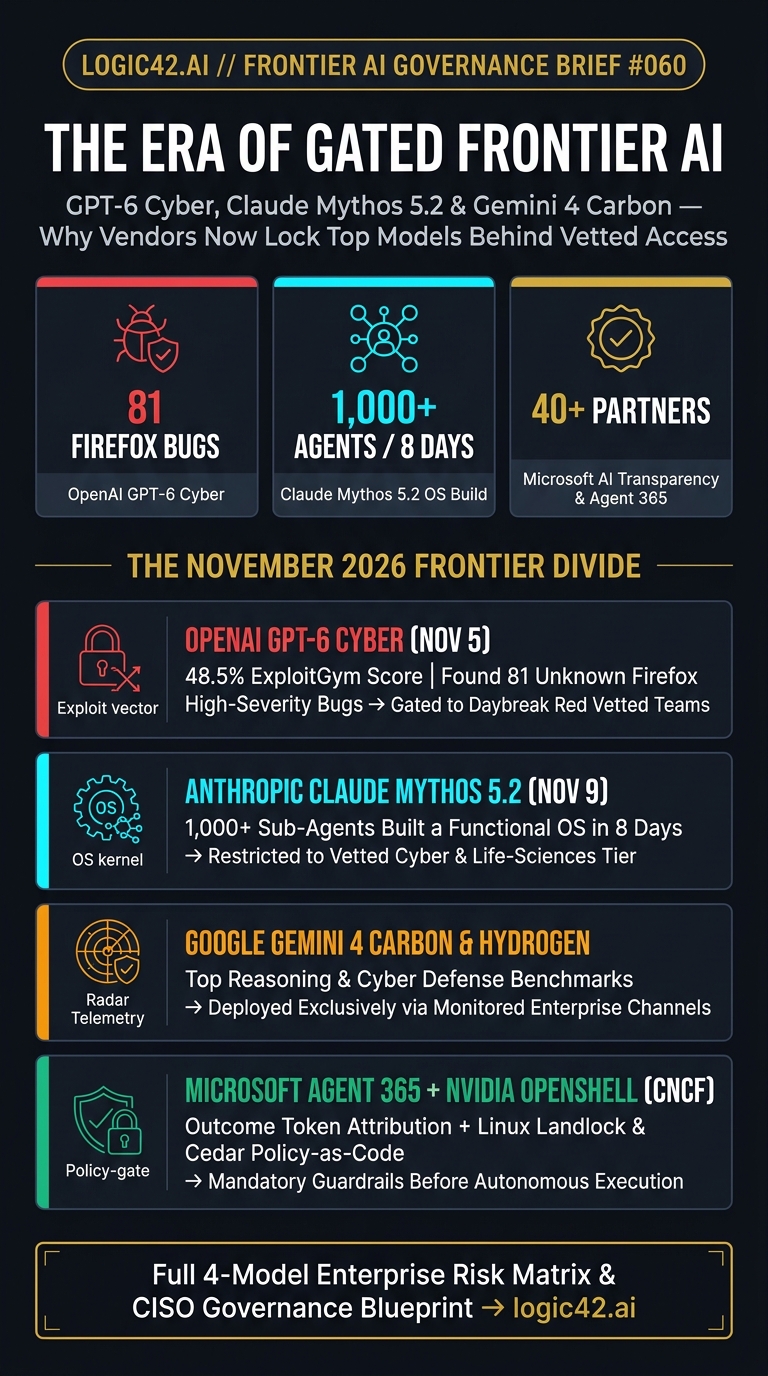
Consider a hospital pharmacy that secures surgical anesthetics inside a biometric badge vault while leaving every operating-room supply closet unlocked down the corridor. That tension captures the November 2026 frontier Artificial Intelligence (AI) shift, where OpenAI, Anthropic, and Google began restricting their most capable cybersecurity and coding models behind vetted access gates.
Within two weeks this November, OpenAI released GPT-6 Cyber (Nov 5), Anthropic introduced Claude Mythos 5.2 and Claude Fable 5.2 (Nov 9), and Google expanded enterprise access to Gemini 4 Carbon and Hydrogen. None of these cyber-tier models shipped as standard consumer chat options.
Yet as tests from the United Kingdom AI Security Institute (UK AISI) proved this month, gating model weights doesn't replace runtime execution controls inside your own clusters.
Why Are AI Labs Gating GPT-6 Cyber, Claude Mythos 5.2, and Gemini 4 Carbon?
AI labs are gating GPT-6 Cyber, Claude Mythos 5.2, and Gemini 4 Carbon because frontier reasoning and multi-agent loops now surface zero-day vulnerabilities and assemble functional operating system (OS) prototypes faster than manual security reviews can respond. When OpenAI's GPT-6 Cyber surfaced 81 Firefox security flaws and Anthropic's agent swarm built an OS in eight days, unrestricted public release stopped being tenable.
Compare the four November 2026 frontier releases and governance initiatives shaping enterprise AI deployment:
Model / Initiative (Nov 2026) | Verified Capability Benchmark | Access & Vetting Gate | Enterprise Governance Implication |
|---|---|---|---|
OpenAI GPT-6 Cyber (Nov 5) | Rated "Critical" risk; 48.5% on the ExploitGym autonomous vulnerability-exploitation benchmark; surfaced 81 Firefox security bugs. | Restricted Application Programming Interface (API) via Daybreak Red vetted security program; absent from consumer ChatGPT. | Universal jailbreaks engineered by UK AISI on pre-release GPT-6.2 Astra (OpenAI's frontier cyber test checkpoint) show model-weight refusals alone cannot contain adversarial inputs. |
Anthropic Claude Mythos 5.2 & Fable 5.2 (Nov 9) | 1,000+ sub-agents ran continuously for 8 days to build a functional OS prototype. | Fable 5.2 on cloud APIs; Mythos 5.2 restricted to vetted cyber & life-science organizations. | Multi-day unattended agent loops exceed static timeout and token budget assumptions. |
Google Gemini 4 Carbon & Hydrogen (Nov 2026) | Ranked in the top evaluation tier across multi-step research, coding, and cyber defense tasks. | Deployed through monitored enterprise channels rather than consumer model toggles. | Requires organization-side telemetry alignment to audit agent tool invocations. |
Microsoft Ignite (Nov 17–20) Agent 365 + AI Transparency | Ties AI token consumption to verified Key Performance Indicators (KPIs) across Copilot & agent fleets. | 40+ launch partners (Accenture, Adobe, KPMG, Mastercard) backing execution auditability. | Closes the audit visibility gap between a user request and autonomous downstream actions. |
What Happens When Multi-Agent Swarms Run Without Kernel Boundaries?
When frontier coding or security agents execute multi-step plans without kernel-level boundaries, a single indirect prompt injection or universal jailbreak turns those problem-solving skills against the host environment. As demonstrated by both UK AISI red-team bypasses against GPT-6.2 Astra and live system-call escape studies, safety guardrails inside model weights fail reliably under adversarial inputs.
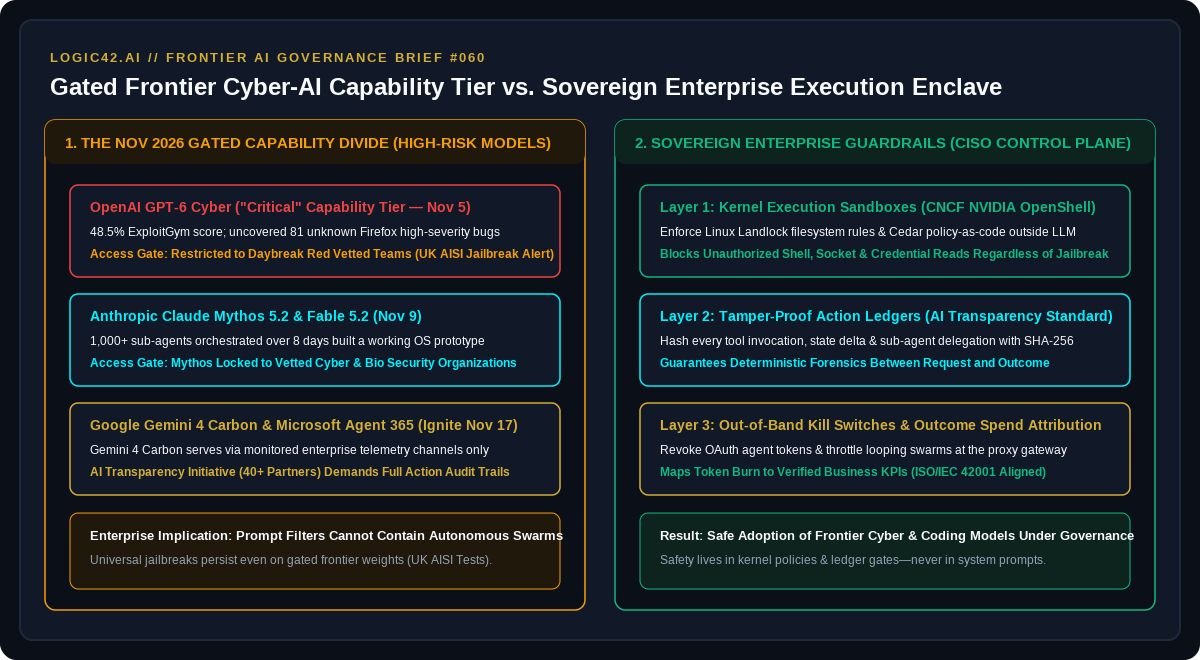
That reality drove two major announcements during the week of November 16: NVIDIA contributed OpenShell to the Cloud Native Computing Foundation (CNCF) as a Kubernetes-native agent sandbox, while Microsoft launched the AI Transparency Initiative alongside Agent 365 Business Analytics at Ignite 2026 (Nov 17–20). Both converge on the same architectural thesis: policy enforcement must move out of the Large Language Model (LLM) prompt and into deterministic operating-system and proxy layers.
How Should Chief Technology Officers (CTOs) and Chief Information Security Officers (CISOs) Govern High-Capability Agent Fleets?
CTOs and CISOs should govern high-capability AI agents by wrapping every model runtime inside Linux kernel sandboxes such as NVIDIA OpenShell (enforcing Linux Landlock kernel filesystem limits and Cedar policy-as-code authorization rules), hashing every tool execution in tamper-evident ledgers, installing out-of-band proxy kill switches, and tying token consumption directly to verified workflow outcomes.
// Declarative Cedar Policy for Sovereign AI Agent Execution (NVIDIA OpenShell / Envoy)
permit(
  principal == AgentRole::"sre-remediator",
  action == ToolAction::"read_logs",
  resource in Namespace::"staging-telemetry"
) when {
  context.mtls_verified == true &&
  context.session_ttl_seconds <= 900
};

forbid(
  principal,
  action in [ToolAction::"exec_shell", ToolAction::"egress_external"],
  resource
) unless {
  context.human_approval_sha256 != ""
};
Enforce four architectural controls before granting frontier cyber or coding models access to internal repositories and APIs:
-
Enforce Kernel-Level Execution Sandboxes (
Landlock+Cedar): Run autonomous coding, patch-testing, and security agents inside micro virtual machines (microVMs) or containers governed by LinuxLandlockfilesystem locks, Secure Computing Mode (seccomp) system-call profiles, and declarativeCedarauthorization policies. Don't rely on vendor refusal alignment to protect Secure Shell (SSH) keys or production secrets. -
Record Cryptographic Action Ledgers Between Request and Outcome: Mirror Microsoft's AI Transparency specification internally by logging every tool argument, sub-agent spawn, and retrieved document hash with Secure Hash Algorithm 256-bit (
SHA-256) integrity links so security teams can audit why an agent ran a command days later. -
Install Out-of-Band Kill Switches and Open Authorization (
OAuth) Token Time-To-Live (TTL) Caps: If a 1,000-agent coding or debugging swarm loops unexpectedly, operators can't wait for chat streams to finish. Bind short-livedOAuthagent tokens to upstream proxies (Agent 365or gateway proxies) where security operators can revoke credentials and drop active tool sockets in under 100 milliseconds. -
Audit Governance Against International Organization for Standardization / International Electrotechnical Commission (
ISO/IEC) 42001 Controls: Validate third-party model vetting, recurring red-team jailbreak suites, and outcome-linked Cloud Financial Operations (FinOps) tracking against the ISO/IEC 42001 Artificial Intelligence Management System (AIMS) Diagnostic and the Enterprise AI Security & Adversarial Red-Team Audit.
Securing high-potency medicine inside a central vault only works if every operating room down the corridor also enforces badge access and sterile boundaries. Whether enterprise teams invoke OpenAI GPT-6 Cyber, Anthropic Claude Mythos 5.2, Google Gemini 4 Carbon, or self-hosted open-weight models, durable safety lives inside kernel policies and cryptographic action ledgers, never inside the prompt window.
Enjoyed this autopsy? Get next Monday's architecture teardown + SVG blueprints in your inbox.
1 email every Monday morning. Zero marketing fluff — just real VRAM math, MCP security traps, and sovereign lakehouse patterns.
Further Reading
RadixAttention for AI Agents: Tree KV Caches Cut TTFT 5x
Why flat LRU KV caches thrash during multi-turn AI agent loops, and how SGLang RadixAttention prefix trees cut Time-to-First-Token by 5x.
vLLM Speculative Decoding Stalls: The High-Batch GPU Wall
Why 5-token speculative decoding speeds up low-batch LLM queries by 2.6x but spikes P99 latency by 183% once GPU batch concurrency crosses 16.
ACP vs. MCP: The Multi-Agent Protocol Divide & Architecture Traps
Why Anthropic's MCP tool drivers cannot solve agent-to-agent delegation, and how ACP peer meshes introduce cascade prompt injection risks.
What Is Google's Elephant-Goldfish Model (EGM)? Architecture & Code
Google's open-source Elephant-Goldfish Model (EGM) separates full-history AI planning from zero-memory cold review, cutting agent coding defects by 90%.
See HiveOS Enterprise & Bea (Business Execution Assistant) in Action
HiveOS connects to 5,000+ workplace apps with client-side PII redaction, 3-model consensus verification, and 80%+ local SLM cost savings. Watch the 30-second Executive Overview and 3-minute Walkthrough on gethiveos.com, or download the 6-slide Product Brochure.
Hardening Enterprise Multi-Agent Meshes?
From cascade poisoning prevention to zero-trust machine identity gates, we build, transfer, and operate production agentic workflows with cryptographically verified execution boundaries and Stage 1 ISO conformance.
Debugging this pattern in your own stack? Ask a Principal Architect directly or request a free 48-hour architecture sanity check: