Malaysia's RM2B Sovereign AI Cloud & Chip Export Guardrails
Malaysia's RM2B Sovereign AI Cloud and US BIS chip export rules reshape ASEAN compute. Architect PDPA-compliant enclaves with HSM custody and access manifests.
Author: Logic42 Sovereign Engineering Practice
Think of a bonded national gold vault where customs officers log every bullion truck crossing the loading dock while also auditing who holds remote vault-access credentials. Under Prime Minister Anwar Ibrahim's RM2 billion (Malaysian Ringgit, roughly US$486–500 million) national budget mandate for a Sovereign Artificial Intelligence (AI) Cloud managed via the Malaysian Communications and Multimedia Commission (MCMC), infrastructure architects face that exact dual boundary across physical silicon transfers and remote compute networks.
Why Data Residency Alone Doesn't Guarantee Compute Sovereignty
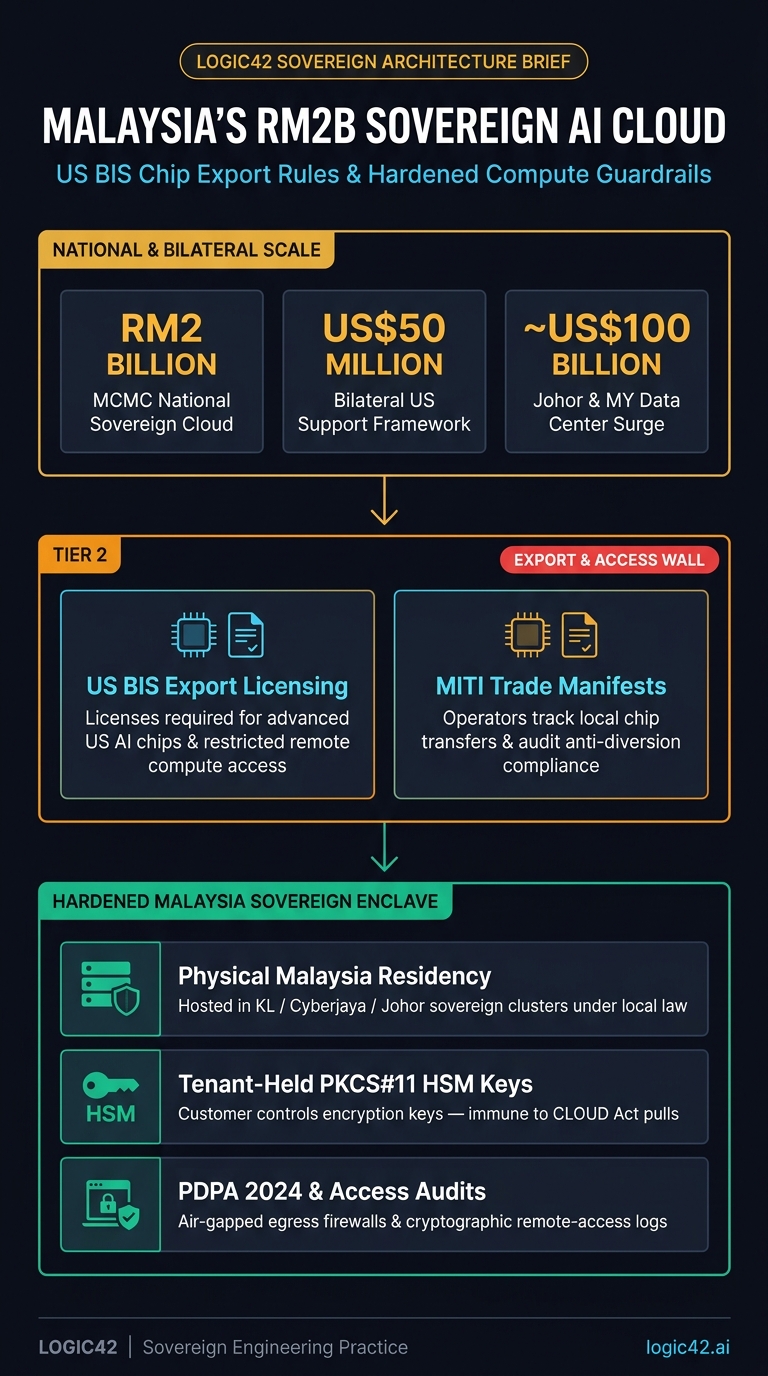
Nearly US$100 billion in announced multi-year data-center investments targets Malaysia across Johor, Cyberjaya, and Kuala Lumpur. That planned physical buildout sits directly at the intersection of domestic residency mandates and international silicon controls. Location alone solves nothing.
On the domestic side, the RM2 billion sovereign infrastructure budget prioritizes classified public-sector workloads, citizen data privacy, Malaysian procurement standards, and local legal governance. Malaysia retains direct control over data stored inside that enclave, complemented by bilateral talks on a proposed US$50 million US technical-assistance and workforce-training package.
On the trade-control side, the US Department of Commerce Bureau of Industry and Security (BIS) imposed tighter export rules on advanced US-origin AI chips and high-density clusters. Outside exempt US-parented hyperscalers such as Amazon Web Services, Microsoft, and Google, transferring advanced US accelerators within Malaysia requires federal licensing, while remote compute access by restricted-jurisdiction tenants also falls under export clearance.
Dual Sovereignty Forces and Architectural Risks
Malaysia's Ministry of Investment, Trade and Industry (MITI) has directed local data-center operators to maintain strategic trade compliance manifests and cooperate with anti-diversion inquiries. Yet even before considering BIS restrictions, hosting workloads inside a US-parented hyperscaler's local facility introduces exposure under the US Clarifying Lawful Overseas Use of Data (CLOUD) Act whenever the provider controls root Key Management Service (KMS) keys.
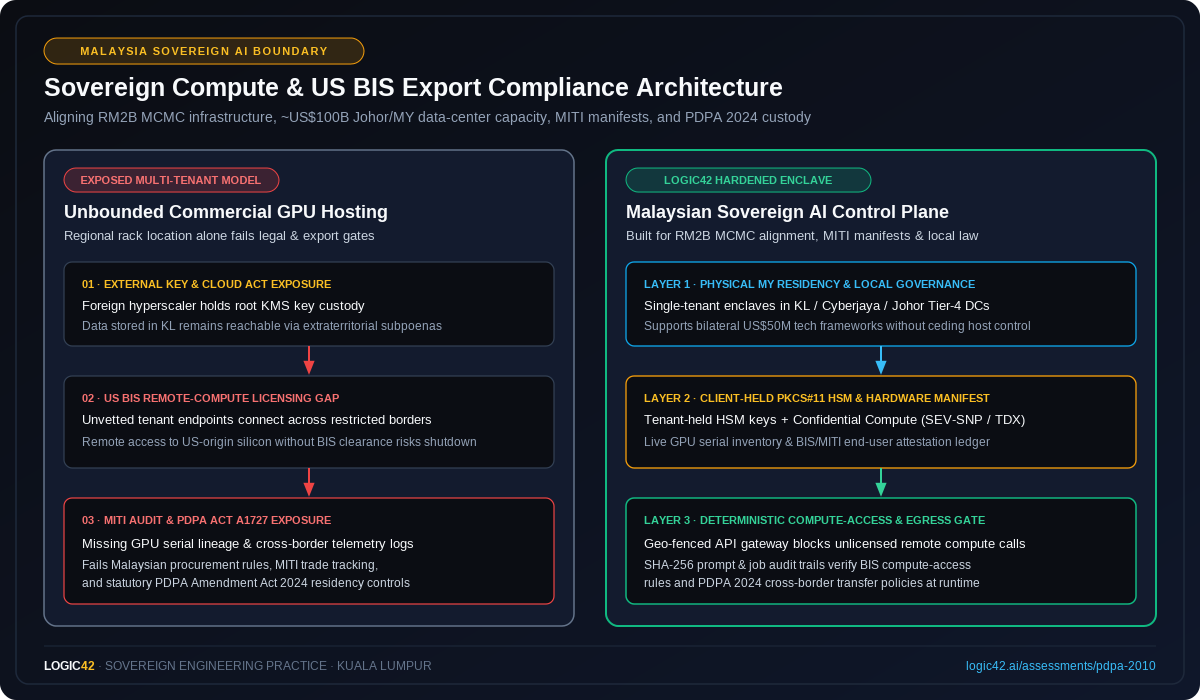
Four concrete exposure gaps appear when teams confuse commercial colocation with full operational sovereignty:
| Boundary Dimension | Standard Commercial Cloud / Colocation | Malaysia Sovereign Enclave Architecture |
|---|---|---|
| 1. Hardware Lineage & BIS Licensing | Shared GPU pools with opaque tenant boundaries and unverified remote logins | Verified GPU serial manifest aligned with MITI strategic-trade reporting requirements |
| 2. Encryption Key & CLOUD Act Custody | Foreign provider manages KMS root keys inside a global control plane | Tenant holds Hardware Security Module (HSM) PKCS#11 (Public-Key Cryptography Standards #11) keys |
| 3. Remote Compute Access Controls | Permissive API tokens allow cross-border prompts and fine-tuning from any IP block | Identity-bound geo-fenced gateways verify tenant jurisdiction before scheduling GPU jobs |
| 4. Statutory Privacy & Audit Logging | Generic billing metrics with fragmented retention across regional caches | Immutable SHA-256 prompt logs aligned with the Personal Data Protection Act (PDPA) Amendment Act 2024 |
Look closely at the trade-control paradox documented in our US CLOUD Act Sovereign Data Blueprint. Keys decide legal custody. A US-parented hyperscaler exempt from local Malaysian chip-transfer licensing under BIS rules can still be legally compelled to surrender keys or memory snapshots under foreign court orders if it holds your root cryptographic secrets.
Declarative Policy for Remote Compute and Hardware Manifests
You don't need brittle custom middleware to enforce export-boundary and residency gates across private clusters. Before scheduling a GPU job, an enclave gateway verifies three primitives: AMD SEV-SNP (Secure Encrypted Virtualization–Secure Nested Paging) or Intel TDX (Trust Domain Extensions) CPU memory encryption, mTLS (mutual Transport Layer Security) device attestation, and WORM (Write-Once-Read-Many) audit storage:
# Sovereign Enclave Admission Policy (Gateway Edge Enforcement)
enclave_profile: my-sovereign-tier4-kl
regulatory_scope:
  residency: MY_PHYSICAL_ONLY        # Malaysia PDPA 2010 / Act A1727:2024
  trade_manifest: MITI_SERIAL_ATTESTED
  export_license_tier: BIS_VERIFIED_TENANT
key_custody:
  mode: CLIENT_HELD_PKCS11_HSM
  cloud_provider_kms_wrap: DENY
  confidential_compute: [AMD_SEV_SNP, INTEL_TDX]
remote_compute_gate:
  require_mtls_device_attestation: true
  deny_unverified_cross_border_egress: true
  audit_ledger: SHA256_IMMUTABLE_WORM
If an inbound API call lacks verified tenant identity, the gateway drops it before prompt tokens ever reach GPU VRAM. Simultaneously, outbound payload filters halt any unredacted data or text payload attempting to leave national borders. It's an executable runtime boundary rather than a static compliance binder.
Five Engineering Controls for Malaysian Sovereign AI Builds
Manifests stop supply-chain freezes. Whether you're building regulated banking clusters in Kuala Lumpur or multi-tenant capacity in Johor, apply five concrete controls across your cluster and air-gapped GPU environments:
-
Bind Decryption to Tenant-Held HSM Keys: Store root encryption keys inside on-premises or Malaysian Tier-4
PKCS#11HSM appliances under strict customer custody so third-party operators can't decrypt model weights or proprietary datasets. -
Enforce Hardware Serial Attestation on Nodes: Automate daily telemetry capturing GPU chassis UUIDs, InfiniBand switch port maps, and physical rack locations into tamper-evident hardware manifests aligned with MITI strategic-trade audits.
-
Terminate Cross-Border Vector Replication by Default: Block unvetted replication of source documents, vector metadata, and evaluation logs outside Malaysia unless source text and metadata fields pass client-side PDPA (Act A1727:2024) Personally Identifiable Information (PII) redaction prior to embedding and replication, closing the leak analyzed in our brief on Cross-Border Vector Residency Traps.
-
Authenticate Remote Compute Sessions via End-User KYB: Because US BIS rules scrutinize remote access as strictly as physical chip transfers, enforce cryptographic workload identity via Secure Production Identity Framework for Everyone / SPIFFE Runtime Environment (
SPIFFE/SPIRE) attestation paired with verified corporate Know-Your-Business (KYB) claims at your ingress API proxy. -
Run Pre-Procurement PDPA and Sovereign Readiness Checks: Before committing long-term cluster capacity or signing bilateral compute leases, benchmark your data residency and governance gaps using the interactive Malaysia PDPA 2010 & Amendment Act 2024 Compliance Audit.
What Does Malaysia's RM2 Billion Sovereign AI Cloud Mandate Cover?
National budget plans allocate RM2 billion (roughly US$486–500 million) for a government-led Sovereign AI Cloud administered via MCMC. Its mandate keeps sensitive public-sector records, citizen privacy protections, and strategic AI hosting physically inside Malaysia under national legal jurisdiction while exploring potential US$50 million bilateral US technical support.
How Do US BIS Export Rules Affect Local Data Center Compute Access?
US Department of Commerce BIS rules restrict both the local transfer of advanced US-origin AI chips inside Malaysia outside exempt US hyperscalers and unlicensed remote access to high-density compute clusters by restricted foreign entities. Local operators must pair physical datacenter security with rigorous customer vetting and MITI hardware manifests.
Why Isn't Regional Cloud Hosting Alone Compliant with Sovereign Data Laws?
Physical hosting in Kuala Lumpur or Johor doesn't establish sovereignty if an overseas parent company holds administrative hypervisor keys, manages KMS secrets, or permits unlogged cross-border remote execution. Combining local residency with confidential-compute hardware enclaves, tenant-held HSM keys, and enforced gateway egress rules provides auditable technical enforcement in support of Malaysian sovereign-compliance requirements.
Enjoyed this autopsy? Get next Monday's architecture teardown + SVG blueprints in your inbox.
1 email every Monday morning. Zero marketing fluff — just real VRAM math, MCP security traps, and sovereign lakehouse patterns.
Further Reading
The Postgres Agent Checkpoint Cliff: Fixing MVCC Bloat
Why writing autonomous AI agent checkpoints and traces into a single PostgreSQL database triggers MVCC dead-tuple stalls, and how to split OLTP from ClickHouse.
pgvector HNSW Memory Cliffs: WAL Bloat & Iterative Scans
Fix PostgreSQL pgvector 0.8+ HNSW maintenance_work_mem disk spills, 4.2x WAL bloat, and empty multi-tenant filtered queries via halfvec and iterative scans.
Multi-Head Latent Attention (MLA): 93% KV Cache Compression
Multi-Head Latent Attention (MLA) compresses Transformer KV caches by 93.3% via low-rank joint projection and decoupled RoPE, multiplying GPU batch sizes by 5.6x.
Parquet Row-Group Bloat: Why AI Agents Pull 500MB for a 4KB Lookup
Unsorted 512MB Parquet row groups force 492MB S3 downloads for 4KB lookups. Clustering 64MB row groups with PageIndex and Bloom filters cuts transfers by 99.96%.
See HiveOS Enterprise & Bea (Business Execution Assistant) in Action
HiveOS connects to 5,000+ workplace apps with client-side PII redaction, 3-model consensus verification, and 80%+ local SLM cost savings. Watch the 30-second Executive Overview and 3-minute Walkthrough on gethiveos.com, or download the 6-slide Product Brochure.
Engineering Sovereign Data Boundaries?
Whether you are navigating cross-border CLOUD Act liability, implementing confidential compute enclaves, or eliminating vector decay, our data practice designs hardened substrates with client-held cryptographic custody.
Debugging this pattern in your own stack? Ask a Principal Architect directly or request a free 48-hour architecture sanity check: