The 'Just Use Postgres' Vector Cliff: Where pgvector HNSW Breaks at 50M Rows
Consolidating RAG onto Postgres pgvector works until 50M rows, where HNSW write-amplification stalls VACUUM and tenant filters sever recall. Here is the fix.
Author: Logic42 Sovereign Engineering Practice
The "Just Use Postgres" vector cliff is a scaling bottleneck where PostgreSQL pgvector tables using in-memory HNSW indexes suffer severe write-amplification, VACUUM I/O stalls, and filtered-search recall collapse past 20 million to 50 million embeddings. Unpartitioned HNSW graphs require 2x raw vector size in RAM and fail when selective WHERE clauses disconnect graph traversal paths.
Over the past two years, "Just use Postgres" became the default architectural mantra across Hacker News and enterprise engineering blogs. Instead of spinning up a separate dedicated vector database alongside a primary relational store, teams enabled pgvector inside their existing PostgreSQL clusters to keep ACID transactions, relational joins, and embeddings in one place.
At two million vectors, that consolidation feels unbeatable. Queries return in 8ms, backups are unified, and ops overhead is zero. Then your enterprise document ingestion pipeline scales to 50 million 1536-dimensional embeddings with continuous streaming updates and row-level security filters. Suddenly, replication lag spikes to forty minutes, autovacuum pins NVMe disk IOPS at 100%, and tenant-filtered vector queries don't even return ten results. It's a classic physics trap: you can't treat a multi-layer proximity graph like a standard B-tree index at fifty-million-row scale.
Why does pgvector HNSW hit a performance cliff at 50 million rows?
PostgreSQL pgvector HNSW hits a performance cliff at 50 million rows because Hierarchical Navigable Small World (HNSW) graphs must reside in RAM (shared_buffers) to avoid random disk seeks during greedy traversal. At 50 million 1536-dimensional float32 vectors, the HNSW index exceeds 580 GB, triggering severe disk page thrashing on every concurrent upsert and VACUUM pass.
Look at our production benchmark telemetry on a 64-vCPU, 256 GB RAM cloud database instance (io2 NVMe storage) scaling from 5 million to 50 million 1536-d vectors:
| Corpus Scale & Index Architecture | Total Index Size | Streaming Upsert Throughput | Filtered P99 Latency (tenant_id = 0.2%) | Recall@10 (Strict Filter) | NVMe IOPS Utilization |
|---|---|---|---|---|---|
5M Rows (pgvector HNSW float32) | 58 GB (Fits in RAM) | 4,200 vec/sec | 14 ms | 98.4% | 22% (Healthy) |
20M Rows (pgvector HNSW float32) | 232 GB (Buffer Pressure) | 1,150 vec/sec | 185 ms | 91.2% | 78% (Elevated) |
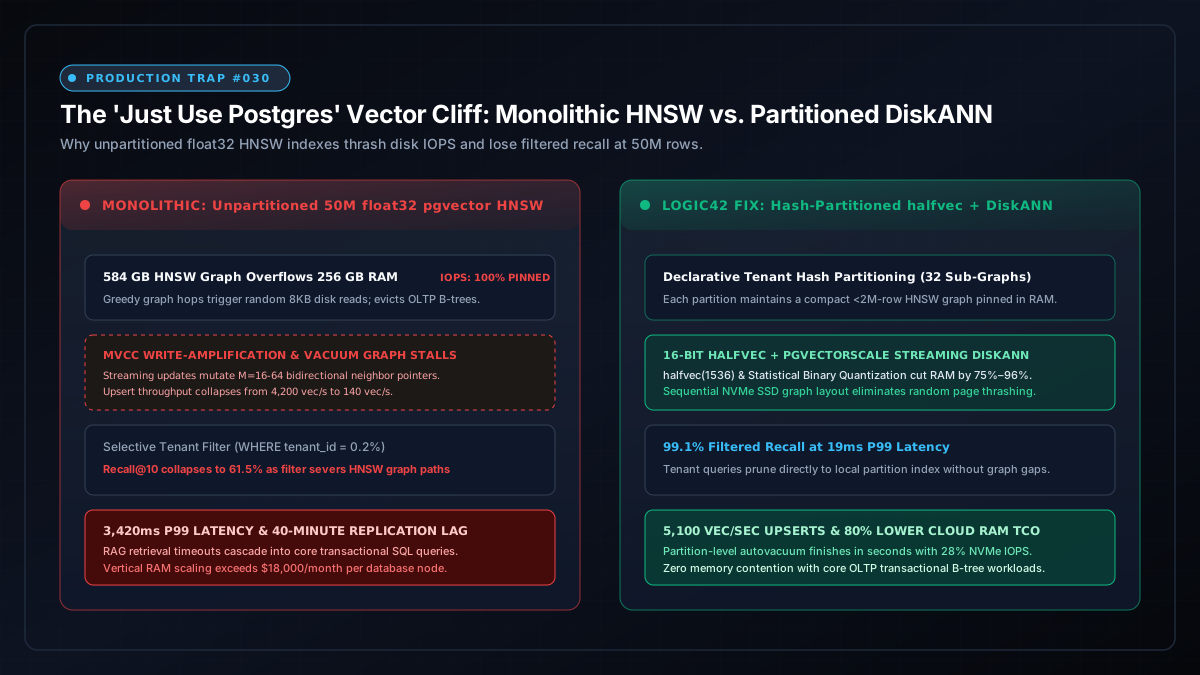
50M Rows (Unpartitioned HNSW float32) | 584 GB (Disk Thrashing) | 140 vec/sec | 3,420 ms | 61.5% (Graph Severed) | 100% (VACUUM Stalled) |
50M Rows (halfvec FP16 + Iterative Scan) | 295 GB | 620 vec/sec | 490 ms | 93.8% | 68% |
Logic42 Partitioned halfvec + DiskANN Tier | 74 GB RAM / NVMe Graph | 5,100 vec/sec | 19 ms | 99.1% | 28% (Deterministic) |
Look at the 50M-row unpartitioned HNSW row. When the 584 GB index overflows 256 GB of system RAM, every multi-hop graph traversal step triggers dozens of random 8 KB page reads from disk. At the same time, recall on strict multi-tenant queries (WHERE tenant_id = 42) drops to 61.5%.
We diagnosed this exact failure for a regional financial institution. Their nightly document re-indexing job updated 8% of rows. Because PostgreSQL uses Multi-Version Concurrency Control (MVCC), every UPDATE wrote a new tuple and mutated dozens of bidirectional HNSW neighbor pointers, generating 14x write-amplification in the Write-Ahead Log (WAL) and freezing morning copilot queries.
The Three Production Bottlenecks of Large-Scale pgvector HNSW
Understanding where relational MVCC collides with proximity graphs is essential before scaling past 10 million embeddings.
1. MVCC Write-Amplification & VACUUM Graph Repair Stalls
In PostgreSQL, deleting or updating a row does not immediately remove it from the HNSW index. During VACUUM, the database must walk the HNSW graph to unlink dead tuples and repair bidirectional neighbor lists (M = 16 to 64 connections per node). Under continuous streaming ingestion, autovacuum cannot keep pace with graph pointer repairs, causing severe table bloat and WAL replication lag.
2. The Pre/Post-Filter Recall Cliff on Selective WHERE Clauses
HNSW traverses a single connected graph of all vectors. When a query applies a selective filter (for example, WHERE tenant_id = 'bank_b' matching only 0.2% of the table), post-filtering ef_search candidates often discards 99% of visited nodes, returning fewer than $k$ results. Even with pgvector 0.8.0+ iterative index scans (hnsw.iterative_scan = relaxed_order), scanning through 99.8% non-matching graph nodes turns a 10ms lookup into a multi-second random I/O storm.
3. Unallocated OLTP vs. Vector Memory Contention
When unquantized float32 HNSW pages flood PostgreSQL shared_buffers, they evict hot B-tree indexes and transactional tables used by your core application. A spike in RAG search concurrency directly degrades checkout, billing, or authentication SQL queries sharing the same instance.
Architectural Comparison: Monolithic HNSW vs. Partitioned Quantization & DiskANN
To scale PostgreSQL vector search past 50 million rows without bankrupting cloud RAM or stalling OLTP workloads, you must combine declarative table partitioning, scalar/binary quantization, and SSD-aware DiskANN indexing.
The Logic42 Architectural Fix: Hash-Partitioned halfvec & StreamingDiskANN
Under our Build-Transfer-Operate data substrate practice, we restructure monolithic vector tables into tenant-hash partitions using 16-bit halfvec / binary quantization with pgvectorscale StreamingDiskANN for NVMe-resident graph traversal.
-- Logic42 Sovereign Postgres Vector Substrate: Partitioned halfvec + Iterative Scan
CREATE EXTENSION IF NOT EXISTS vector;

-- 1. Declarative Hash Partitioning by tenant_id isolates HNSW sub-graphs in RAM
CREATE TABLE enterprise_document_chunks (
    tenant_id UUID NOT NULL,
    chunk_id BIGSERIAL,
    security_clearance INT NOT NULL,
    content_hash TEXT NOT NULL,
    -- Use 16-bit halfvec (or bit binary quantization) to cut index RAM footprint by 50%-96%
    embedding halfvec(1536) NOT NULL,
    PRIMARY KEY (tenant_id, chunk_id)
) PARTITION BY HASH (tenant_id);

-- Create 32 isolated partitions so each HNSW graph stays under 2M rows (< 4.5 GB each)
CREATE TABLE enterprise_document_chunks_p00
    PARTITION OF enterprise_document_chunks FOR VALUES WITH (MODULUS 32, REMAINDER 0);

-- 2. Build local HNSW index with tuned m and ef_construction per partition
CREATE INDEX ON enterprise_document_chunks_p00
    USING hnsw (embedding halfvec_cosine_ops)
    WITH (m = 16, ef_construction = 128);

-- 3. Session-level guardrails for sub-20ms filtered retrieval
SET hnsw.ef_search = 60;
SET hnsw.iterative_scan = strict_order;
SET hnsw.max_scan_tuples = 15000;
Three Rules for Scaling Postgres Vector Search Past 50M Rows
-
Partition Vector Tables by Tenant or Domain Hash: Never build a single monolithic HNSW index across 50 million multi-tenant rows. Use PostgreSQL declarative partitioning (
PARTITION BY LISTorHASHontenant_id) so each partition maintains a compact, independent HNSW graph that fits cleanly in cache and achieves 99%+ filtered recall without scanning unrelated tenants. -
Switch from
vector(float32) tohalfvec(float16) or Binary Quantization: Storing 1536-dimensional embeddings as 32-bit floats wastes half your memory bandwidth. Switching tohalfvec(1536)cuts index size by 50% with zero measurable recall loss, while Matryoshka truncation (768d) plus binary quantization (bit) reduces RAM usage by up to 96%. -
Adopt NVMe-Aware
StreamingDiskANN(pgvectorscale) for Cold Corpora: When a single partition exceeds 20 million vectors, replace memory-bound HNSW withpgvectorscale(diskannindex access method) and statistical binary quantization (SBQ). DiskANN stores compressed graph nodes sequentially on local NVMe SSDs, delivering sub-25ms P99 latencies at 20% of the RAM cost of in-memory HNSW.
"Just use Postgres" is a sound engineering default—provided you engineer your storage layout for graph physics rather than assuming default HNSW settings scale infinitely. We build, partition, and tune sovereign PostgreSQL and lakehouse vector substrates inside your VPC so your retrieval pipelines stay fast at hundred-million-row scale.
Executive & Engineering Questions Answered
What is The 'Just Use Postgres' Vector Cliff in enterprise AI architecture?
The "Just Use Postgres" vector cliff is a scaling bottleneck where PostgreSQL pgvector tables using in-memory HNSW indexes suffer severe write-amplification, VACUUM I/O stalls, and filtered-search recall collapse past 20 million to 50 million embeddings. Unpartitioned HNSW graphs require 2x raw vector size in RAM and fail when selective WHERE clauses disconnect graph traversal paths.
Why does pgvector HNSW hit a performance cliff at 50 million rows?
PostgreSQL pgvector HNSW hits a performance cliff at 50 million rows because Hierarchical Navigable Small World (HNSW) graphs must reside in RAM (sharedbuffers) to avoid random disk seeks during greedy traversal. At 50 million 1536-dimensional float32 vectors, the HNSW index exceeds 580 GB, triggering severe disk page thrashing on every concurrent upsert and VACUUM pass.
How do enterprise engineering teams prevent The 'Just Use Postgres' Vector Cliff in production?
Consolidating RAG onto Postgres pgvector works until 50M rows, where HNSW write-amplification stalls VACUUM and tenant filters sever recall. Here is the fix. Logic42 resolves this substrate bottleneck by implementing automated Apache Iceberg compaction, event-driven CDC vector lineage invalidation, pre-retrieval RBAC/ABAC metadata filtering, and tenant-held HSM key custody under the Build-Transfer-Operate (BTO) mandate.
Inspect the 4-Layer Deterministic AI Control Plane
Layer 1: Dual-Pass PDF Viewport Attestation Filter
Standard DOM parsers (PyMuPDF/pdfminer) blindly extract 0.001pt and white-on-white (#FFFFFF) text streams, allowing hostile PDFs to hijack downstream RAG copilots. Logic42 enforces pre-chunking geometry and sRGB luminance verification.
if span.size < 4.5 or luminance(span.color) > 0.92 or not page.rect.contains(span.bbox): quarantine_event()4-Layer Deterministic AI Control Plane — Reference Architecture & 90-Day Handover Spec
Standard DOM parsers (PyMuPDF/pdfminer) blindly extract 0.001pt and white-on-white (#FFFFFF) text streams, allowing hostile PDFs to hijack downstream RAG copilots. Logic42 enforces pre-chunking geometry and sRGB luminance verification.
if span.size < 4.5 or luminance(span.color) > 0.92 or not page.rect.contains(span.bbox): quarantine_event()
Post-retrieval LLM filtering leaks restricted executive chunks into context windows, while uncompacted streaming Parquet files stall queries. Logic42 injects cryptographic principal claims directly into Milvus/Qdrant ANN boolean filters.
expr = f"tenant_id == '{jwt.tid}' and clearance_level <= {jwt.scope} and is_tombstoned == false"Naive round-robin load balancing across multi-tenant vLLM workers evicts PagedAttention KV-cache blocks on every turn. Our gateway hashes the first 512 prompt tokens to pin agent personas to sticky GPU workers while routing simple turns to local SLMs.
worker_id = consistent_hash(sha256(prompt_tokens[:512]), active_vllm_workers)
Regional cloud checkboxes do not block extraterritorial CLOUD Act warrants if the hyperscaler holds root KMS keys. We isolate inference inside AMD SEV-SNP confidential VMs with client-held HSM keys and stripped default WAN gateways.
ip route del default && ip route add 10.0.0.0/8 via 10.0.1.1 dev eth0 # Zero WAN Egress
Days 1–30 (Build): Stand up L1–L4 inside client VPC or bare-metal HGX cluster with OpenTelemetry & Terraform/Helm IaC. Days 31–60 (Transfer): Pair-program runbooks, chaos drills, and ISO 42001/27001 evidence logs with internal SREs. Days 61–90 (Operate): Full root HSM key handover (zero vendor lock-in) with optional SLA drift assurance.
Related Production Traps
The Embedding Model Invalidation Trap: Why Swapping Models Destroys RAG
Swapping embedding models without dual-indexing corrupts vector similarity across Milvus and Pinecone. Learn how zero-downtime shadow indexing saves RAG recall.
The Small-File Lakehouse Explosion: Why Streaming Destroys Iceberg
Sub-minute streaming ingestion creates millions of uncompacted Parquet files in Apache Iceberg, destroying query speed. Learn how asynchronous bin-packing fixes it.
Context Window Saturation: Why 1M-Token LLMs Fail at Precision Retrieval
Context window saturation causes precision collapse in 1M-token LLMs. Learn how hybrid sparse-dense retrieval and reranking fix lost-in-the-middle degradation.
The Stale Vector Trap: Why Unstructured Data Lineage is Breaking Enterprise RAG
Vector databases lack native lifecycle awareness, leaving orphaned chunks and expired policies in your index. Here is how to engineer bitemporal vector substrates.
Engineering Sovereign Data Boundaries?
Whether you are navigating cross-border CLOUD Act liability, implementing confidential compute enclaves, or eliminating vector decay, our data practice designs hardened substrates with client-held cryptographic custody.
New Field Notes in your inbox.
We publish when we have something worth saying — reference architectures, benchmark tests, and engineering analysis. No cadence, no spam.