The Cross-AZ & NAT Gateway AI Tax: Plugging the 30% Leak
How multi-AZ Kubernetes routing and Managed NAT Gateways silently add 30% to cloud GPU inference bills, and how zonal pinning eliminates it.
Author: Logic42 Engineering
Consider a restaurant kitchen that hires a commercial toll-bridge courier every time a chef passes a plate six feet from the stove to the expediter counter, and pays a second customs broker whenever a line cook grabs flour from the pantry. That is what default multi-zone Kubernetes networking does to enterprise AI inference bills.
Engineering leaders obsess over Graphics Processing Unit (GPU) hourly spot rates and per-million-token API pricing, yet routinely ignore the cloud networking layer underneath their clusters. When you deploy self-hosted Large Language Model (LLM) inference engines (such as vLLM or Structured Generation Language, SGLang) and Retrieval-Augmented Generation (RAG) pipelines inside standard high-availability Virtual Private Cloud (VPC) blueprints, two invisible infrastructure meters start spinning: Inter-Availability-Zone (Cross-AZ) data transfer tolls and Managed Network Address Translation (NAT) Gateway processing fees.
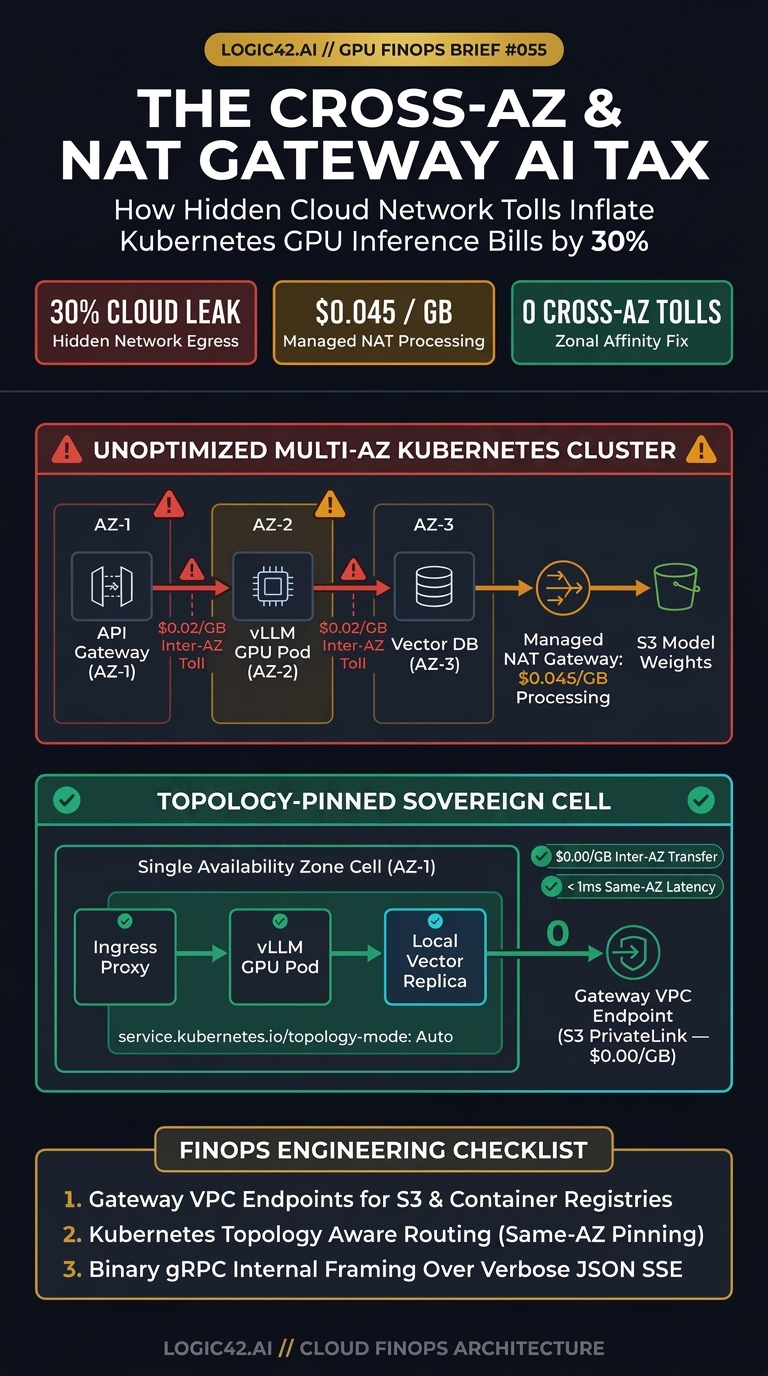
Across production Kubernetes GPU deployments audited in 2026, these two networking defaults quietly consume 22% to 31% of the total monthly AI infrastructure invoice, while remaining completely invisible to token-level observability tools.
Why Do Kubernetes AI Clusters Bleed 30% on Cross-AZ and NAT Fees?
Kubernetes AI clusters bleed up to 30% of their budget on network fees because default kube-proxy round-robin routing distributes multi-megabyte prompt contexts, vector embeddings, and streaming Server-Sent Events (SSE) randomly across three Availability Zones (AZs) at $0.02/GB per hop. Simultaneously, private GPU nodes pulling multi-gigabyte model weights or object-storage chunks through a Managed NAT Gateway incur an additional $0.045/GB data processing surcharge.
Traditional microservices pass compact 2KB JSON payloads where cross-zone transfer fees aren't noticeable. Production AI inference pipelines move orders of magnitude more data per request:
-
The Multi-Hop Cross-AZ Amplifier: In a standard 3-AZ Kubernetes cluster (
us-east-1a,1b,1c), an Application Load Balancer (ALB) inAZ-1forwards an incoming 64KB multimodal or long-context request to an orchestrator pod inAZ-2. That pod queries a vector database inAZ-3(pulling back 400KB of dense float32 embeddings and document chunks), sends the assembled prompt to avLLMGPU pod back inAZ-1, and streams 1,500 Server-Sent Event (SSE) chunks back across zones. Every cross-zone boundary charges$0.01/GBegress plus$0.01/GBingress ($0.02/GBeffective bidirectional toll). -
The 1.8x SSE JSON Framing Multiplier: Streaming an LLM response token-by-token over HTTP
SSEwraps each 4-byte token in repetitive JSON envelopes (data: {"id":"chatcmpl-...","choices":[{"delta":{"content":"..."}}]}) and TCP/IP packet headers, inflating raw wire bytes by1.6xto2.1x. -
The Managed NAT Gateway Surcharge (
$0.045/GB): Because GPU worker nodes run in private subnets for security, any pull of 140GB 8-bit floating-point (FP8) model weights from Hugging Face or Amazon Simple Storage Service (S3, when misconfigured without a direct VPC endpoint) routes through a Managed NAT Gateway at$0.045/GBon top of standard bandwidth rates. As we showed in our analysis of AI cloud storage egress fees on GPU data lakes, unmonitored storage-to-compute plumbing rapidly eclipses silicon rent.
Unoptimized Multi-AZ Kubernetes vs Topology-Pinned Sovereign GPU Cells
Eliminating this network bleed doesn't require sacrificing multi-zone high availability. Instead of scattering every single request across three zones, cellular architectures pin the entire request lifecycle inside a single Availability Zone cell and fail over across zones only when a local capacity or health circuit breaker trips.
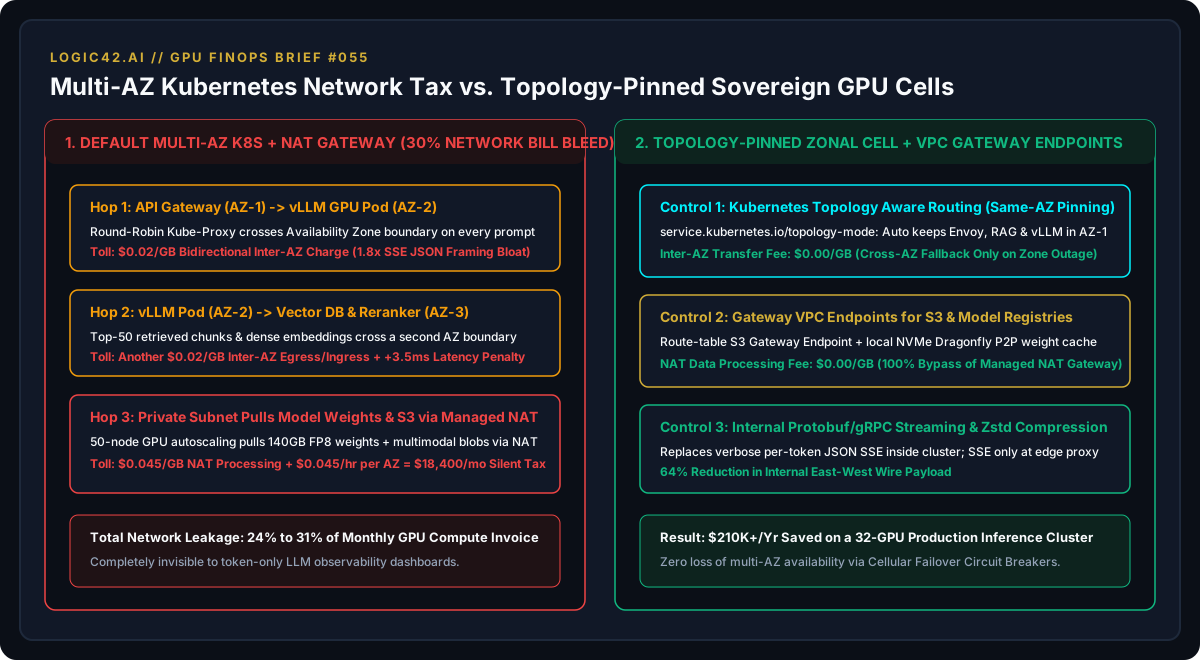
| Cost & Latency Vector | Default Multi-AZ Kubernetes + Managed NAT | Topology-Pinned Sovereign Cell + VPC Endpoints |
|---|---|---|
| Ingress-to-GPU Routing | Random kube-proxy iptables distribution; 66% of requests cross an AZ boundary ($0.02/GB). | Topology Aware Routing (topology-mode: Auto) keeps Ingress, RAG orchestrator, and GPU pod in the same AZ ($0.00/GB). |
| Vector DB & Reranker Reads | Primary/replica queries cross zones blindly, adding $0.02/GB and +2.5ms–4.0ms network Round-Trip Time (RTT). | Local read-only vector replica in each AZ serves top-K retrieval with < 0.4ms intra-zone latency. |
| Model Weights & S3 Fetches | Private subnet traffic hairpins through Managed NAT Gateway at $0.045/GB processing fee. | Gateway VPC Endpoint (PrivateLink) + peer-to-peer Non-Volatile Memory Express (NVMe) image cache (Dragonfly) drops NAT fee to $0.00/GB. |
| Internal Streaming Protocol | Verbose JSON-wrapped HTTP SSE across every internal microservice hop (1.8x byte inflation). | Binary gRPC / Protobuf with zstd compression internally; converts to SSE only at the edge gateway. |
| Annual Network Spend (32x H100 Cluster) | $228,000 / year in pure Cross-AZ + NAT Gateway surcharges. | $14,200 / year (93.8% reduction in cloud network tolls). |
You can model how these hidden cloud network tolls shift your 24-month bare-metal repatriation break-even point for Mixture-of-Experts (MoE) and dense models using our Sovereign MoE Silicon X-Ray & Cloud Repatriation Calculator.
How Do You Eliminate Cross-AZ and NAT Gateway Tolls in Kubernetes?
Platform engineering teams can eliminate 90%+ of Cross-AZ and NAT Gateway AI surcharges in under an afternoon by enabling Kubernetes Topology Aware Routing (service.kubernetes.io/topology-mode: Auto), provisioning free Gateway Virtual Private Cloud (VPC) Endpoints for object storage, and co-locating read-only vector replicas inside each GPU availability zone.
Deploy this declarative Kubernetes and Terraform pattern to lock traffic inside same-zone cells:
# 1. Kubernetes Service with Topology Aware Routing (Same-AZ Pinning)
apiVersion: v1
kind: Service
metadata:
  name: vllm-inference-cell
  namespace: ai-production
  annotations:
    # Forces EndpointSlices to route traffic to pods in the caller's own AZ
    service.kubernetes.io/topology-mode: "Auto"
spec:
  selector:
    app: vllm-worker
  ports:
    - name: grpc-inference
      port: 50051
      targetPort: 50051
      protocol: TCP
---
# 2. Pod Affinity: Co-locate Agent Orchestrator with Zonal GPU & Vector Pods
apiVersion: apps/v1
kind: Deployment
metadata:
  name: agent-rag-orchestrator
  namespace: ai-production
spec:
  replicas: 6
  template:
    spec:
      affinity:
        podAffinity:
          preferredDuringSchedulingIgnoredDuringExecution:
            - weight: 100
              podAffinityTerm:
                labelSelector:
                  matchExpressions:
                    - key: app
                      operator: In
                      values: ["vllm-worker", "qdrant-local-replica"]
                topologyKey: "topology.kubernetes.io/zone"
Pair your Kubernetes topology manifest with three non-negotiable FinOps rules:
-
Attach Free Gateway VPC Endpoints for S3 and Container Registries: In AWS, a Gateway VPC Endpoint for Amazon S3 (
com.amazonaws.<region>.s3) is completely free ($0.00/hrand$0.00/GB) and injects a direct private route into your subnet route tables. Every model checkpoint pull, Parquet read, and container layer fetch bypasses the$0.045/GBManaged NAT Gateway immediately. -
Cache Model Weights on Local NVMe via Peer-to-Peer Distribution: When autoscaling 10 new GPU nodes during a traffic spike, don't let 10 nodes pull the same 140GB model from object storage simultaneously. Run a DaemonSet weight cache (or read-only FSx/Lustre volume pinned per AZ) alongside our zero-loss Spot GPU checkpointing architecture so new pods hydrate weights over free intra-zone local network fabrics.
-
Verify Billing SKU Line-Items Weekly: Don't rely solely on LLM token dashboards. Alert on AWS Cost & Usage Report (
CUR) line itemsNatGateway-BytesandDataTransfer-Regional-Bytes(or GCPInter-zone egress), and benchmark your full governance posture with our Enterprise Data & AI Architecture Maturity Index.
A chef shouldn't pay a toll-bridge courier to hand a plate across the kitchen counter. Pinning your ingress proxy, vector replica, and GPU worker inside the same Availability Zone cell—and routing object storage through a free VPC Gateway Endpoint—keeps 100% of your AI budget paying for actual compute instead of cloud network tolls.
Enjoyed this autopsy? Get next Monday's architecture teardown + SVG blueprints in your inbox.
1 email every Monday morning. Zero marketing fluff — just real VRAM math, MCP security traps, and sovereign lakehouse patterns.
Further Reading
Disaggregated Prefill-Decode in vLLM: NixlConnector Guide
Decoupling vLLM V1 prefill and decode pools via NVIDIA NIXL (NixlConnector) and LMCache cuts p99 inter-token latency by 74% and boosts GPU goodput 2.4x.
GPU Spot Preemption FinOps: Zero-Loss Async Checkpointing
Synchronous S3 checkpoints take 4.5 minutes and fail inside 30-second Spot GPU eviction windows. Two-tier pinned RAM snapshots cut training costs by 68.4%.
LLM Fallback Retry Storms: Stopping 4x Token Spend Spikes
Nested SDK and AI gateway retries multiply 32K-token prompts by 9x during HTTP 429 rate limits. Single-owner retry budgets and prefill guards cap overhead at 1.04x.
The Context Engineering Trap: Why Prefix Mutation Breaks Prompt Caching
Dynamic timestamps and unsorted MCP tool schemas invalidate 90% of LLM KV-cache blocks. Deterministic 4-tier context compilation cuts prefill spend by 79%.
See HiveOS Enterprise & Bea (Business Execution Assistant) in Action
HiveOS connects to 5,000+ workplace apps with client-side PII redaction, 3-model consensus verification, and 80%+ local SLM cost savings. Watch the 30-second Executive Overview and 3-minute Walkthrough on gethiveos.com, or download the 6-slide Product Brochure.
Eliminating GPU Waste & Token Burn?
We audit enterprise inference unit economics, engineer request-level OpenTelemetry pipelines, and eliminate the 60% idle capacity tax through dynamic model routing, VRAM virtualization, and private weight hosting.
Debugging this pattern in your own stack? Ask a Principal Architect directly or request a free 48-hour architecture sanity check: