
LLM Fallback Retry Storms: Stopping 4x Token Spend Spikes
Nested SDK and AI gateway retries multiply 32K-token prompts by 9x during HTTP 429 rate limits. Single-owner retry budgets and prefill guards cap overhead at 1.04x.
Author: Logic42 Sovereign Engineering Practice
LiteLLM and Envoy AI gateways paired with default application SDK settings (max_retries=3) trigger 9x multiplicative request amplification whenever a primary cloud LLM region hits an HTTP 429 or drops a streaming SSE socket mid-generation. Enforcing max_retries=0 at the client SDK, capping gateway retry budgets at 20%, and blocking automatic retries after prompt prefill completion eliminates cross-region quota cascades and caps failover overhead at 1.04x.
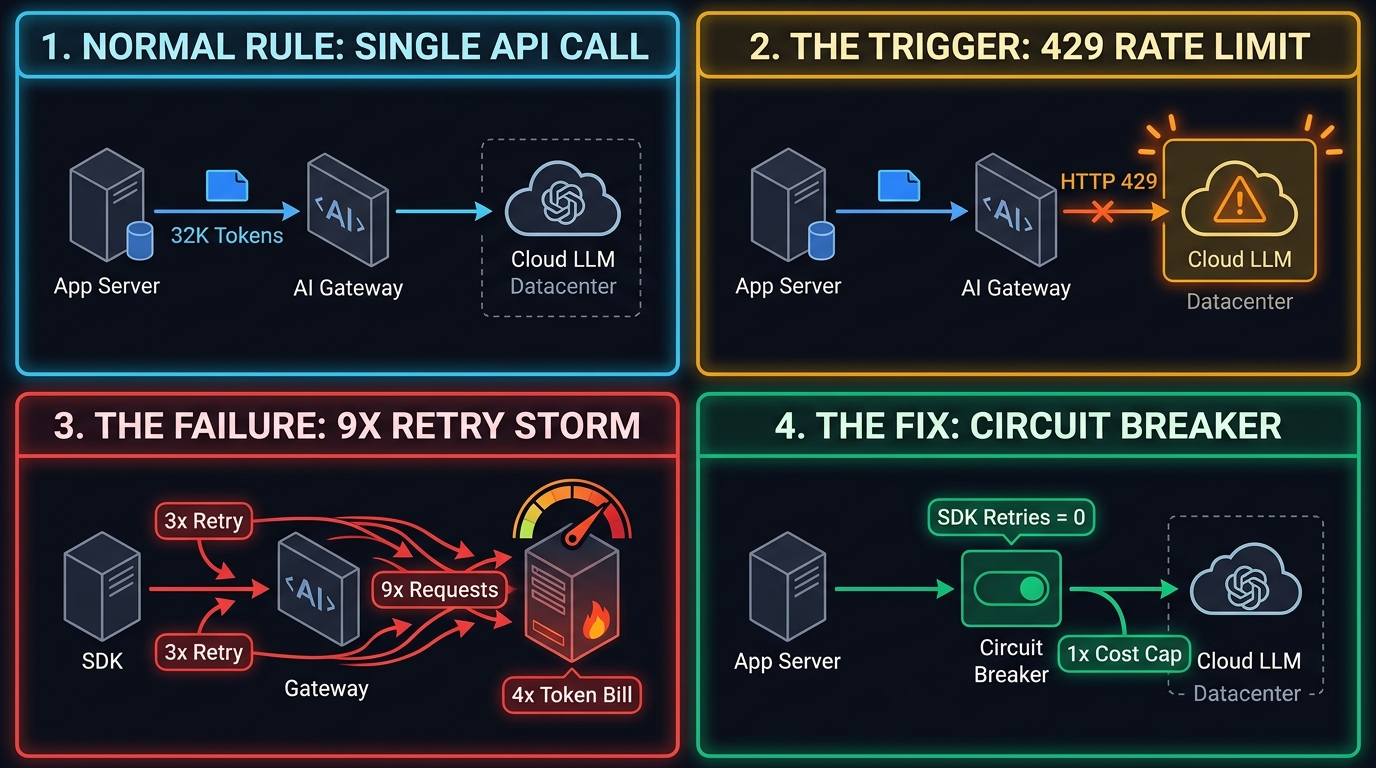
Every production AI engineering team configures multi-region or multi-provider fallbacks (us-east-1 $\rightarrow$ eu-west-1 $\rightarrow$ ap-southeast-1, or Claude Sonnet $\rightarrow$ GPT-4o $\rightarrow$ Gemini Pro) to protect uptime against regional rate limits (HTTP 429) and provider overload (HTTP 529). On paper, routing around a degraded region should cost exactly the same number of tokens as a normal request.
In production, naive fallback chains routinely multiply your hourly token bill by 4.1x while knocking over every backup region in under ninety seconds. Why? Because application developers and platform engineers don't disable the default retry loops inside each layer of the stack, and traditional HTTP proxies can't see how Server-Sent Events (text/event-stream) bill prompt prefill tokens before a streaming timeout occurs. You won't survive a regional brownout if every dropped socket re-bills a 32,000-token prompt four times.
Examine the request volume, token consumption, and P99 latency we captured during a 12-minute regional HTTP 429 / 504 brownout across an enterprise agent fleet sending 32,000-token RAG prompts at 45 requests per minute:
| Telemetry Metric (12-Min Brownout) | Default Nested Retries (SDK 3x × Proxy 3x) | Gateway-Only Retries (Blind SSE Retry) | Single-Owner Budget + Prefill Checkpoint | FinOps & Reliability Mechanism |
|---|---|---|---|---|
| 1. Effective Attempts per Failed Call | 9 to 16 attempts ((1+3) × (1+3)) | 4 attempts | 1.04 attempts (Max 2 on pre-prefill 429) | Sets SDK max_retries=0 and enforces a 20% global retry budget |
| 2. Billed Input Prefill Tokens / Call | 131,200 tokens (4.1x billed) | 96,000 tokens (3.0x billed) | 32,000 tokens (1.0x billed) | Blocks blind re-transmission once first_token_received == True |
| 3. Secondary Region TPM Exhaustion | Collapsed in 78 seconds | Collapsed in 4.2 minutes | 0% secondary exhaustion (Stable) | Trips circuit breaker at <8% x-ratelimit-remaining-tokens |
| 4. Wasted Spend During 12-Min Event | $1,840 USD wasted | $890 USD wasted | $19 USD overhead (-98.9% waste) | Eliminates duplicate 32K prefill billing on dropped mid-stream sockets |
| 5. End-to-End Request Success Rate | 31.4% (Cascading timeouts) | 68.0% | 99.4% | Routes pre-prefill traffic cleanly to healthy regional quota pools |
| 6. P99 Client Response Latency | 64.2 seconds (Gateway 504) | 28.5 seconds | 4.1 seconds | Fast-fails degraded upstreams via header-driven circuit breaking |
Look at Row 1 and Row 2 in the table. When your primary LLM endpoint slows down or drops a streaming connection, nested retry loops turn 1 user request into 9 to 16 upstream attempts, billing your account for 131,200 input tokens on a single 32,000-token prompt.
We audited a customer support platform whose monthly Anthropic and OpenAI bill spiked by $14,200 over a single weekend despite flat user traffic. Their Python microservices initialized AsyncOpenAI() with its default max_retries=2 (3 total attempts) and pointed base_url at an internal LiteLLM proxy configured with num_retries=3 (4 total attempts). When us-east-1 experienced transient 15-second streaming stalls, the proxy retried each stalled 32K-token request 3 times, exceeding the client SDK's 20-second timeout and causing the client SDK to fire 2 more top-level requests that each triggered 4 proxy attempts (3 × 4 = 12 upstream calls per user click).
Why Standard HTTP Retry Middleware Fails on Streaming LLMs
Traditional microservice retry patterns assume idempotent, low-cost HTTP calls that fail before expensive compute executes. Large Language Model inference violates every one of those assumptions.
1. Multiplicative Retry Amplification Across SDK, Agent, and Proxy Layers
Modern AI stacks stack three independent retry loops on top of each other: the orchestration framework (LangChain / LlamaIndex max_retries=3), the provider client SDK (openai / anthropic Python & TypeScript SDKs default to max_retries=2), and the central AI gateway (LiteLLM, Kong AI Proxy, Envoy). Unless retry authority is stripped from the inner layers, a single upstream 429 or 502 multiplies exponentially (3 × 3 × 4 = 36 attempts), compounding the cost spikes already caused by autonomous agent infinite tool loops and thinking token inflation.
2. The Post-Prefill SSE Streaming Double-Billing Trap
In a streaming chat.completions call (stream=True), the upstream LLM provider immediately executes the most expensive part of the request: prompt prefill across your 32,000 input tokens, and begins streaming Server-Sent Events (HTTP 200 OK). If the upstream connection drops or hits a read timeout at token 450 of 800, you have already been billed for 100% of the 32,000 input tokens plus 450 output tokens. When a naive AI gateway catches that broken stream exception and transparently retries the request on a fallback region, it re-sends and re-bills all 32,000 prefill tokens a second, third, and fourth time.
3. Cross-Region Token-Per-Minute (TPM) Thundering Herds
When a primary region (us-east-1, provisioned for 10M TPM) hits a rate limit during peak traffic and your gateway dumps 100% of failed requests plus 3x retry amplification onto a smaller secondary region (eu-west-1, provisioned for 2M TPM), the backup region's token bucket saturates in seconds, triggering a global multi-region outage.
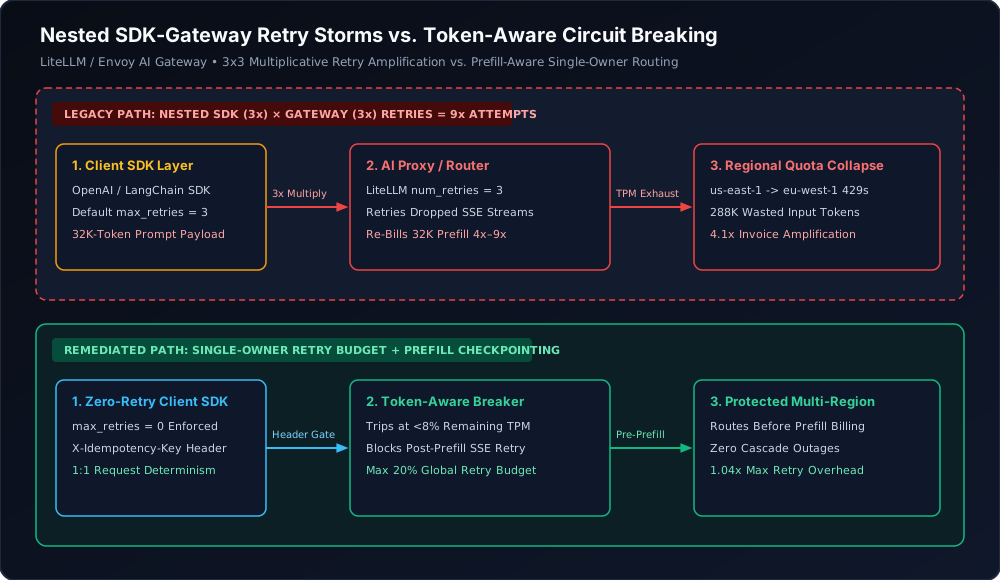
Nested 9x Retry Storms vs. Prefill-Aware Single-Owner Circuit Breaking
Preventing token retry storms requires enforcing a single retry owner, inspecting provider rate-limit headers proactively, and separating pre-prefill connection errors (safe to reroute) from mid-stream generation drops (never blind-retry).
Implementing Prefill-Safe Routing & Token-Bucket Circuit Breakers
In our production AI gateways, we enforce max_retries=0 across all application SDKs and centralize routing inside a prefill-aware gateway wrapper. The router tracks x-ratelimit-remaining-tokens headers from every upstream response to trip the regional circuit breaker before 429 errors occur, and strictly forbids automatic full-prompt retries once the first SSE token chunk has been emitted (indicating prefill billing has already executed).
# Production AI Gateway Pattern: Single-Owner Retry Budget + Prefill-Safe Streaming Guard
import time
from typing import AsyncIterator, List, Dict
import openai

# 1. Enforce max_retries=0 on all SDK clients so the SDK NEVER multiplies gateway retries
primary_client = openai.AsyncOpenAI(api_key="...", base_url="https://us-east.api.example.com/v1", max_retries=0, timeout=15.0)
fallback_client = openai.AsyncOpenAI(api_key="...", base_url="https://ap-se.api.example.com/v1", max_retries=0, timeout=15.0)

class TokenAwareCircuitBreaker:
    def __init__(self, min_remaining_tpm_ratio: float = 0.08, cooldown_sec: float = 30.0):
        self.min_ratio = min_remaining_tpm_ratio
        self.cooldown_sec = cooldown_sec
        self.tripped_until: float = 0.0

    def record_headers(self, headers: Dict[str, str]) -> None:
        rem = float(headers.get("x-ratelimit-remaining-tokens", 100_000))
        lim = float(headers.get("x-ratelimit-limit-tokens", 100_000))
        if lim > 0 and (rem / lim) < self.min_ratio:
            # Proactively trip before HTTP 429 storms hit
            self.tripped_until = time.monotonic() + self.cooldown_sec

    def is_healthy(self) -> bool:
        return time.monotonic() >= self.tripped_until

breaker = TokenAwareCircuitBreaker()

async def stream_with_prefill_guard(
    messages: List[Dict[str, str]],
    model: str,
) -> AsyncIterator[str]:
    clients = [primary_client, fallback_client] if breaker.is_healthy() else [fallback_client]
    prefill_executed = False
    partial_output: List[str] = []

    for idx, client in enumerate(clients):
        try:
            raw_response = await client.chat.completions.with_raw_response.create(
                model=model,
                messages=messages,
                stream=True,
            )
            breaker.record_headers(raw_response.headers)
            stream = raw_response.parse()

            async for chunk in stream:
                delta = chunk.choices[0].delta.content or ""
                if delta:
                    # 2. Once the first token arrives, 100% of prompt prefill has been billed!
                    prefill_executed = True
                    partial_output.append(delta)
                    yield delta
            return

        except (openai.RateLimitError, openai.APITimeoutError, openai.APIConnectionError) as exc:
            # 3. NEVER auto-retry a dropped stream after prefill_executed == True (prevents 4x double billing)
            if prefill_executed or idx == len(clients) - 1:
                raise RuntimeError(
                    f"Stream interrupted after prefill ({len(partial_output)} chunks emitted); blocking duplicate 32K prefill retry."
                ) from exc
            # Pre-prefill 429/connect error: safe to fail over once to fallback region
            breaker.tripped_until = time.monotonic() + 30.0
Three FinOps Controls to Eliminate Retry Amplification
-
Hardcode
max_retries=0in Every Application SDK and Agent Framework: Audit your repository forOpenAI(),Anthropic(),ChatOpenAI(), andLiteLLMclient initializations. Explicitly setmax_retries=0at the application and LangChain/LlamaIndex layers so the central AI gateway is the sole owner of retry and failover logic. -
Block Full-Prompt Retries After First-Token Arrival (
TTFT): Configure your AI gateway to distinguish between connection/pre-prefill errors (where0tokens were billed and failing over to a secondary region is free) and mid-stream read timeouts (where 100% of input tokens were already billed). Never blind-retry a 32K-token prompt that dropped mid-stream. -
Enforce a Global 20% Retry Budget and Proactive Header Shedding: Configure Envoy or your AI proxy with a token-bucket retry budget (
budget_percent: 20.0) and parsex-ratelimit-remaining-tokensheaders on every response—shifting overflow traffic to secondary regions or quantized sovereign endpoints at<8%remaining quota rather than waiting forHTTP 429cascades.
Enjoyed this autopsy? Get next Monday's architecture teardown + SVG blueprints in your inbox.
1 email every Monday morning. Zero marketing fluff — just real VRAM math, MCP security traps, and sovereign lakehouse patterns.
Further Reading
The Context Engineering Trap: Why Prefix Mutation Breaks Prompt Caching
Dynamic timestamps and unsorted MCP tool schemas invalidate 90% of LLM KV-cache blocks. Deterministic 4-tier context compilation cuts prefill spend by 79%.
The Thinking Token Inflation Trap: Why Reasoning Models Spike Cloud Bills 8x
Reasoning models generate thousands of invisible chain-of-thought tokens billed at premium output rates. Complexity routing and hard thinking budgets cut spend by 74%.
The GPU Repatriation Blueprint: When Private Clusters Beat Cloud Hyperscalers
Sustained inference workloads cross the cloud-versus-private GPU TCO inflection point at 65% utilization over a 36-month hardware amortization cycle.
The Infinite Tool Loop: Why Autonomous Agents Cause 400% Cloud Token Spikes
Autonomous agents trapped in recursive tool-retry loops inflate cloud token bills by 400%. Deterministic state-hash circuit breakers halt runaway execution.
Eliminating GPU Waste & Token Burn?
We audit enterprise inference unit economics, engineer request-level OpenTelemetry pipelines, and eliminate the 60% idle capacity tax through dynamic model routing, VRAM virtualization, and private weight hosting.
Debugging this pattern in your own stack? Ask a Principal Architect directly or request a free 48-hour architecture sanity check: