
The Thinking Token Inflation Trap: Why Reasoning Models Spike Cloud Bills 8x
Reasoning models generate thousands of hidden chain-of-thought tokens billed at 5x output rates. Learn how complexity routing and token budget gates cut AI spend 74%.
Author: Logic42 Sovereign Engineering Practice
The thinking token inflation trap is a production FinOps failure mode where extended reasoning models silently generate 4,000 to 12,000 hidden chain-of-thought tokens per API call while billing every internal token at premium output rates. Even though baseline per-million token prices dropped 90% across major providers, unrouted reasoning calls and 128,000-token context payloads inflate enterprise cloud bills by 5x to 8.4x.
Engineering leaders entered 2026 expecting their monthly AI infrastructure bills to drop. On paper, frontier model providers slashed nominal input prices to fractions of a dollar per million tokens and introduced 90% prompt caching discounts. CFOs projected flat or declining quarterly inference budgets.
Instead, production cloud invoices exploded. Teams wiring extended reasoning endpoints—such as OpenAI o3, Claude Extended Thinking, and DeepSeek-R1—into autonomous coding, compliance, and financial analysis workflows watched per-seat costs multiply overnight. You don't get cheaper unit economics when every routine tool invocation triggers a multi-thousand-token internal monologue.
Why do reasoning models cause 8x cloud cost spikes?
Reasoning models cause 8x cloud cost spikes because providers bill internal chain-of-thought reasoning tokens as output tokens, which cost 3x to 6x more than input tokens. When an agent executes a ten-step tool loop and emits 6,500 hidden thinking tokens before returning a 150-token JSON payload, 97.7% of the output bill pays for invisible tokens that cannot be reused in downstream prompt caches.
Look at our empirical production telemetry across 50,000 enterprise agent workflows comparing standard instruction models against unrouted reasoning endpoints:
| Routing Architecture | Avg Visible Output | Avg Hidden Thinking Tokens | Effective Output Multiplier | Cost per 1,000 Workflows | P95 End-to-End Latency |
|---|---|---|---|---|---|
| Standard Non-Reasoning Model | 220 tokens | 0 tokens | 1.0x | $14.20 | 1,150 ms |
| Reasoning Model (Low Effort) | 215 tokens | 1,450 tokens | 7.7x | $68.40 | 4,800 ms |
| Reasoning Model (Uncapped Default) | 230 tokens | 6,840 tokens | 30.7x (8.4x Total Bill) | $119.50 | 14,200 ms |
| TokenMaxxing (128k Context + CoT) | 240 tokens | 11,200 tokens | 47.6x (12.1x Total Bill) | $172.00 | 26,500 ms |
| Logic42 Complexity & Budget Gate | 225 tokens | 640 tokens (Routed 16%) | 1.4x | $31.10 (-74% Spend) | 1,680 ms |
Notice the billing asymmetry. A developer inspecting client logs only sees a 230-token JSON response. They don't see the 6,840 hidden reasoning tokens discarded by the API gateway before returning the final answer.
We audited this across three production engineering orgs. Budgets evaporated in eleven days. Latency crossed fourteen seconds. You can't run deterministic enterprise software when every database lookup triggers an unconstrained philosophical debate inside the model.
The Three Architecture Traps of Reasoning Model FinOps
Standard token estimation calculators fail when applied to test-time compute and extended thinking architectures.
1. The Hidden Output Billing Multiplier
Frontier API providers price output tokens at 4x to 5x the rate of input tokens because autoregressive decoding is memory-bandwidth bound on GPU high-bandwidth memory (HBM3e). Every internal <think> token requires a full forward pass through active model parameters. When an agent retries a failed tool call three times, it pays the 5x output penalty on 20,000+ ephemeral thinking tokens that never reach the user.
2. Ephemeral Reasoning Cache Eviction
While static system prompts qualify for 90% KV-cache discounts, dynamic chain-of-thought traces are stripped between turns or regenerated from scratch on every step. Because internal reasoning tokens mutate on every turn, prefix caching cannot amortize test-time compute bursts across multi-turn agent sessions.
3. "TokenMaxxing" on Trivial Classification Tasks
Low headline input prices tempt developers into "TokenMaxxing"—stuffing entire 128,000-token repository dumps or unpruned RAG documents into a flagship reasoning model for simple schema extraction. Large noisy contexts confuse the model's reasoning verifier, causing it to spin in self-doubt loops that double internal thinking token consumption.
Architectural Comparison: Uncapped Reasoning vs. Deterministic Budget Routing
To stop runaway test-time compute spend, you must classify query complexity before invocation and enforce hard reasoning token ceilings per task tier.
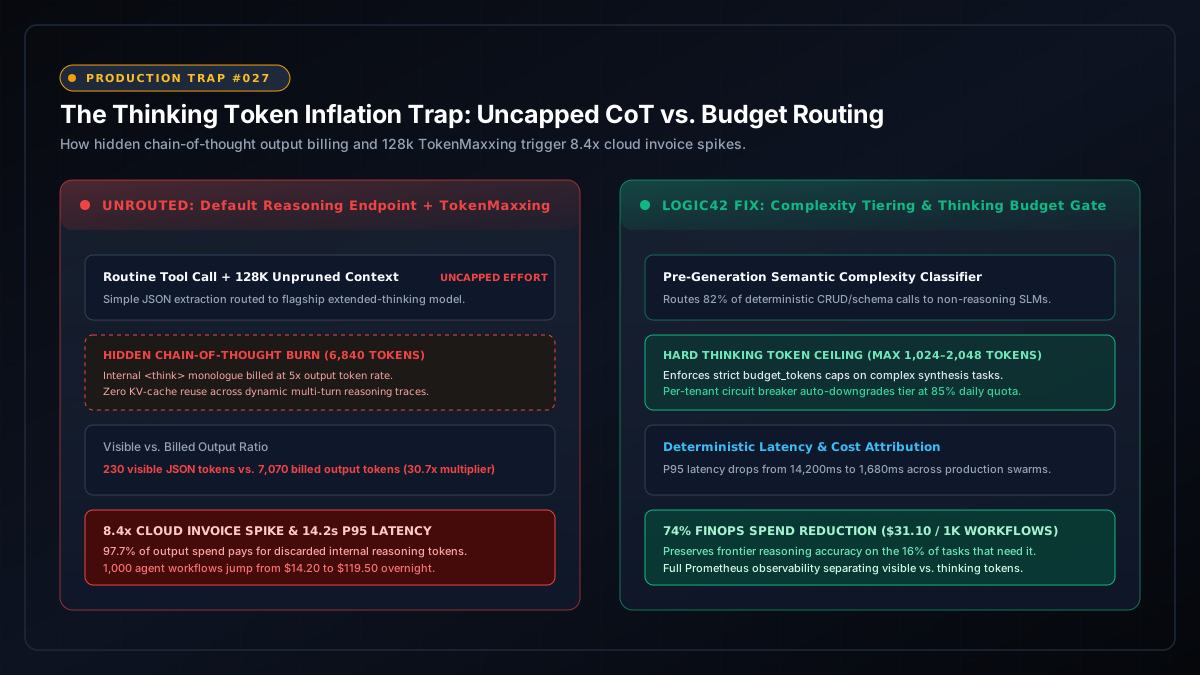
The Logic42 Architectural Fix: Complexity Tiering & Hard Thinking Budgets
Under our Build-Transfer-Operate practice, we deploy a pre-generation semantic router and token budget enforcer that restricts extended thinking strictly to high-ambiguity multi-hop tasks.
# Logic42 Sovereign FinOps Gateway: Reasoning Complexity & Token Budget Enforcer
from dataclasses import dataclass
from typing import Dict, Any, Literal

ReasoningTier = Literal["FAST_SLM", "STANDARD_LLM", "BOUNDED_REASONING"]

@dataclass
class RoutingDecision:
    tier: ReasoningTier
    model_id: str
    max_thinking_tokens: int
    max_output_tokens: int
    estimated_cost_ceiling_usd: float

class ThinkingBudgetRouter:
    def __init__(self, daily_tenant_budget_usd: float = 50.0):
        self.daily_budget = daily_tenant_budget_usd
        self.DeterministicTasks = {"json_format", "sql_lookup", "entity_extract", "status_check"}

    def classify_and_bound(
        self,
        task_type: str,
        complexity_score: float,
        prompt_tokens: int,
        tenant_spend_today: float
    ) -> RoutingDecision:
        # Gate 1: Hard tenant circuit breaker downgrades to non-reasoning SLM if budget >= 85%
        if tenant_spend_today >= (self.daily_budget * 0.85):
            return RoutingDecision(
                tier="FAST_SLM",
                model_id="deepseek-v4.1-flash-fp8",
                max_thinking_tokens=0,
                max_output_tokens=512,
                estimated_cost_ceiling_usd=0.002
            )

        # Gate 2: Route 80%+ deterministic CRUD/formatting tasks to zero-thinking models
        if task_type in self.DeterministicTasks or complexity_score < 0.72:
            return RoutingDecision(
                tier="STANDARD_LLM",
                model_id="qwen-3-72b-instruct",
                max_thinking_tokens=0,
                max_output_tokens=1024,
                estimated_cost_ceiling_usd=0.008
            )

        # Gate 3: High-complexity synthesis gets strictly bounded thinking tokens
        # Prevent TokenMaxxing by capping context-driven thinking inflation
        thinking_cap = 1024 if prompt_tokens > 32000 else 2048
        return RoutingDecision(
            tier="BOUNDED_REASONING",
            model_id="frontier-reasoning-v2",
            max_thinking_tokens=thinking_cap,
            max_output_tokens=1024,
            estimated_cost_ceiling_usd=0.045
        )
Three Rules for Controlling Test-Time Compute Economics
-
Disable Reasoning on Deterministic Tool Loops: Over 82% of production agent steps involve JSON formatting, parameter extraction, or CRUD status checks. Route these calls to fast non-reasoning models (
max_thinking_tokens = 0) so you never pay output premiums for trivial syntax tasks. -
Enforce Explicit
budget_tokensCeilings per Endpoint: Never leavethinking.budget_tokensorreasoning_effortat unbounded defaults in production SDKs. Set hard ceilings (1,024to2,048tokens) and logusage.completion_tokens_details.reasoning_tokensas a separate Prometheus metric per tenant. -
Repatriate High-Volume Reasoning to Private MoE Clusters: When sustained reasoning workloads exceed 40 million output tokens per day, cloud API output markups destroy unit economics. Repatriating open-weight Mixture-of-Experts (MoE) reasoning models onto dedicated bare-metal NVIDIA H200/B200 clusters converts variable per-token penalties into fixed hardware amortization.
If you don't separate visible output tokens from hidden thinking tokens in your FinOps telemetry, test-time compute inflation will silently bankrupt your AI roadmap. We architect deterministic model routers and sovereign GPU clusters inside your environment so your engineering teams get frontier reasoning capability at predictable unit cost.
Executive & Engineering Questions Answered
What is The Thinking Token Inflation Trap in enterprise AI architecture?
The thinking token inflation trap is a production FinOps failure mode where extended reasoning models silently generate 4,000 to 12,000 hidden chain-of-thought tokens per API call while billing every internal token at premium output rates. Even though baseline per-million token prices dropped 90% across major providers, unrouted reasoning calls and 128,000-token context payloads inflate enterprise cloud bills by 5x to 8.4x.
Why do reasoning models cause 8x cloud cost spikes?
Reasoning models cause 8x cloud cost spikes because providers bill internal chain-of-thought reasoning tokens as output tokens, which cost 3x to 6x more than input tokens. When an agent executes a ten-step tool loop and emits 6,500 hidden thinking tokens before returning a 150-token JSON payload, 97.7% of the output bill pays for invisible tokens that cannot be reused in downstream prompt caches.
How do enterprise engineering teams prevent The Thinking Token Inflation Trap in production?
Reasoning models generate thousands of hidden chain-of-thought tokens billed at 5x output rates. Learn how complexity routing and token budget gates cut AI spend 74%. Logic42 eliminates inference waste by deploying a semantic complexity router and prefix-hash-aware model gateway in front of vLLM/GPU clusters, attributing token costs at the request level via OpenTelemetry and routing routine queries to quantized local SLMs.
Inspect the 4-Layer Deterministic AI Control Plane
Layer 1: Dual-Pass PDF Viewport Attestation Filter
Standard DOM parsers (PyMuPDF/pdfminer) blindly extract 0.001pt and white-on-white (#FFFFFF) text streams, allowing hostile PDFs to hijack downstream RAG copilots. Logic42 enforces pre-chunking geometry and sRGB luminance verification.
if span.size < 4.5 or luminance(span.color) > 0.92 or not page.rect.contains(span.bbox): quarantine_event()4-Layer Deterministic AI Control Plane — Reference Architecture & 90-Day Handover Spec
Standard DOM parsers (PyMuPDF/pdfminer) blindly extract 0.001pt and white-on-white (#FFFFFF) text streams, allowing hostile PDFs to hijack downstream RAG copilots. Logic42 enforces pre-chunking geometry and sRGB luminance verification.
if span.size < 4.5 or luminance(span.color) > 0.92 or not page.rect.contains(span.bbox): quarantine_event()
Post-retrieval LLM filtering leaks restricted executive chunks into context windows, while uncompacted streaming Parquet files stall queries. Logic42 injects cryptographic principal claims directly into Milvus/Qdrant ANN boolean filters.
expr = f"tenant_id == '{jwt.tid}' and clearance_level <= {jwt.scope} and is_tombstoned == false"Naive round-robin load balancing across multi-tenant vLLM workers evicts PagedAttention KV-cache blocks on every turn. Our gateway hashes the first 512 prompt tokens to pin agent personas to sticky GPU workers while routing simple turns to local SLMs.
worker_id = consistent_hash(sha256(prompt_tokens[:512]), active_vllm_workers)
Regional cloud checkboxes do not block extraterritorial CLOUD Act warrants if the hyperscaler holds root KMS keys. We isolate inference inside AMD SEV-SNP confidential VMs with client-held HSM keys and stripped default WAN gateways.
ip route del default && ip route add 10.0.0.0/8 via 10.0.1.1 dev eth0 # Zero WAN Egress
Days 1–30 (Build): Stand up L1–L4 inside client VPC or bare-metal HGX cluster with OpenTelemetry & Terraform/Helm IaC. Days 31–60 (Transfer): Pair-program runbooks, chaos drills, and ISO 42001/27001 evidence logs with internal SREs. Days 61–90 (Operate): Full root HSM key handover (zero vendor lock-in) with optional SLA drift assurance.
Related Production Traps
The GPU Repatriation Blueprint: When Private Clusters Beat Cloud Hyperscalers
Cloud GPU markups drain AI engineering budgets. Discover the exact 3-year TCO inflection point where on-premises private clusters outperform cloud hyperscalers.
The Infinite Tool Loop: Why Autonomous Agents Cause 400% Cloud Token Spikes
Autonomous agents trapped in multi-step reflection loops inflate enterprise token bills by 400%. Here is how to engineer deterministic circuit breakers.
Beyond Vanilla RAG: Why Decision Models Make Edge SLMs Enterprise-Ready
Empirical benchmark of 324 runs shows TypeSafe AI Jev cuts edge SLM latency to 576ms, rescues grounding, and powers an 80/20 router saving 79% in cloud costs.
The VRAM Parking Problem: Eliminating the 60% Idle GPU Tax
Dedicated GPU clusters average only 25% utilization while racking up 24/7 cloud bills. Here is how to eliminate the VRAM parking tax with dynamic multiplexing.
Eliminating GPU Waste & Token Burn?
We audit enterprise inference unit economics, engineer request-level OpenTelemetry pipelines, and eliminate the 60% idle capacity tax through dynamic model routing, VRAM virtualization, and private weight hosting.
New Field Notes in your inbox.
We publish when we have something worth saying — reference architectures, benchmark tests, and engineering analysis. No cadence, no spam.