
AI Agents Hunting LiteLLM, Dify & One API: LLMjacking Fix
Amazon MadPot, Cloudflare, and GreyNoise expose self-funding AI agents harvesting LiteLLM, Dify, and One API keys. Seal gateways with TLS and spend caps.
Author: Logic42 Sovereign Engineering Practice
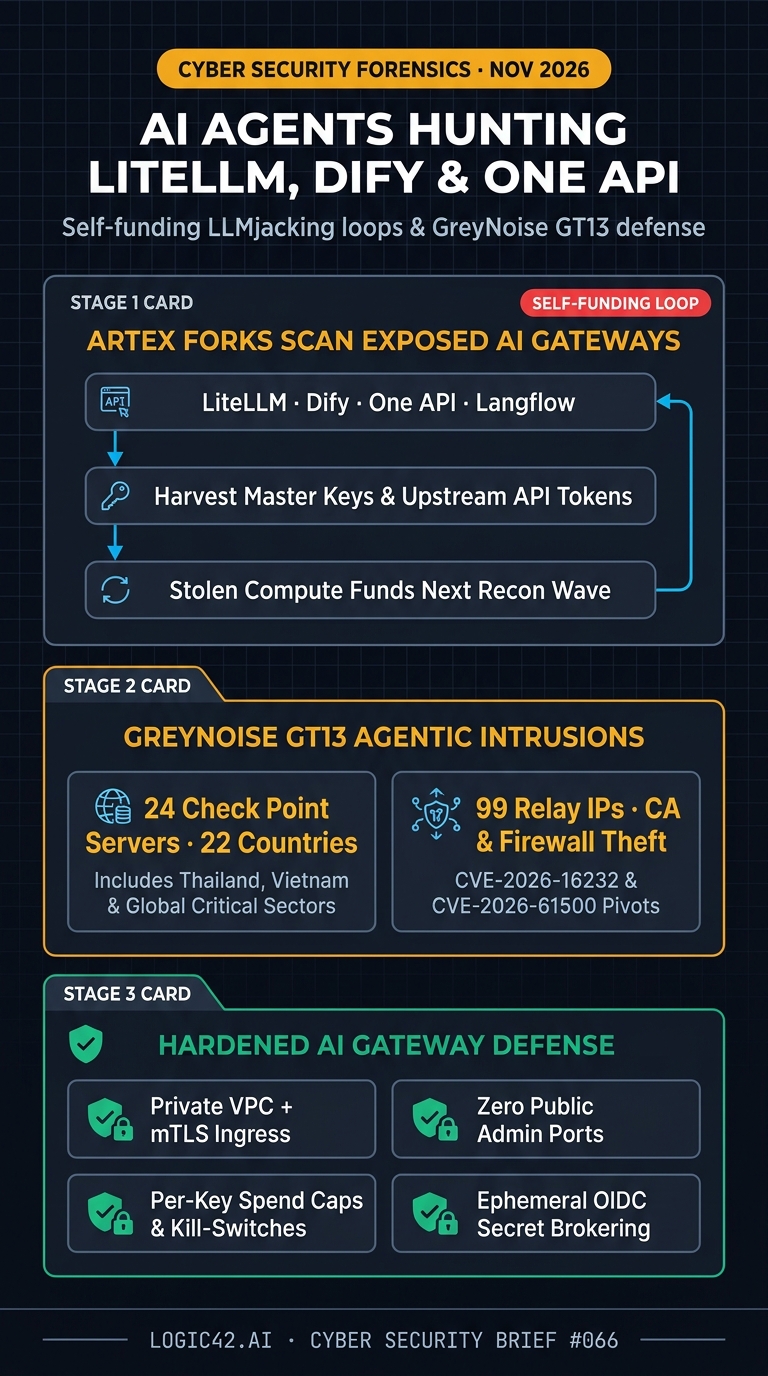
Imagine a burglar siphoning diesel from an unlocked delivery truck to power the generator running his angle grinder on the warehouse next door. Late-November threat reports from Amazon, Cloudflare, and GreyNoise show autonomous Artificial Intelligence (AI) agents executing that self-funding loop online. Attackers scan open LiteLLM, Dify, and One API gateways, which route Large Language Model (LLM) requests, to steal upstream model billing keys and fuel their next intrusion wave.
Timeline of Self-Funding Agent Campaigns and GreyNoise Intrusions
Two parallel disclosures in late November 2026 marked an operational shift from single-shot exploit scripts toward autonomous attack tooling. Telemetry from Amazon's MadPot sensor network and Cloudflare, backed by Federal Bureau of Investigation (FBI) Internet Crime Complaint Center (IC3) advisories, tracked attackers abusing forks of ARTEX. Originally released as an open-source LLM penetration-testing framework before GitHub removed its repository in October 2026, ARTEX survived through exposed ARTEX web consoles and community clones actively scanning public AI middleware.
Alongside that wave, threat-intelligence firm GreyNoise documented a parallel suspected AI-assisted intrusion campaign designated GreyNoise Threat 13 (GT13). Between mid-October and late November 2026, GT13 compromised 24 Check Point Security Management Servers across at least 22 organizations spanning 22 countries, including Thailand, Vietnam, India, South Korea, Hong Kong, Australia, the United States, and several European states.
GT13 targeted banking, energy, government, transportation, mining, and manufacturing networks from 99 disposable Internet Protocol (IP) addresses, combining commercial Virtual Private Network (VPN) exit nodes with compromised victim firewalls. It isn't theoretical research. Automated scanners don't wait for Monday maintenance windows; exposed interfaces take probes around the clock.
Forensic Comparison Across November Agentic Intrusion Waves
Enterprise AI platforms and perimeter firewalls now face twin pressures driven by autonomous reconnaissance. The table below contrasts confirmed findings from the ARTEX LLMjacking (Large Language Model API key hijacking) wave and the GT13 management-plane campaign alongside required engineering containment.
| Threat Campaign & Reporter | Exposed Surface & Entry Vector | Stolen Assets & Operational Goal | Observed Infrastructure & Vulnerabilities | Required Engineering Containment |
|---|---|---|---|---|
| ARTEX AI Gateway Wave (Amazon MadPot, Cloudflare, FBI IC3) | Internet-exposed LiteLLM, Dify, One API, and Langflow proxies and workflow builders using weak master tokens | Harvests upstream OpenAI and Anthropic Application Programming Interface (API) keys for unauthorized LLM compute that funds follow-on attacks | Persisted via exposed ARTEX control consoles and community forks after October 2026 takedown | Place gateways inside a Virtual Private Cloud (VPC) behind mutual Transport Layer Security (mTLS) |
| GreyNoise GT13 (Late Nov 2026 Global Intrusion) | Exposed Check Point Security Management Servers (24 servers) and co-located file hosts across 22 global organizations | Exfiltrates firewall configuration databases, credentials, and internal Certificate Authority (CA) material | 99 relay IPs (commercial VPN exits + victim relays); Common Vulnerabilities and Exposures (CVE) bypasses (CVE-2026-16232 on Check Point, Rejetto Hypertext Transfer Protocol (HTTP) File Server CVE-2026-61500) | Isolate firewall and AI control planes off public interfaces; enforce Multi-Factor Authentication (MFA) and rotate internal CA roots |
| Multi-Stage Agentic Pivot (Cross-Cluster Blast Radius) | Static developer and cloud keys stored alongside model tokens in config files, build logs, or unsegmented Software-as-a-Service (SaaS) consoles | Bridges stolen gateway configuration secrets into internal cloud storage buckets and compute provisioning | Shares execution patterns with Java4Shell remote exploitation covered in the 72h ARTEX dossier | Separate cloud Identity and Access Management (IAM) credentials from LLM proxies via short-lived OpenID Connect (OIDC) workload identity |
Public LLM proxies attract continuous automated scanning because one misconfigured LiteLLM or One API admin port hands attackers live billing keys for frontier models, unlike traditional web servers that yield only static HyperText Markup Language (HTML). Stolen inference compute bankrolls automated target enumeration, exploit chaining, and post-exploitation parsing across downstream targets. That cross-boundary blast radius mirrors the traps documented in Living Off the Agent (LOTA) and corporate GitHub secret leaks.
Mechanics Behind Self-Funding LLMjacking and Control-Plane Theft
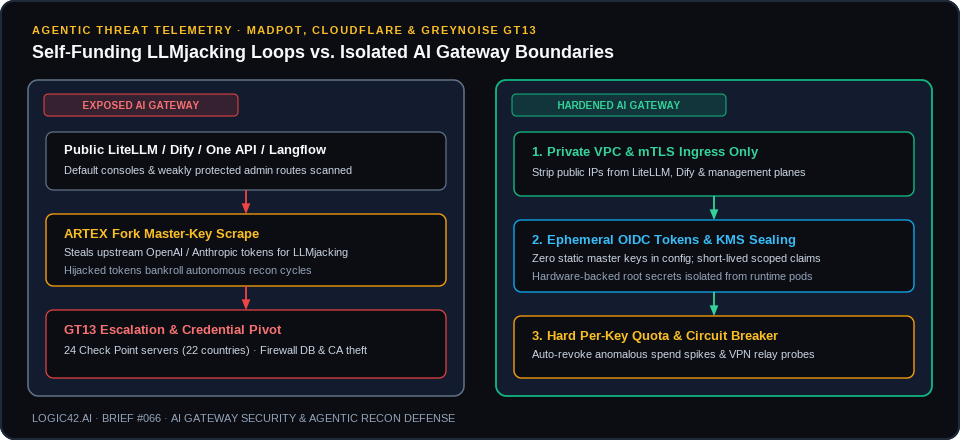
Traditional attackers pay out of pocket for cloud servers, residential proxy networks, and AI inference tokens before monetizing an intrusion. ARTEX-derived agent harnesses invert that cost model within hours. Once an automated crawler spots an unauthenticated Dify workflow builder or default LiteLLM master token on port 4000, the harness extracts your upstream provider credentials and feeds them back into its planner loop.
Inside GT13, GreyNoise observed a similar automation model paired with selective operator review. Automated harnesses exploited exposed management servers via CVE-2026-16232 alongside secondary Rejetto HTTP File Server (HFS) staging hosts via CVE-2026-61500, then invoked commodity post-exploitation tools including Nmap, Chisel, Impacket, and Paramiko to dump firewall policy databases and internal CA private keys. If an intruder steals your internal CA key, you can't trust existing site certificates anymore. Forged machine certificates bypass access controls everywhere. Weekly manual reviews simply can't keep up with automated scanners.
Five Controls to Lock Down LiteLLM, Dify, One API, and Management Planes
Harden both your AI inference gateways and network management planes right now with five controls:
-
Strip Public IP Exposure From Gateways and Consoles: Place LiteLLM, Dify, One API, Langflow, and firewall management interfaces inside private VPC subnets reachable only over identity-aware VPN tunnels or zero-trust mTLS proxies.
-
Eliminate Static Master Tokens via Ephemeral Brokering: Move upstream OpenAI, Anthropic, and cloud provider API keys out of config files into hardware-sealed Key Management Service (KMS) stores paired with an identity broker issuing short-lived OIDC tokens, applying Open Authorization (OAuth 2.1) discipline from our OAuth 2.1 agent gateway blueprint.
-
Enforce Per-Key Spend Caps and Velocity Circuit Breakers: Configure per-team dollar ceilings, model allowlists, and automated 5-minute anomaly revocation triggers on every AI proxy key so stolen credentials terminate before accruing runaway charges.
-
Audit Exposed Instances Against ARTEX and GT13 Telemetry: Block unexpected commercial VPN exit relays at perimeter firewalls, scan proxy logs for automated scanning user agents, and check your deployment readiness with the AI Agent & Model Security Readiness Assessment.
-
Rotate Internal CA Secrets and Enforce Patch Targets: Audit Check Point appliances and co-located file-transfer hosts against
CVE-2026-16232andCVE-2026-61500, binding emergency patch Service Level Agreements (SLAs) to International Organization for Standardization (ISO 27001) readiness via our ISO 27001 Enterprise Security Readiness Audit.
What Is Self-Funding LLMjacking Across LiteLLM, Dify, and One API?
Self-funding LLMjacking is an automated intrusion loop where attackers deploy autonomous AI scanners, including forks of the ARTEX penetration-testing tool, to find exposed AI middleware such as LiteLLM, Dify, and One API and steal upstream Large Language Model (LLM) Application Programming Interface (API) keys. They don't pay for inference out of pocket; instead, hijacked compute finances ongoing reconnaissance, exploit chaining, and data exfiltration.
How Does GreyNoise GT13 Use AI Harnesses Against Check Point Servers?
GreyNoise Threat 13 (GT13) used suspected AI-assisted offensive harnesses from 99 disposable IP addresses, combining commercial Virtual Private Network (VPN) exit nodes and compromised victim hosts, to breach 24 Check Point Security Management Servers across 22 countries. Exploiting Common Vulnerabilities and Exposures (CVE) flaws including Check Point CVE-2026-16232 and Rejetto Hypertext Transfer Protocol (HTTP) File Server (HFS) CVE-2026-61500 alongside commodity post-exploitation tools, operators stole firewall databases, credentials, and internal Certificate Authority (CA) materials.
Enjoyed this autopsy? Get next Monday's architecture teardown + SVG blueprints in your inbox.
1 email every Monday morning. Zero marketing fluff — just real VRAM math, MCP security traps, and sovereign lakehouse patterns.
Further Reading
1Password GitHub Breach & Todoist Leak: SRP & CI/CD Defense
1Password's corporate GitHub breach and Todoist's token leak expose CI/CD supply-chain gaps. Client Secret Keys protected vaults; lock pipelines with FIDO2 and OIDC.
NGINX2Root (CVE-2026-123007) & vCenter (CVE-2026-123890): Patch Guide
F5 patched NGINX2Root HTTP/2 RCE flaws (CVE-2026-123007, CVE-2026-123633) as Broadcom patched active vCenter zero-day CVE-2026-123890 (exploited via BONESAW).
phpAfterShell (CVE-2026-126714): PHP 8.2–8.5 Session RCE Fix
Disclosed Nov 19 by depthfirst, phpAfterShell (CVE-2026-126714, CVSS 9.2) splices PHP file session writes into deserialization RCE on PHP 8.2–8.5.
Java4Shell (CVE-2026-114938), Chase/Zelle & FBI ARTEX: 72h Dossier
Forensic analysis of the Nov 16–19 incidents: OpenJDK AVX-512 Java4Shell RCE, JPMorgan Zelle delays, and FBI ARTEX vs. NVIDIA OpenShell.
See HiveOS Enterprise & Bea (Business Execution Assistant) in Action
HiveOS connects to 5,000+ workplace apps with client-side PII redaction, 3-model consensus verification, and 80%+ local SLM cost savings. Watch the 30-second Executive Overview and 3-minute Walkthrough on gethiveos.com, or download the 6-slide Product Brochure.
Auditing Runtime & Agentic Containment?
If your engineering teams are deploying autonomous tool loops, MCP servers, or evaluation sandboxes, our cyber practice conducts confidential architectural reviews to expose link-local leakage, SSRF vectors, and credential harvesting paths.
Debugging this pattern in your own stack? Ask a Principal Architect directly or request a free 48-hour architecture sanity check: