
1Password GitHub Breach & Todoist Leak: SRP & CI/CD Defense
1Password's corporate GitHub breach and Todoist's token leak expose CI/CD supply-chain gaps. Client Secret Keys protected vaults; lock pipelines with FIDO2 and OIDC.
Author: Logic42 Sovereign Engineering Practice
Think of a bank contractor duplicating a maintenance badge to photograph the lobby guestbook while customer safe-deposit boxes stay sealed because every renter holds half the physical key. Between November 19 and November 26, 2026, two vendor incidents showed that boundary in action. Both the 1Password GitHub breach and the Todoist account compromise turned internal developer tooling into customer data leaks without breaking client-side vault encryption.
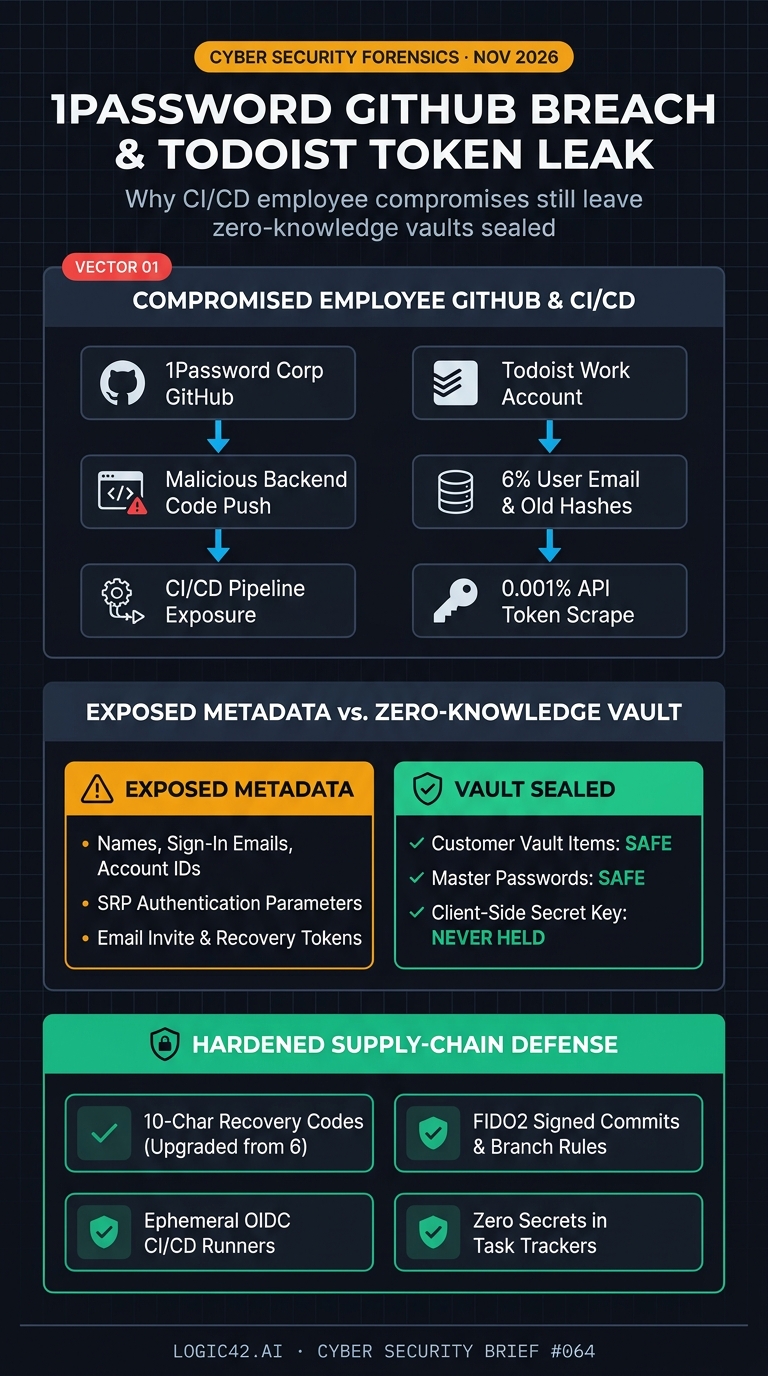
Timeline of the 1Password and Todoist Developer Breaches
Two late-November compromises stemmed from employee developer accounts rather than broken encryption math. On November 19, 2026, 1Password launched a forensic investigation after detecting unauthorized access to an employee's corporate GitHub account. That foothold let the intruder inspect private source code repositories, push malicious exfiltration code into backend services, and reach Continuous Integration and Continuous Delivery (CI/CD) systems before incident responders cut access.
Days later, between November 22 and November 24, 2026, task-management provider Todoist disclosed an unrelated employee work-account compromise across its version control and cloud infrastructure. That intrusion exposed email addresses and older password hashes for roughly 6% of Todoist users. For about 0.001% of accounts, attackers also abused exposed Application Programming Interface (API) tokens obtained via the compromised infrastructure to query task comments, project descriptions, and attachments for plaintext API keys, wallet recovery phrases, and cryptocurrency seeds.
Vaults stayed sealed inside 1Password. Stored vault items, master passwords, and locally held Secret Keys didn't leak because 1Password's zero-knowledge model keeps decryption strictly on client hardware. Even so, leaked authentication metadata creates downstream exposure, showing that employee engineering environments are primary attack surfaces.
Forensic Comparison Across Both November Vendor Breaches
If you run engineering or compliance programs, you shouldn't lump backend Secure Remote Password (SRP) metadata leaks together with plaintext Software-as-a-Service (SaaS) workspace exposure. The table below contrasts confirmed blast radii across both incidents alongside an independent enforcement ruling on November 25, 2026, when Singapore's Personal Data Protection Commission (PDPC) fined a Singapore law firm S$247,000 for ignoring vendor security alerts.
| Incident & Window | Initial Compromise Vector | Exposed Customer Data & Tokens | Protected Boundaries & Cryptographic Limits | Confirmed Remediation & Lessons |
|---|---|---|---|---|
| 1Password (Nov 19–26, 2026) | Compromised employee corporate GitHub account touching private repos and CI/CD pipelines | Subset metadata including names, sign-in emails, user IDs, timestamps, public keys, SRP parameters, and email invite/recovery link tokens | Customer vault items, master passwords, and local Secret Keys stayed untouched | Disabled compromised GitHub account, rotated infrastructure secrets, deployed clean builds, retained external auditors, upgraded verification codes from 6 numeric digits to 10 alphanumeric characters |
| Todoist (Nov 22–24, 2026) | Compromised employee work account accessing version control and cloud infrastructure | Roughly 6% of users had emails and older password hashes exposed; ~0.001% suffered API token queries across tasks and comments | Core systems contained after token revocation and internal account hardening | Forced token invalidation; exposed why pasting plaintext API keys or crypto seeds inside productivity boards creates immediate lateral exposure |
| Singapore Law Firm PDPC Fine (Nov 25, 2026) | Independent Singapore enforcement after internal cybersecurity staff ignored external vendor warnings | Client records exposed because urgent vendor patch advisories went unacted upon | Illustrates regulatory boardroom liability when vendor telemetry is ignored | Singapore PDPC issued a S$247,000 fine establishing direct financial liability for delayed alert triage |
The 1Password incident contrasts sharply with everyday SaaS sprawl. When an adversary abuses a backend CI/CD pipeline at a zero-knowledge password manager, client-side encryption still blocks wholesale decryption of stored secrets. When an adversary queries unencrypted productivity comments inside Todoist, every pasted credential sits in plaintext. That exact credential-sprawl trap mirrors the local Model Context Protocol (MCP) standard input/output (Stdio) exposure we analyzed in the MCP Stdio Master-Key Trap.
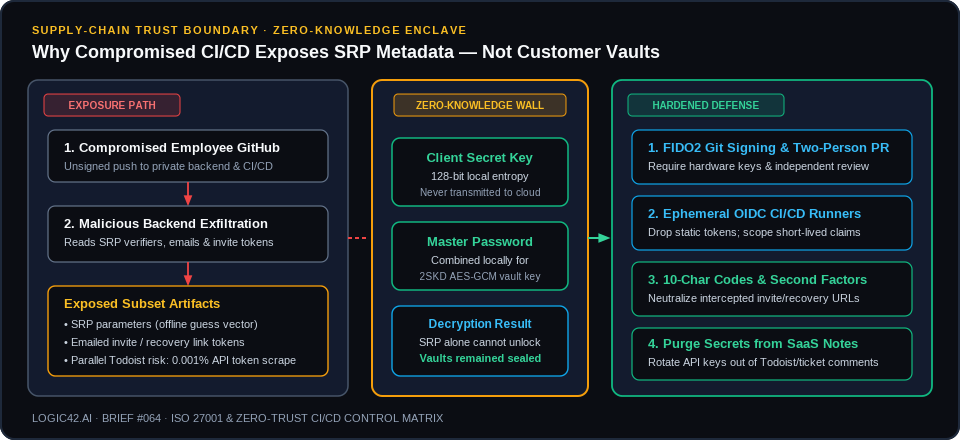
Secure Remote Password Parameters and Invitation Link Risks
Many security teams saw "SRP protocol parameters" in headlines this week and asked whether attackers had captured master password hashes. They didn't. Under SRP, your client proves knowledge of a secret verifier without sending your plaintext password across the wire.
If an attacker steals an SRP verifier from a standard password-only service, it's possible to run offline brute-force guesses against weak passphrases on Graphics Processing Unit (GPU) cracking rigs. Inside 1Password, however, SRP verification binds directly to a client-side 128-bit Secret Key that 1Password's servers never store. Without that Secret Key on your devices or Emergency Kit, server-side SRP parameters won't yield the vault key unless an enterprise disabled Secret Key enforcement or configured weak Single Sign-On (SSO) rules.
Email-delivered invitation, provisioning, and recovery link tokens carry a distinct risk you can't ignore. By themselves, those tokens don't hijack accounts because onboarding and recovery still require SSO verification or a secondary code. Because short codes invite automated brute-forcing, 1Password upgraded its verification challenge from 6 numeric digits (one million combinations) to 10 alphanumeric characters. If you observed unexpected recovery prompts or team invites between November 19 and November 26, audit your identity logs immediately.
Five Hardening Controls for Developer Pipelines and SaaS Secrets
Attackers rarely break Advanced Encryption Standard (AES) encryption directly; instead, they target developer GitHub sessions or static CI/CD tokens and wait for backend services to leak metadata. Harden your engineering supply chain with five controls:
-
Require Hardware Keys on Source Control Accounts: Mandate Fast Identity Online 2 (FIDO2) hardware security keys or Web Authentication (WebAuthn) passkeys for GitHub sign-in and commit signing, backed by two-person peer review on every pull request touching backend telemetry or deployment scripts.
-
Eliminate Static CI/CD Secrets via Ephemeral Workload Identity: Replace long-lived personal access tokens and static cloud keys inside build pipelines with short-lived OpenID Connect (OIDC) federation tokens scoped per repository and environment, aligning build security with our guidance on perimeter and hypervisor defense.
-
Monitor Build Diffs Outside Normal Developer Workflows: Alert security operations whenever unexpected commits modify authentication middleware, email templates, or telemetry exporters, applying Artificial Intelligence (AI) drift detection rules from the AI Agent & Model Security Readiness Assessment.
-
Purge Plaintext Credentials from Project Management Workspaces: Run automated regular-expression and entropy scans across Todoist, Jira, Notion, and Slack exports to delete historical API keys, service-account tokens, and recovery seeds stored in task notes.
-
Codify Vendor Alert Service Level Agreement Escalations: Track upstream vendor security advisories under binding Service Level Agreement (SLA) triage timelines so critical rotations can't stall in an unread mailbox, aligned with International Organization for Standardization (ISO) rules in the ISO 27001 Enterprise Security Readiness Audit.
Were 1Password Customer Vaults or Master Passwords Compromised?
No. 1Password confirmed that customer vaults, stored credentials, master passwords, and locally held Secret Keys weren't accessed during the November 2026 breach. Because 1Password enforces client-side zero-knowledge encryption requiring your local Secret Key alongside your master password, unauthorized access to source code and Continuous Integration and Continuous Delivery (CI/CD) systems couldn't decrypt stored customer vaults.
What Are SRP Parameters and Can Attackers Crack Your Account With Them?
Secure Remote Password (SRP) parameters are server-side cryptographic verifiers used to authenticate users without transmitting plaintext passwords during sign-in. Although leaked SRP parameters can help attackers attempt offline password guessing against conventional services, cracking a standard 1Password account stays blocked because authentication and vault decryption also require your unique client-side Secret Key, which 1Password doesn't store on its servers.
Enjoyed this autopsy? Get next Monday's architecture teardown + SVG blueprints in your inbox.
1 email every Monday morning. Zero marketing fluff — just real VRAM math, MCP security traps, and sovereign lakehouse patterns.
Further Reading
NGINX2Root (CVE-2026-123007) & vCenter (CVE-2026-123890): Patch Guide
F5 patched NGINX2Root HTTP/2 RCE flaws (CVE-2026-123007, CVE-2026-123633) as Broadcom patched active vCenter zero-day CVE-2026-123890 (exploited via BONESAW).
phpAfterShell (CVE-2026-126714): PHP 8.2–8.5 Session RCE Fix
Disclosed Nov 19 by depthfirst, phpAfterShell (CVE-2026-126714, CVSS 9.2) splices PHP file session writes into deserialization RCE on PHP 8.2–8.5.
Java4Shell (CVE-2026-114938), Chase/Zelle & FBI ARTEX: 72h Dossier
Forensic analysis of the Nov 16–19 incidents: OpenJDK AVX-512 Java4Shell RCE, JPMorgan Zelle delays, and FBI ARTEX vs. NVIDIA OpenShell.
Bleeding Llama (CVE-2026-7482): GGUF Memory Leak Defense
How the critical Bleeding Llama (CVE-2026-7482) heap over-read in Ollama's GGUF loader leaks live LLM prompts and API keys, and how to harden enclaves.
See HiveOS Enterprise & Bea (Business Execution Assistant) in Action
HiveOS connects to 5,000+ workplace apps with client-side PII redaction, 3-model consensus verification, and 80%+ local SLM cost savings. Watch the 30-second Executive Overview and 3-minute Walkthrough on gethiveos.com, or download the 6-slide Product Brochure.
Auditing Runtime & Agentic Containment?
If your engineering teams are deploying autonomous tool loops, MCP servers, or evaluation sandboxes, our cyber practice conducts confidential architectural reviews to expose link-local leakage, SSRF vectors, and credential harvesting paths.
Debugging this pattern in your own stack? Ask a Principal Architect directly or request a free 48-hour architecture sanity check: