
Java4Shell (CVE-2026-114938), Chase/Zelle & FBI ARTEX: 72h Dossier
Forensic analysis of the Nov 16–19 incidents: OpenJDK AVX-512 Java4Shell RCE, JPMorgan Zelle delays, and FBI ARTEX vs. NVIDIA OpenShell.
Author: Logic42 Engineering
Consider a bank vault whose locks, security cameras, and armored delivery trucks were upgraded this year, yet a hairline crack inside a single loading-dock hinge lets anyone force the door open in three minutes. Between Monday, November 16, and Thursday, November 19, 2026, three separate incidents proved that execution boundaries without bulkheads still bypass enterprise security controls.
Coming days after Microsoft's global cloud outage and the US Federal Aviation Administration (FAA) nationwide ground stop, that 72-hour cluster sparked widespread rumors of a coordinated cyberwar. It wasn't. Instead, enterprise engineering teams observed a rare side-by-side failure across Central Processing Unit (CPU) vector instructions, interbank payment rails, and autonomous Artificial Intelligence (AI) intrusion frameworks.
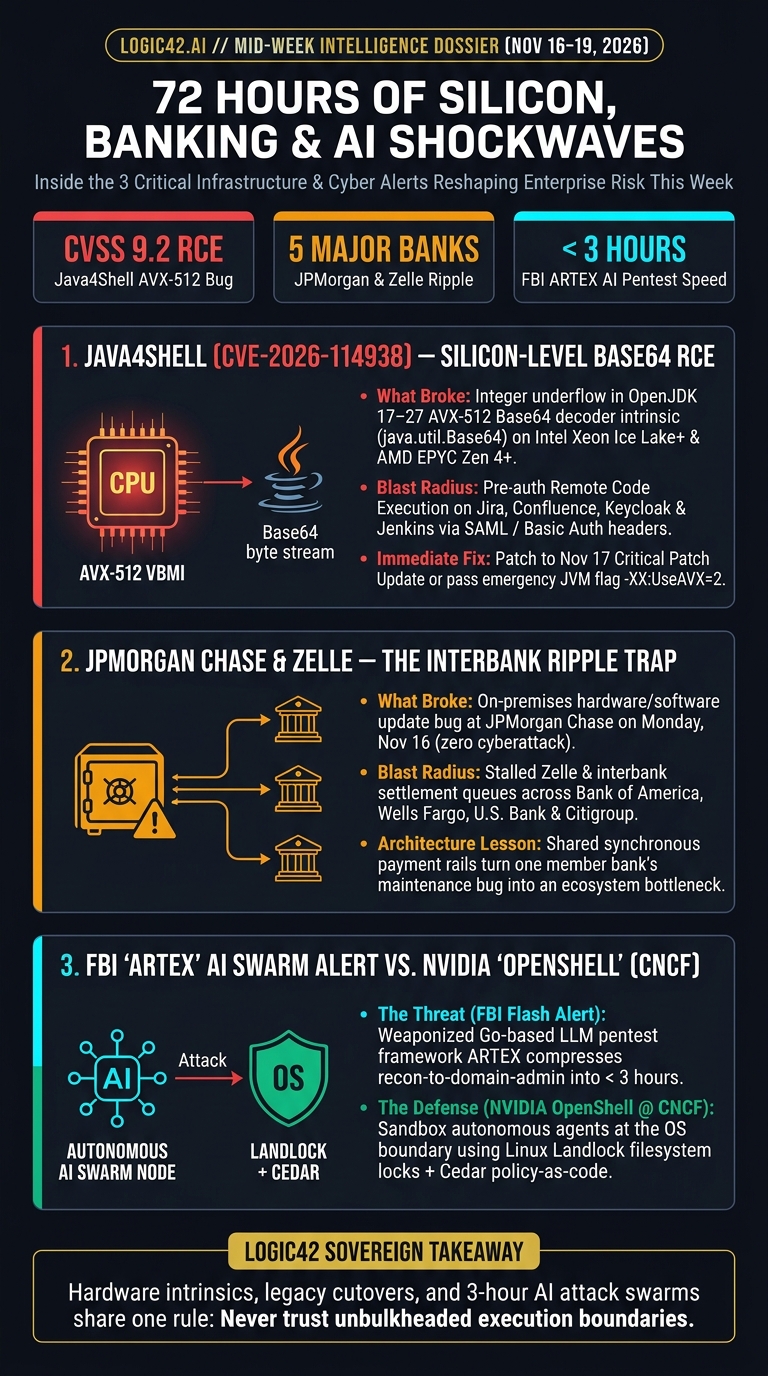
Specifically, between Nov 16 and Nov 19, JPMorgan Chase hit an on-premises software update bug, Oracle and OpenJDK disclosed Java4Shell (Common Vulnerabilities and Exposures CVE-2026-114938, scored 9.2 on Common Vulnerability Scoring System CVSS v4.0 for pre-authentication Remote Code Execution RCE on Advanced Vector Extensions 512 AVX-512 processors), and the Federal Bureau of Investigation (FBI) warned of weaponized ARTEX penetration-testing runs as NVIDIA donated its OpenShell agent sandbox to the Cloud Native Computing Foundation (CNCF).
What Happened Across Enterprise Infrastructure Between Nov 16 and Nov 19, 2026?
Between November 16 and November 19, 2026, three independent incidents disrupted enterprise security and banking: JPMorgan Chase suffered an on-premises update defect delaying Zelle transfers across five major banks, Oracle and OpenJDK disclosed the critical Java4Shell (CVE-2026-114938) AVX-512 vulnerability on Tuesday, and the FBI warned of autonomous ARTEX intrusion waves alongside NVIDIA donating OpenShell to the CNCF.
| Incident & Disclosure Date | Forensic Classification | Confirmed Blast Radius & Root Cause | Primary Immediate Fix |
|---|---|---|---|
JPMorgan Chase & Zelle Delays (Mon Nov 16) | Internal Bug (Zero Cyberattack) | On-premises hardware/software update delayed Chase core ledger posting, spilling payment stalls into Bank of America, Wells Fargo, U.S. Bank, and Citigroup. | Isolate partner clearing queues with per-partner async circuit breakers. |
Java4Shell (CVE-2026-114938 · Tue Nov 17) | Pre-Authentication RCE (CVSS v4.0: 9.2) | Integer underflow in OpenJDK 17.0.6+, 21, 25, and 27 hardware-accelerated Base64 decoder triggers heap corruption on modern AVX-512 CPUs. | Apply Oracle's Nov 17 Critical Patch Update or set -XX:UseAVX=2. |
FBI ARTEX Warning vs. NVIDIA OpenShell (Nov 16–19) | Autonomous Offense vs. Kernel Sandbox | Weaponized Go-based Large Language Model (LLM) penetration-testing framework ARTEX hits domain admin in under 3 hours; OpenShell cages agents at the Linux kernel. | Enforce Linux Landlock kernel filesystem locks and Cedar policy-as-code rules. |
How Does Java4Shell (CVE-2026-114938) Exploit AVX-512 Silicon?
Java4Shell (CVE-2026-114938, scored 9.2 on CVSS v4.0 and 8.1 on CVSS v3.1) is a pre-authentication RCE and heap overflow vulnerability inside the OpenJDK HotSpot Java Virtual Machine (JVM). It corrupts Java heap memory when the Just-In-Time (JIT) compiler processes malformed Base64 strings through its hardware-accelerated vector decoder (java.util.Base64.Decoder).
Unlike generic software bugs, Java4Shell depends on a narrow combination of modern silicon and modern runtimes:
-
The Silicon Requirement (
AVX-512 VBMI): The vulnerable assembly loop only activates on x86-64 servers supportingAVX-512Vector Byte Manipulation Instructions (AVX-512 VBMI), such as Intel Xeon Ice Lake+ and AMD EPYC Zen 4+ processors. Older processors withoutAVX-512 VBMIand ARM64 servers aren't affected. -
The Vulnerable Software Versions: OpenJDK, Oracle Java Standard Edition (
SE), GraalVM, Red Hat OpenJDK, Amazon Corretto, Eclipse Temurin, Microsoft Build of OpenJDK, Azul Zulu, and BellSoft Liberica versions17.0.6and later (including Java21,25, and27) ship the faulty intrinsic. Java8and Java11don't include this code path. -
The 65-Character Trigger & Pre-Authentication Surface: Because Security Assertion Markup Language (
SAML) identity assertions, Open Authorization (OAuth) tokens, and Hypertext Transfer Protocol (HTTP) Basic Authentication headers decode Base64 strings before verifying user credentials, an unauthenticated attacker sending a crafted 65-character string (64"A" characters plus a padding character) can trigger a heap over-read ("JavaBleed"), JVM crash, or fullRCEon Atlassian Jira, Confluence, Jenkins, and Keycloak. Public proofs of concept (PoCs), Cybersecurity and Infrastructure Security Agency (CISA) alerts, and Malaysia Computer Emergency Response Team (MyCERT) advisories were published alongside Oracle's November 17 patch release.
# 1. Inspect every running container/host for vulnerable OpenJDK 17.0.6+ / 21 / 25 / 27
java -version
lscpu | grep -E "avx512f|avx512bw|avx512vbmi|bmi2"

# 2. Emergency JVM mitigation if immediate Nov 17 Java Development Kit (JDK) patching lags (forces safe Advanced Vector Extensions 2 / AVX2 path)
export JAVA_TOOL_OPTIONS="${JAVA_TOOL_OPTIONS} -XX:UseAVX=2"
Why Did a JPMorgan Update Stall Zelle Transfers Across Five Banks?
On Monday, November 16, 2026, JPMorgan Chase experienced an on-premises hardware and software update defect that slowed internal transaction processing for several hours until stabilization that evening. Because Chase sits at the center of US interbank clearing and co-owns Early Warning Services, the operator of Zelle, transfers linking Bank of America, Wells Fargo, U.S. Bank, and Citigroup customers stalled simultaneously despite healthy core networks at Zelle and peer banks.
That failure mirrors the same architectural trap seen in Microsoft's EX1550543 identity cascade: synchronous upstream coupling. When Bank A holds checkout threads or synchronous payment confirmations open waiting for Bank B's ledger acknowledgments, Bank B's maintenance defect degrades Bank A's customer experience immediately. Decoupling partner payment legs behind bounded timeouts and asynchronous reconciliation queues prevents a single institution's upgrade bug from rippling nationwide.
How Can Defenders Stop Sub-3-Hour ARTEX Intrusions Using NVIDIA OpenShell?
FBI Flash advisories released this week confirmed that threat actors are deploying ARTEX—an open-source, Go-based autonomous penetration-testing framework powered by LLMs—to translate natural-language attack goals into terminal commands, compressing reconnaissance through privileged domain takeover to under three hours. Linked in advisories to automated compromises (including a ConnectWise Cloud Backup managed-service supply-chain campaign), ARTEX forces defenders to replace static prompt filters with kernel-enforced agent sandboxes like NVIDIA OpenShell.
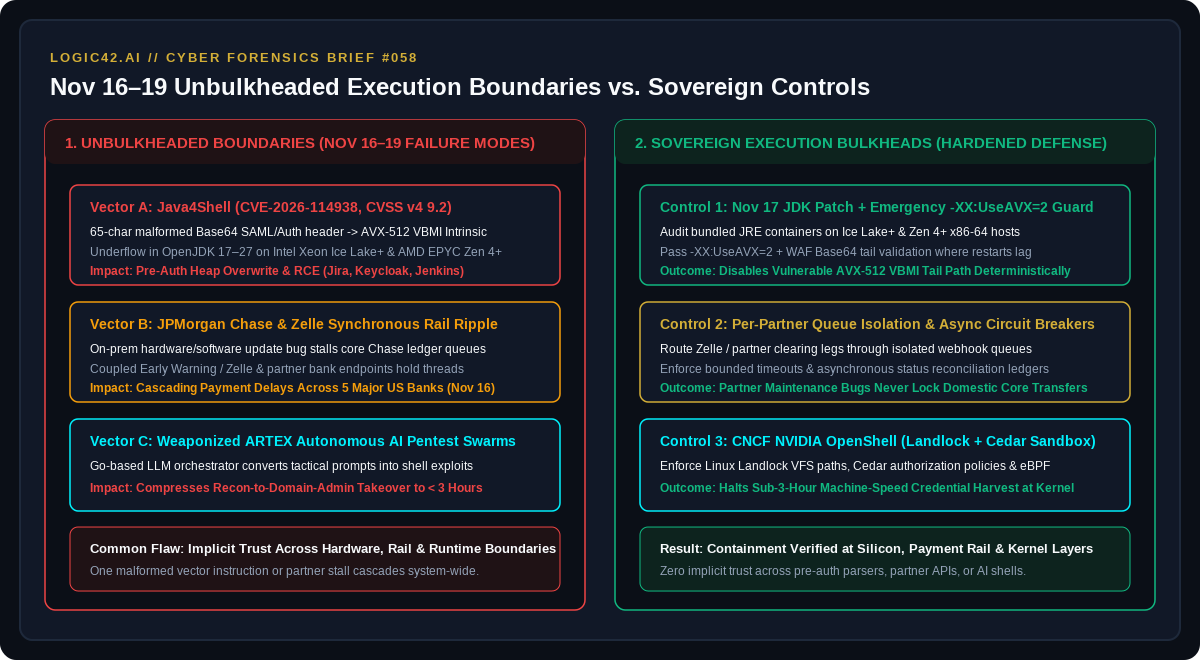
Donated to the CNCF at KubeCon in November 2026, NVIDIA OpenShell demonstrates where enterprise agent governance is heading. You can't rely on Web Application Firewalls (WAFs) or human ticket queues when an attacker's LLM loop pivots laterally in minutes, nor can you trust internal AI workers running unconstrained shells.
| Execution Boundary | Unisolated Enterprise Default | Sovereign Bulkhead Control (Post-Nov 19 Baseline) |
|---|---|---|
Processor Intrinsics & Bundled Java Runtime Environments (JREs) | Unpatched OpenJDK 17–27 containers running default AVX-512 intrinsics on Internet SAML and authentication gateways. | Deploy the Nov 17 Java security patches, audit hidden Java Archive (JAR) runtimes, and apply -XX:UseAVX=2 plus WAF Base64 tail filtering. |
Partner Settlement Rails (Chase / Zelle) | Synchronous payment Application Programming Interfaces (APIs) block user workflows whenever a clearing partner enters maintenance. | Per-partner webhook queues, bounded timeouts, and async ledger state machines preserve payment availability. |
AI Agent & Shell Governance (ARTEX / OpenShell) | AI coding and security agents execute raw bash commands with inherited host network and cloud credentials. | Enforce OpenShell Linux Landlock filesystem locks, network egress allowlists, and Cedar policy-as-code authorization rules. |
Execute four immediate checks across affected environments:
-
Inventory Bundled JVMs on Modern x86-64 Silicon: Scan container registries and Kubernetes DaemonSets for embedded Java
17.0.6+,21,25, and27binaries running onAVX-512 VBMIhosts (particularly Jira, Confluence, Jenkins, Keycloak, and Elasticsearch nodes). Apply Oracle's Nov 17 security update or enforce-XX:UseAVX=2viaJAVA_TOOL_OPTIONSimmediately. -
Reject Malformed Base64 Ingress at the Edge: Configure perimeter
WAFrules to drop malformed, oversized, or irregularly padded Base64 headers insideSAMLassertions,Authorization: Basic, and Bearer endpoints before traffic ever reaches an application worker thread. -
Add Per-Partner Circuit Breakers to Payment & Integration Queues: Audit third-party clearing rails, payment webhooks, and single sign-on (
SSO) identity dependencies so latency spikes or maintenance faults at one partner trip cleanly into retry queues without exhausting core application threads. -
Move Autonomous Agent Controls into Linux Kernel Space: Sandbox internal coding, operations, and red-team agents with Linux
Landlockpath constraints, Secure Computing Mode (seccomp) system-call filters, and explicitCedarauthorization policies outside model weights, and validate perimeter controls via an Enterprise AI Security & Adversarial Red-Team Audit.
Upgrading bank vault cameras won't help if a single unguarded loading-dock hinge breaks under pressure. Whether the fault starts inside an AVX-512 Base64 vector loop, an on-premises bank ledger update, or a three-hour autonomous ARTEX intrusion wave, resilient systems hold only when every execution boundary enforces its own independent bulkhead.
Enjoyed this autopsy? Get next Monday's architecture teardown + SVG blueprints in your inbox.
1 email every Monday morning. Zero marketing fluff — just real VRAM math, MCP security traps, and sovereign lakehouse patterns.
Further Reading
NGINX2Root (CVE-2026-123007) & vCenter (CVE-2026-123890): Patch Guide
F5 patched NGINX2Root HTTP/2 RCE flaws (CVE-2026-123007, CVE-2026-123633) as Broadcom patched active vCenter zero-day CVE-2026-123890 (exploited via BONESAW).
phpAfterShell (CVE-2026-126714): PHP 8.2–8.5 Session RCE Fix
Disclosed Nov 19 by depthfirst, phpAfterShell (CVE-2026-126714, CVSS 9.2) splices PHP file session writes into deserialization RCE on PHP 8.2–8.5.
Bleeding Llama (CVE-2026-7482): GGUF Memory Leak Defense
How the critical Bleeding Llama (CVE-2026-7482) heap over-read in Ollama's GGUF loader leaks live LLM prompts and API keys, and how to harden enclaves.
Inside the US FAA Ground Stop: How a TDM Router Flood Halted Flights
How an L3Harris TDM-to-fiber cutover router flooded the FAA FTI network with 1,000 connection requests every 5 seconds and grounded US aviation.
See HiveOS Enterprise & Bea (Business Execution Assistant) in Action
HiveOS connects to 5,000+ workplace apps with client-side PII redaction, 3-model consensus verification, and 80%+ local SLM cost savings. Watch the 30-second Executive Overview and 3-minute Walkthrough on gethiveos.com, or download the 6-slide Product Brochure.
Auditing Runtime & Agentic Containment?
If your engineering teams are deploying autonomous tool loops, MCP servers, or evaluation sandboxes, our cyber practice conducts confidential architectural reviews to expose link-local leakage, SSRF vectors, and credential harvesting paths.
Debugging this pattern in your own stack? Ask a Principal Architect directly or request a free 48-hour architecture sanity check: