NGINX2Root (CVE-2026-123007) & vCenter (CVE-2026-123890): Patch Guide
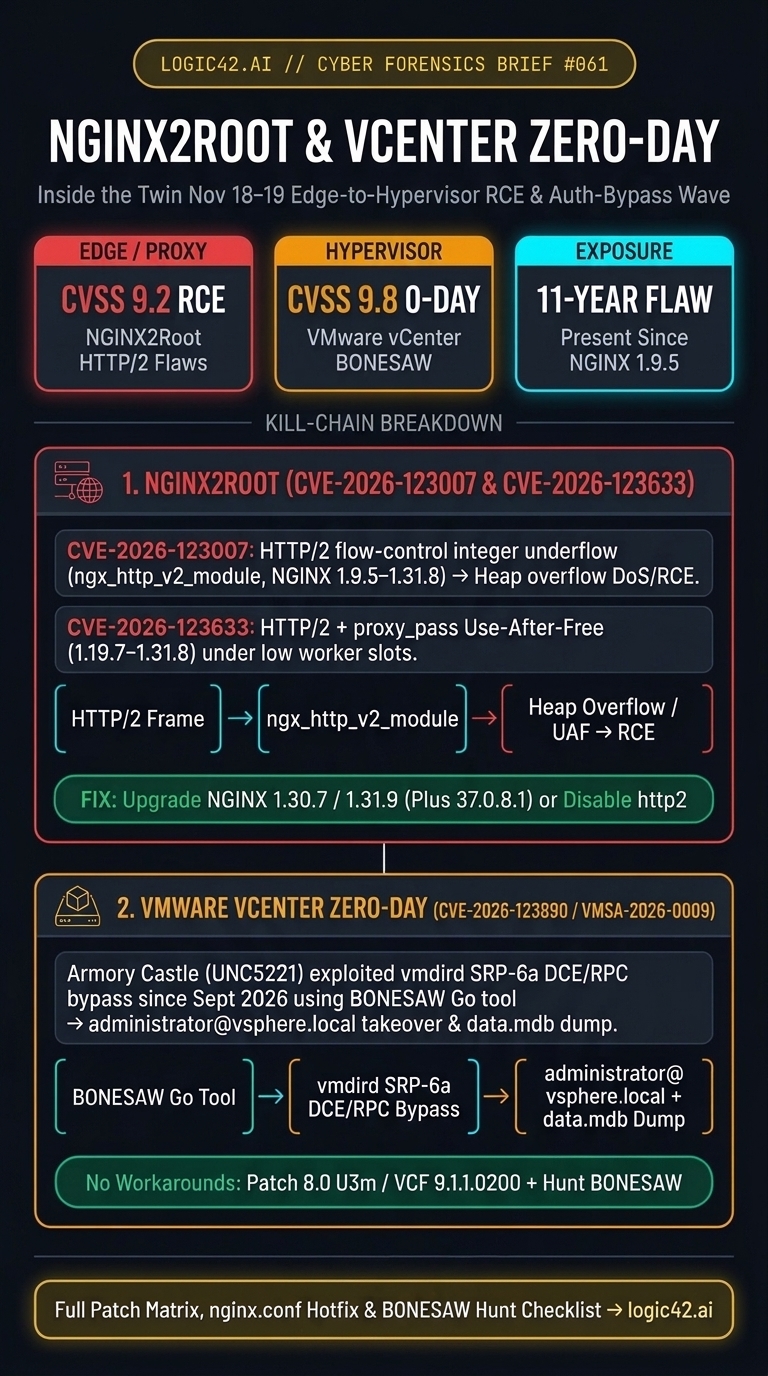
F5 patched NGINX2Root HTTP/2 RCE flaws (CVE-2026-123007, CVE-2026-123633) as Broadcom patched active vCenter zero-day CVE-2026-123890 (exploited via BONESAW).
Author: Logic42 Engineering
Consider a downtown skyscraper where the street-level revolving door unlatches under pressure while the basement elevator controller hands out penthouse master keys without checking a badge. Between November 18 and November 19, 2026, twin critical disclosures hit both infrastructure tiers at once.
F5 patched critical Hypertext Transfer Protocol Version 2 (HTTP/2) memory corruption flaws (Common Vulnerabilities and Exposures CVE-2026-123007 dating back 11 years and CVE-2026-123633, Common Vulnerability Scoring System (CVSS) v4.0 score 9.2) inside the "NGINX2Root" five-flaw bundle—which chains worker compromise with a Linux kernel Stream Control Transmission Protocol (SCTP) bug to reach host root—while Broadcom disclosed and patched an actively exploited VMware vCenter Server zero-day (CVE-2026-123890, CVSS v3.1 score 9.8) linked to China-nexus espionage tooling.
Patch velocity decides your exposure window here. Vendor updates alone won't eject intruders who already exploited vCenter before Broadcom published its advisory.
What Are the NGINX2Root (CVE-2026-123007 / CVE-2026-123633) and VMware vCenter (CVE-2026-123890) Advisories?
Disclosed on November 18 and November 19, 2026, these advisories affect your internet-facing NGINX reverse proxies running HTTP/2 and internal VMware vCenter management servers. Both NGINX flaws permit worker crashes (Denial of Service, or DoS) or Remote Code Execution (RCE), while the vCenter flaw, tracked in Broadcom's VMware Security Advisory (VMSA-2026-0009) under Common Weakness Enumeration (CWE-288), enables unauthenticated administrator@vsphere.local takeover via Secure Remote Password 6a (SRP-6a) session-key disclosure.
Review the verified scope across NGINX Open Source, NGINX Plus (R34–R37 release branches), VMware vCenter, and VMware Cloud Foundation (VCF), covering NGINX Use-After-Free (UAF) memory corruption and the custom BONESAW vCenter exploitation utility:
| Vulnerability Identifier & Release | Severity & Bug Class | Affected Software Branches | Fixed Target Builds & Interim Option |
|---|---|---|---|
CVE-2026-123007 (NGINX2Root · Nov 18) | CVSS v4.0 9.2 (v3.1: 8.1) · Integer Underflow / Heap Overflow | NGINX Open Source 1.9.5–1.30.6, 1.31.0–1.31.8; NGINX Plus 37.0.0–37.0.7.1, 37.1.0–37.2.0.1, R34–R36. | Upgrade to 1.30.7 (Stable), 1.31.9 (Mainline), or Plus 37.0.8.1 / 37.3.0.1 (plus R34–R36 fixes); interim option disables HTTP/2. |
CVE-2026-123633 (NGINX2Root · Nov 18) | CVSS v4.0 9.2 (v3.1: 8.1) · Proxy UAF Memory Corruption | NGINX Open Source 1.19.7–1.30.6, 1.31.0–1.31.8; NGINX Plus 37.0.0–37.0.6.1, R34–R36. | Upgrade to 1.30.7 / 1.31.9 or cumulative Plus 37.0.8.1 / 37.3.0.1 (CVE-2026-123633 fixed in 37.0.7.1 / 37.2.0.1); interim option disables HTTP/2. |
CVE-2026-123890 (VMSA-2026-0009 · Nov 19) | CVSS v3.1 9.8 (CWE-288) · Zero-Day Auth Bypass via SRP-6a | VMware vCenter 8.0, VCF 9.0.x / 9.1.x / 5.x, extended 7.0. | No workaround exists: upgrade to 8.0 U3m, VCF 9.1.1.0200 / 9.0.2.0200, or 5.2.5, then hunt BONESAW. |
How Do CVE-2026-123007 and CVE-2026-123633 Corrupt NGINX HTTP/2 Workers?
Both HTTP/2 flaws in the NGINX2Root disclosure corrupt memory inside ngx_http_v2_module on edge proxies and ingress controllers without authentication. CVE-2026-123007 triggers an integer underflow inside HTTP/2 flow-control windows, present since HTTP/2 shipped in NGINX 1.9.5 in 2015, while CVE-2026-123633 triggers a UAF bug when worker_connections slots run low on upstream proxy_pass routes.
Even though public proofs of concept (PoCs) already circulate, understanding their exploitation constraints helps infrastructure teams triage exposure accurately:
-
CVE-2026-123007Flow-Control Window Underflow: Crafted client streams push NGINX'sngx_http_v2_moduleflow-control window arithmetic past allowed boundaries. Unauthenticated callers reliably crash worker processes (DoS), whereas achieving arbitraryRCEtypically requires transmitting roughly 128 gigabytes (GB) across one sustainedHTTP/2stream and bypassing Address Space Layout Randomization (ASLR). -
CVE-2026-123633Proxy Connection Exhaustion (UAF): When an NGINX reverse proxy serves bothHTTP/2and upstreamproxy_passroutes under heavy connection slot pressure, NGINX can free memory structures for active upstream requests prematurely, corrupting worker heap pointers.
Disabling HTTP/2 over Secure Sockets Layer (SSL) and Transport Layer Security (TLS) mitigates both bugs immediately, except on frontends strictly serving gRPC Remote Procedure Calls (gRPC). For gRPC ingress tiers, patching binary packages directly to 1.30.7, 1.31.9, or NGINX Plus 37.0.8.1 / 37.3.0.1 isn't optional.
# Temporary nginx.conf hotfix (safe when backends don't require HTTP/2 or gRPC)
server {
    listen 443 ssl; # Omit the 'http2' parameter
    # http2 off;    # Uncomment for NGINX 1.25.1+ standalone directive setups
    server_name api.enterprise-enclave.internal;

    ssl_certificate /etc/ssl/certs/edge.pem;
    ssl_certificate_key /etc/ssl/private/edge.key;
}
# Validate syntax and reload config: sudo nginx -t && sudo systemctl reload nginx
Why Can't Patching Alone Resolve the VMware vCenter CVE-2026-123890 Zero-Day?
Broadcom's VMSA-2026-0009 advisory confirms that CVE-2026-123890 (CWE-288) stems from unauthenticated SRP-6a session key disclosure over Distributed Computing Environment / Remote Procedure Call (DCE/RPC) inside VMware Directory Service (vmdird). Patching alone won't remove backdoors planted before November 19.
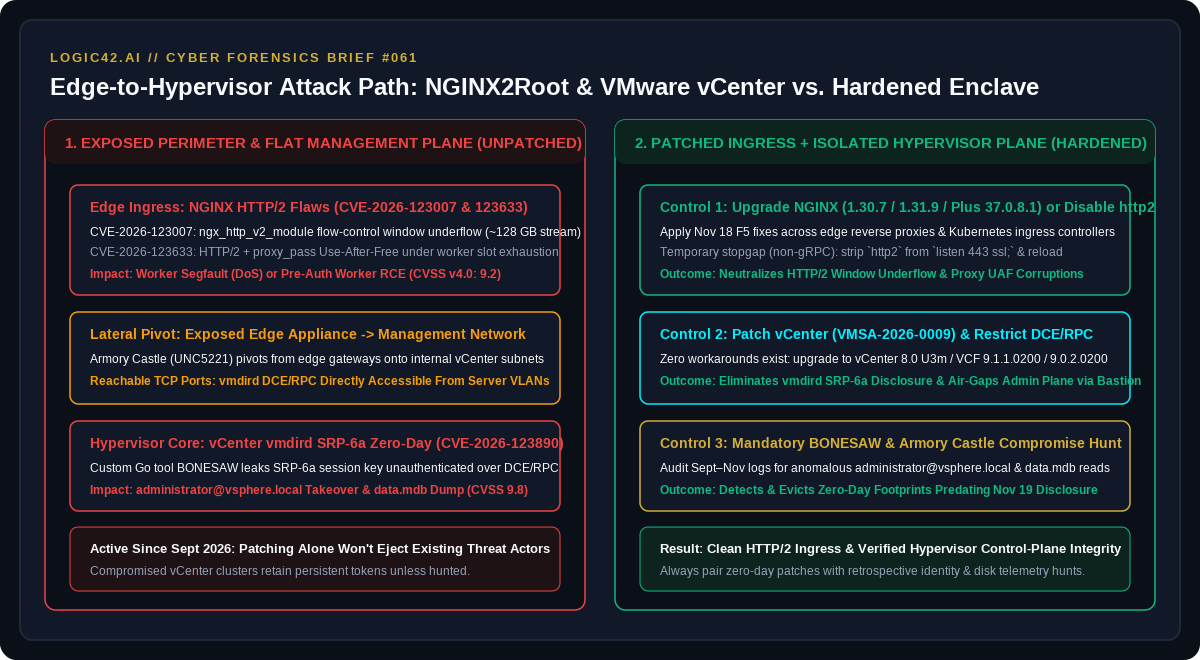
According to telemetry published by the Google Threat Intelligence Group (GTIG) and Mandiant, the China-nexus espionage actor Armory Castle (formerly tracked as UNC5221) pivoted from compromised edge appliances such as BeyondTrust Remote Support onto internal management networks. Using BONESAW, intruders leaked SRP-6a session keys directly from vmdird, forged administrator@vsphere.local sessions, and extracted the underlying data.mdb identity database.
Workarounds don't exist for vCenter CVE-2026-123890. Alongside upgrading open Java runtimes (Java4Shell) and PHP file session handlers (phpAfterShell), infrastructure teams must execute retrospective threat hunts across hypervisor logs.
How Should Infrastructure Teams Contain Edge-to-Hypervisor Exposure?
To close both exposure paths, platform teams must patch NGINX ingress tiers (1.30.7, 1.31.9, or NGINX Plus 37.0.8.1 / 37.3.0.1), alert on worker Signal Segmentation Violation (SIGSEGV) restarts, upgrade VMware vCenter Server Appliance (VCSA) hosts under VMSA-2026-0009, isolate DCE/RPC Transmission Control Protocol (TCP) port 2012 behind bastions, and audit Security Information and Event Management (SIEM) and Endpoint Detection and Response (EDR) telemetry for BONESAW.
| Control Domain | Emergency 24-Hour Action | Permanent Sovereign Hardening |
|---|---|---|
| Internet Edge & API Gateways | Audit NGINX binaries; patch to 1.30.7 / 1.31.9 (Plus 37.0.8.1 / 37.3.0.1) or disable http2 and reload. | Automate ingress container rebuilds, blacklist unused sctp kernel modules on hosts, and alert on worker SIGSEGV restarts. |
Hypervisor Control Plane (vCenter) | Upgrade to 8.0 U3m, VCF 9.1.1.0200 / 9.0.2.0200, or 5.2.5; contact support for extended 7.0. | Place vmdird and DCE/RPC endpoints behind out-of-band jump hosts unreachable from general server subnets. |
| Retrospective Compromise Hunt | Query SIEM and EDR logs from Sept–Nov. | Rotate all vSphere credentials and inspect data.mdb access events after confirming a clean cluster state. |
Execute four verification steps across your infrastructure before closing incident tickets:
-
Upgrade NGINX Open Source, NGINX Plus, and Kubernetes Ingress Images: Inventory every load balancer, sidecar proxy, and containerized ingress controller you operate running Open Source
1.9.5–1.30.6or1.31.0–1.31.8and affected NGINX PlusR34–R37builds. Roll out1.30.7,1.31.9, or the Nov 18 NGINX Plus releases with a full process restart (a config reload leaves the old binary in memory), or stripHTTP/2on non-gRPClisteners and block thesctpkernel module on container hosts until change windows open. -
Apply
VMSA-2026-0009Across Every vCenter Appliance: Confirm exact patch parity (8.0 U3m,VCF9.1.1.0200,9.0.2.0200, or5.2.5) across both your production and disaster-recovery virtualization clusters, since unpatched backup clusters expose the same virtual disk layer. -
Run a Targeted
BONESAW& Armory Castle Compromise Hunt: Review your authentication logs from September 2026 onward for anomalousadministrator@vsphere.localsessions, unexpected reads of/storage/db/vmware-vmdir/data.mdb, or lateral pivots originating from edge appliances. -
Isolate Management Interfaces From Production Workloads: Never allow internet-exposed reverse proxies or server subnets to route directly to hypervisor
DCE/RPCports (TCP2012), and validate segmentation hygiene against International Organization for Standardization / International Electrotechnical Commission (ISO/IEC) 27001 controls via the ISO/IEC 27001 Infrastructure Continuity Diagnostic.
A skyscraper can't stay secure when an unlatching revolving door opens onto an unguarded basement elevator controller still honoring unchecked master keys. Closing an 11-year-old HTTP/2 edge defect alongside an active vmdird hypervisor zero-day requires rapid binary patching, out-of-band management isolation, and historical telemetry hunts to revoke any keys forged before patches landed.
Enjoyed this autopsy? Get next Monday's architecture teardown + SVG blueprints in your inbox.
1 email every Monday morning. Zero marketing fluff — just real VRAM math, MCP security traps, and sovereign lakehouse patterns.
Further Reading
phpAfterShell (CVE-2026-126714): PHP 8.2–8.5 Session RCE Fix
Disclosed Nov 19 by depthfirst, phpAfterShell (CVE-2026-126714, CVSS 9.2) splices PHP file session writes into deserialization RCE on PHP 8.2–8.5.
Java4Shell (CVE-2026-114938), Chase/Zelle & FBI ARTEX: 72h Dossier
Forensic analysis of the Nov 16–19 incidents: OpenJDK AVX-512 Java4Shell RCE, JPMorgan Zelle delays, and FBI ARTEX vs. NVIDIA OpenShell.
Bleeding Llama (CVE-2026-7482): GGUF Memory Leak Defense
How the critical Bleeding Llama (CVE-2026-7482) heap over-read in Ollama's GGUF loader leaks live LLM prompts and API keys, and how to harden enclaves.
Inside the US FAA Ground Stop: How a TDM Router Flood Halted Flights
How an L3Harris TDM-to-fiber cutover router flooded the FAA FTI network with 1,000 connection requests every 5 seconds and grounded US aviation.
See HiveOS Enterprise & Bea (Business Execution Assistant) in Action
HiveOS connects to 5,000+ workplace apps with client-side PII redaction, 3-model consensus verification, and 80%+ local SLM cost savings. Watch the 30-second Executive Overview and 3-minute Walkthrough on gethiveos.com, or download the 6-slide Product Brochure.
Auditing Runtime & Agentic Containment?
If your engineering teams are deploying autonomous tool loops, MCP servers, or evaluation sandboxes, our cyber practice conducts confidential architectural reviews to expose link-local leakage, SSRF vectors, and credential harvesting paths.
Debugging this pattern in your own stack? Ask a Principal Architect directly or request a free 48-hour architecture sanity check: