Bare-Metal GPU Repatriation: HGX B300 & Cloud Inference TCO
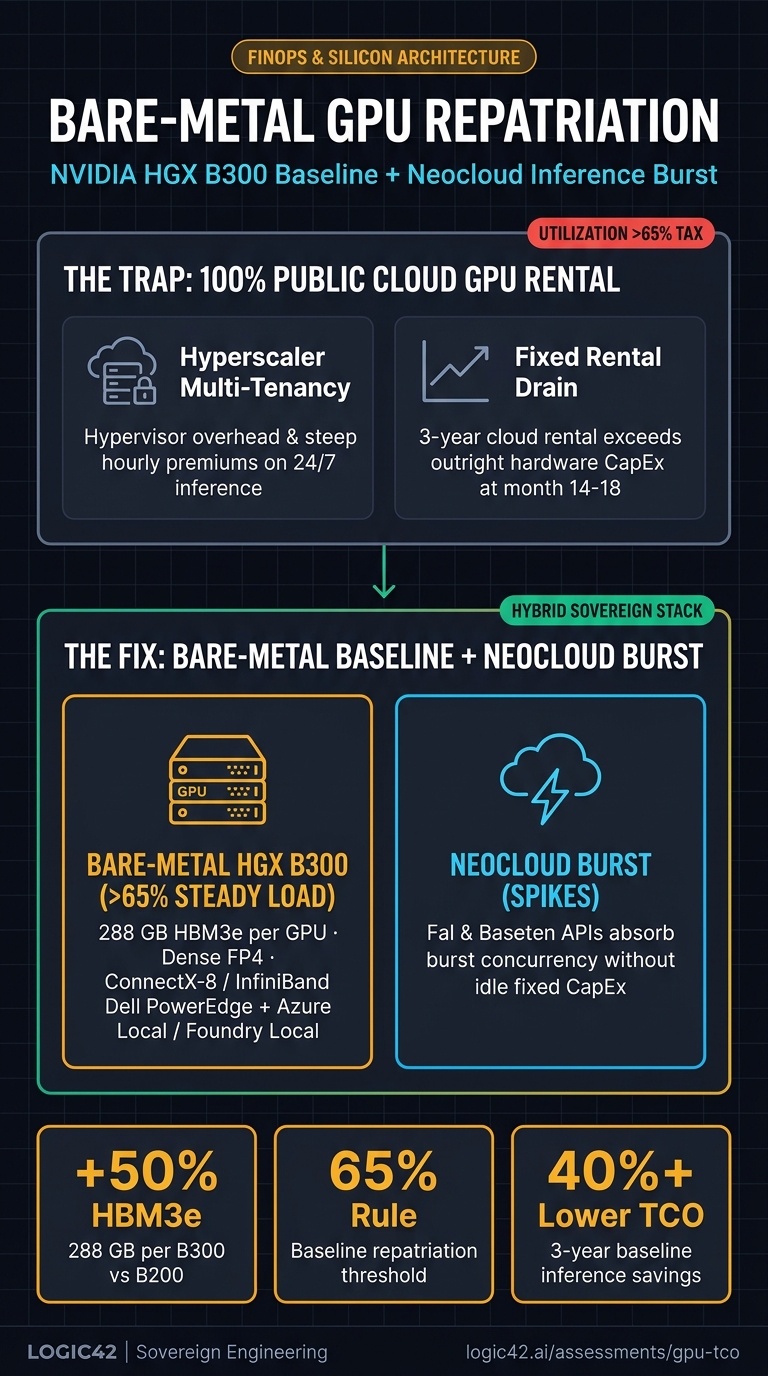
Pairing bare-metal NVIDIA HGX B300 (288 GB HBM3e) baseline clusters with Fal or Baseten burst cuts 24/7 AI inference TCO by 40%+ above 65% utilization.
Author: Logic42 Sovereign Engineering Practice
Imagine a delivery fleet paying steep daily spot rental rates for every van driving the same 24/7 urban route, instead of owning baseline vehicles and renting extra box trucks only during holiday peaks. Your production artificial intelligence (AI) inference stack hits that exact economic cliff past 65% utilization, where single-tenant NVIDIA 8-GPU HGX B300 (Blackwell Ultra) bare metal paired with per-second external inference clouds (neoclouds) replaces perpetual cloud rental burn.
Why Multi-Tenant Cloud Inference Fails Above 65% Utilization
In our earlier Colocation vs. Cloud GPU Repatriation Analysis, the break-even rule for dedicated hardware settled cleanly between 62% and 68% sustained cluster utilization. Renting hyperscaler GPUs works well for irregular prototyping, yet once continuous inference traffic locks in 24/7 concurrency, annualized cloud rental fees pass outright server capital expenditure (CapEx) by month 14 to 18, driving up 36-month total cost of ownership (TCO).
Hyperscaler virtualization also imposes runtime friction. Hypervisor scheduling jitter, noisy network neighbors, and cross-AZ or internet egress latency throttle memory-bound decoding loops while egress fees inflate operating expenses. Provisioning reserved cloud instances for worst-case midday peaks also leaves expensive memory sitting idle overnight, compounding what we call the VRAM Parking Tax.
Teams don't have to size dedicated racks for worst-case peaks. It's cheaper to spill sporadic surges onto elastic pools than let private silicon sit idle overnight.
What NVIDIA HGX B300 Changes for Long-Context Serving
NVIDIA's 8-GPU HGX B300 (Blackwell Ultra) platform targets inference unit economics by expanding memory capacity and bandwidth before raw FLOPS. Each B300 GPU packs 288 GB of High Bandwidth Memory 3e (HBM3e), a 50% capacity jump over B200, paired with dense 4-bit floating-point (FP4) tensor execution engineered for memory-bound reasoning and Mixture-of-Experts (MoE) weights.
Higher VRAM capacity per chip cuts tensor-parallelism splits across servers. Confining a 128K-token context window or large FP4 MoE checkpoint inside a single 8-GPU node reduces Inter-Process Communication (IPC) wait time. Locality cuts latency.
On single-tenant bare metal, engineers control every scheduling and fabric boundary directly:
- Direct Interconnects: Unvirtualized NVIDIA InfiniBand and ConnectX-8 network adapters provide deterministic tail latencies for distributed Key-Value (KV) cache transfers.
- Serving Runtime Control: Full host privileges let platform teams pin
vLLM(open-source LLM inference engine) PagedAttention blocks,TensorRT-LLM(NVIDIA's inference runtime) Compute Unified Device Architecture (CUDA) graphs, and Non-Uniform Memory Access (NUMA) memory affinity without noisy cloud tenants causing the stalls examined in The KV-Cache Thrashing Trap. - Private Enterprise Racks: Liquid-cooled NVIDIA MGX modular server racks and Dell PowerEdge platforms integrated with Microsoft Azure Local (Microsoft's hybrid on-premises control plane) and Foundry Local (Microsoft's local model-serving runtime) run HGX B300 inference directly alongside private data stores.
Comparing Full Cloud vs. Pure Neocloud vs. Hybrid Bare Metal
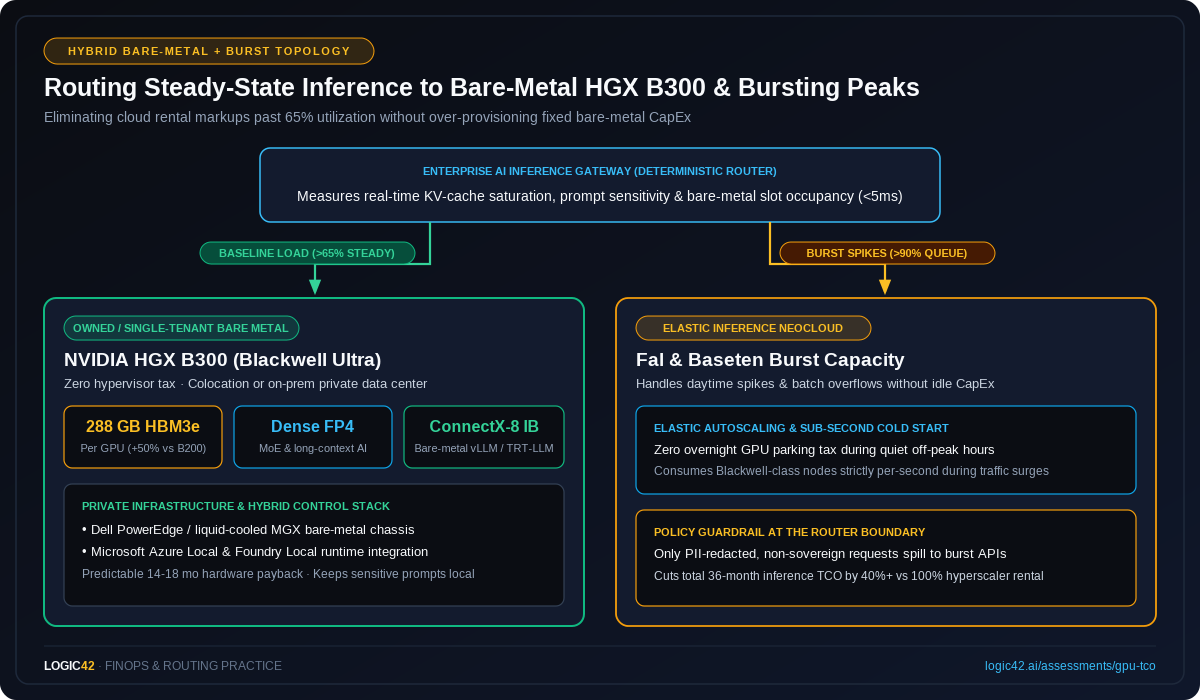
Pure bare metal has one costly trap: buying enough servers for Friday afternoon concurrency leaves GPUs empty all weekend. Specialized inference neoclouds such as Fal and Baseten close that gap by metering burst traffic per second over standardized APIs while your bare-metal cluster stays above 75% baseline occupancy.
| Operating Model | Baseline 36-Month TCO (>65% Load) | Burst Peak Elasticity | Security & Key Management Control | Primary Operational Pitfall |
|---|---|---|---|---|
| 100% Hyperscaler Cloud Rental | Highest spend (ongoing rental exceeds hardware past month 14–18 CapEx break-even) | Instant scaling via managed APIs | Hypervisor shared tenancy and cloud Key Management Service (KMS) reliance | Multi-tenant jitter and steep inference egress charges |
| 100% Inference Neocloud (Fal / Baseten) | Lower hourly rates than Tier-1 clouds with zero upfront CapEx | Sub-second autoscaling for sporadic traffic surges | Shared API endpoints unless contracted as dedicated single-tenant nodes | Rising variable bills when steady 24/7 base volume grows |
| Hybrid Bare-Metal HGX B300 + Burst | Lowest TCO (40%+ savings over 100% cloud via owned base + elastic burst) | Owned baseline handles steady load while queue spikes past 90% burst outward | Sovereign Dell PowerEdge / Azure Local enclave keeps sensitive weights local | Requires strict Personally Identifiable Information (PII) scrubbing before burst spill |
Utilization decides every dollar. Don't commit capital until telemetry proves your base traffic stays hot across weeknights and weekends.
Reproducible Python TCO Model: Baseline Repatriation vs. Burst
Use this reproducible Python 3 model with your actual colocation power, cloud hourly reservation, and neocloud burst quotes to verify 36-month TCO and CapEx payback before signing hardware leases:
from dataclasses import dataclass

@dataclass
class ClusterInputs:
    hours_36mo: int = 26_280                  # 3 years * 365 * 24
    base_node_equiv: int = 2                  # Steady baseline (8-GPU HGX node units)
    peak_extra_nodes: int = 1                 # Overflow load active 12% of hours
    peak_duty_cycle: float = 0.12
    # Illustrative 8-GPU Blackwell-class assumptions; replace with vendor quotes
    cloud_node_hr: float = 40.00              # Tier-1 hyperscaler ($5.00/GPU-hr * 8)
    bare_metal_capex_per_node: float = 400_000.0
    coloc_power_maint_mo: float = 4_200.0     # Power, liquid cooling & OEM support/mo
    neocloud_burst_hr: float = 30.00          # Normalized elastic burst ($3.75/GPU-hr * 8)

def compare_36mo_tco(cfg: ClusterInputs) -> dict[str, float]:
    cloud_only = (
        (cfg.base_node_equiv * cfg.hours_36mo * cfg.cloud_node_hr)
        + (cfg.peak_extra_nodes * cfg.hours_36mo * cfg.peak_duty_cycle * cfg.cloud_node_hr)
    )
    hybrid_bare_metal = (
        (cfg.base_node_equiv * cfg.bare_metal_capex_per_node)
        + (cfg.base_node_equiv * 36 * cfg.coloc_power_maint_mo)
        + (cfg.peak_extra_nodes * cfg.hours_36mo * cfg.peak_duty_cycle * cfg.neocloud_burst_hr)
    )
    savings_pct = ((cloud_only - hybrid_bare_metal) / cloud_only) * 100
    monthly_net_cloud_delta = (cfg.cloud_node_hr * 730) - cfg.coloc_power_maint_mo
    payback_months = cfg.bare_metal_capex_per_node / monthly_net_cloud_delta
    return {
        "cloud_only_tco_usd": round(cloud_only, 2),
        "hybrid_bare_metal_tco_usd": round(hybrid_bare_metal, 2),
        "savings_pct": round(savings_pct, 1),
        "baseline_payback_months": round(payback_months, 1),
    }

if __name__ == "__main__":
    # Outputs: savings_pct = 46.3%, baseline_payback_months = 16.0 months
    print(compare_36mo_tco(ClusterInputs()))
Idle silicon burns margin. Separating baseline throughput from peak_duty_cycle prevents buying a third 8-GPU bare-metal node that sits idle 88% of the month.
Four Rules to Execute a Safe Bare-Metal Repatriation
-
Size Your Cluster Against Floor Utilization, Not Peak: Audit 90 days of hourly inference concurrency and size bare-metal HGX purchases strictly around the 70th-percentile baseline floor while routing bursts past 90% queue utilization onto Fal or Baseten.
-
Enforce Zero-PII Spilling at the Deterministic Router: Configure your model gateway so regulated prompts never leave internal racks; only redacted or non-sovereign workloads overflow onto external neocloud APIs.
-
Standardize Serving Engines Across Tiers: Run matching
vLLMorTensorRT-LLMcontainer images and OpenTelemetry metrics across on-premises Azure Local / Foundry Local nodes and neocloud workers to stop latency regressions during failover. -
Model Exact MoE VRAM & 24-Month Payback First: Before issuing requests for proposals (RFPs), validate your quantized parameter weights, context budgets, and payback timeline inside the interactive Sovereign MoE Silicon X-Ray & Cloud GPU Repatriation Calculator.
When Should AI Teams Repatriate Inference From Cloud GPUs to Bare Metal?
Engineering teams hit clear financial repatriation payback once baseline inference and continuous fine-tuning sustain above 65% cluster utilization. Below that point, on-demand neoclouds avoid fixed hardware depreciation; above it, recurring cloud markups rapidly exceed owned bare-metal CapEx plus colocation operating costs.
Why Does NVIDIA HGX B300 Change Memory-Bound Inference Economics?
Autoregressive token decoding and long reasoning chains aren't limited by raw matrix math—they saturate memory capacity and bandwidth first. With 288 GB of HBM3e per GPU (50% more than B200) and dense FP4 execution, HGX B300 servers keep large MoE models across fewer interconnects, cutting cross-chip latency and lowering dollars per million tokens.
How Do Dell PowerEdge and Inference Neoclouds Fit Into One Hybrid Stack?
Organizations shouldn't choose purely between private hardware and elastic APIs. Running single-tenant Dell PowerEdge HGX B300 nodes under Azure Local or Foundry Local maximizes baseline utilization and local data custody for continuous 24/7 throughput, while external neoclouds absorb short daytime spikes without stranding fixed capital overnight.
Enjoyed this autopsy? Get next Monday's architecture teardown + SVG blueprints in your inbox.
1 email every Monday morning. Zero marketing fluff — just real VRAM math, MCP security traps, and sovereign lakehouse patterns.
Further Reading
The Cross-AZ & NAT Gateway AI Tax: Plugging the 30% Leak
How multi-AZ Kubernetes routing and Managed NAT Gateways silently add 30% to cloud GPU inference bills, and how zonal pinning eliminates it.
Disaggregated Prefill-Decode in vLLM: NixlConnector Guide
Decoupling vLLM V1 prefill and decode pools via NVIDIA NIXL (NixlConnector) and LMCache cuts p99 inter-token latency by 74% and boosts GPU goodput 2.4x.
GPU Spot Preemption FinOps: Zero-Loss Async Checkpointing
Synchronous S3 checkpoints take 4.5 minutes and fail inside 30-second Spot GPU eviction windows. Two-tier pinned RAM snapshots cut training costs by 68.4%.
LLM Fallback Retry Storms: Stopping 4x Token Spend Spikes
Nested SDK and AI gateway retries multiply 32K-token prompts by 9x during HTTP 429 rate limits. Single-owner retry budgets and prefill guards cap overhead at 1.04x.
See HiveOS Enterprise & Bea (Business Execution Assistant) in Action
HiveOS connects to 5,000+ workplace apps with client-side PII redaction, 3-model consensus verification, and 80%+ local SLM cost savings. Watch the 30-second Executive Overview and 3-minute Walkthrough on gethiveos.com, or download the 6-slide Product Brochure.
Eliminating GPU Waste & Token Burn?
We audit enterprise inference unit economics, engineer request-level OpenTelemetry pipelines, and eliminate the 60% idle capacity tax through dynamic model routing, VRAM virtualization, and private weight hosting.
Debugging this pattern in your own stack? Ask a Principal Architect directly or request a free 48-hour architecture sanity check: