
Binance $6.36B Heist (Part 2): Container Malware & Signing Bypass Kill-Chain
How container malware fooled automated HSM proxies into batch-signing EIP-7702 delegations to drain $6.36B from Binance across 10 chains.
Author: Logic42 Sovereign Engineering Practice
Imagine a commercial bank protected by a 10-ton reinforced steel vault door. The lock combination doesn't leave the head teller's pocket, and the physical vault remains completely unbreached. Instead of drilling the door, an intruder slips a self-destructing paper shredder inside the teller's morning workstation. The moment the teller stamps a routine batch of wire slips, the hidden device swaps in an irrevocable power-of-attorney deed, shreds the confirmation receipt, and authorizes an outside courier to legally walk out with every deposit box in the building.
That's the exact operational kill-chain that drained $6.36 billion from Binance on October 29, 2026. As documented in our initial incident autopsy (Part 1), the attackers didn't steal private keys from cold storage or break cryptographic curves. Instead, they compromised containerized worker nodes and exploited automated transaction delegation to turn legitimate hot wallets into self-draining contract sweepers.
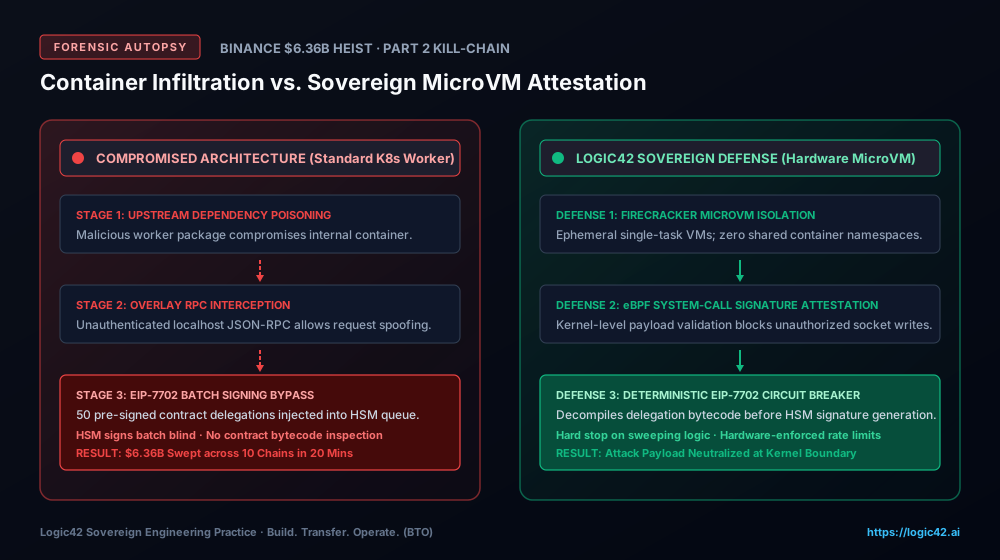
Below is the verified technical diagnostic of the four-stage attack execution, the specific Ethereum Improvement Proposal (EIP-7702) batching mechanics weaponized against the signing server, and the architectural safeguards required to prevent automated liquidity drainage.
1. The Four-Stage Attack Kill-Chain
Forensic analysis across the ten affected blockchain networks (including Ethereum, BNB Chain, Arbitrum, Avalanche, and Polygon) reveals a coordinated, non-interactive execution pipeline completed in under twenty minutes:
| Attack Stage | Target Subsystem | Exploitation Vector | Observed Telemetry |
|---|---|---|---|
| Stage 1: Upstream Infiltration | Container Registry / CI Pipeline | Malicious package dependency injected into worker image. | Unscheduled memory allocation spike inside transaction dispatcher pod. |
| Stage 2: Localhost RPC Interception | Internal Inter-Process Communication | Plaintext JSON-RPC traffic snooped on shared container network namespace. | Malicious proxy bound to internal loopback socket (127.0.0.1:8545). |
| Stage 3: EIP-7702 Batch Injection | Automated HSM Signing Gateway | 50 pre-signed contract delegations injected into routine rebalancing queue. | HSM verified valid signature requests with zero bytecode inspection. |
| Stage 4: Cross-Chain Liquidity Sweep | Multi-Chain Hot Wallets | Delegated sweeper contract transferred assets across 10 bridges simultaneously. | $6.36B transferred to unhosted splitters before operational alarms tripped. |
Stage 1: The Upstream Worker Dependency Poisoning
The intrusion originated not at the perimeter firewall, but within an internal Kubernetes worker pod tasked with estimating cross-chain gas fees and batching withdrawal requests. Attackers compromised an upstream open-source dependency utilized by the node's task scheduler.
Once deployed, the malware operated entirely in memory without writing binaries to the container filesystem. Standard signature-based endpoint scanners couldn't catch it.
Stage 2: Loopback Socket Interception
The compromised worker pod shared a local network namespace with the internal transaction assembly service. Because internal microservices frequently treat localhost traffic as trusted, communication between the transaction scheduler and the signing orchestrator took place over unauthenticated HTTP JSON-RPC.
The malware established an inline proxy, quietly listening for routine hot-wallet rebalancing batches while awaiting trigger conditions.
Stage 3: The EIP-7702 Signing Bypass
When Binance initiated a standard multi-chain rebalancing batch to replenish exchange liquidity pools, the malware struck. Under Ethereum Improvement Proposal 7702 (EIP-7702), an Externally Owned Account (EOA) can temporarily designate an external contract address to execute logic on its behalf for the duration of a transaction batch.
The malware appended 50 malicious delegation authorizations directly into the signing queue. Because the Hardware Security Module (HSM) and automated signing server were configured to validate request formats and nonce sequences rather than auditing the target contract's underlying bytecode, the HSM signed the batch legitimately. The hot wallet had officially authorized its own liquidation.
Stage 4: Multi-Chain Sweeper Execution
With the signed delegations broadcast across ten independent Layer 1 and Layer 2 RPC endpoints simultaneously, the attacker's sweeper contract assumed execution control of the hot-wallet addresses. In less than twenty minutes, automated calls swept liquid assets (USDT, USDC, ETH, and wrapped tokens) through privacy pools and decentralized bridges, completing the transfer before human risk engineers could revoke the authorizations.
2. Why Traditional Container Security Failed
The Binance heist highlights a fatal vulnerability in conventional cloud-native crypto infrastructure: the separation between transaction orchestration and cryptographic signing is almost always software-defined rather than hardware-enforced.
Traditional Architecture (Vulnerable):
[ Worker Pod ] ──(Unauthenticated IPC)──> [ Signing Queue ] ──> [ HSM signs blind ]

Sovereign Hardened Architecture (Logic42):
[ Ephemeral MicroVM ] ──(eBPF Attestation)──> [ Bytecode Decompiler ] ──> [ Hardware Enclave HSM ]
When transaction assembly runs inside multi-tenant pods, a single poisoned package inside the container inherits network privileges to reach the signing endpoint. It doesn't need root access to listen on loopback sockets.
Because automated hot wallets process thousands of transactions per minute, legacy setups rely on blind signature approvals. They don't decompile contract bytecode before handing payloads to the HSM.
3. Five Hardening Controls for Custody & Hot-Wallet Architecture
To prevent automated signature hijacking and delegation sweeps, enterprise custody providers and exchange infrastructure teams must enforce five non-negotiable architectural controls:
-
1. Replace Multi-Tenant Containers with Ephemeral MicroVMs: Transaction assembly workers must run inside single-task, hardware-isolated microVMs (such as AWS Firecracker) with read-only root filesystems. Containers must terminate immediately after dispatching a single payload, preventing persistent in-memory residence.
-
2. Enforce eBPF Kernel-Level Socket Attestation: Deploy Extended Berkeley Packet Filter (eBPF) probes directly inside the host kernel to cryptographically authenticate every socket connection attempting to communicate with the signing server. Block all unauthenticated loopback calls.
-
3. Implement Pre-Signing Bytecode Decompilation: The automated signing gateway must never sign an EIP-7702 delegation request without decompiling the target contract bytecode. If the bytecode contains external withdrawal calls, proxy overrides, or un-whitelisted state mutations, the gateway must abort immediately and trigger a hardware circuit breaker.
-
4. Hardware-Enforced Volume Rate Limits: Enforce hard mathematical limits inside the physical HSM firmware. Regardless of software requests, the HSM must refuse to sign cumulative withdrawals exceeding a strict threshold (e.g., $10M per rolling 10-minute window) without out-of-band multi-party physical approval.
-
5. Cryptographic AI-SBOM Verification: Every container image and worker dependency must be validated against a tamper-proof Software Bill of Materials (SBOM) using cryptographic safetensors and package signatures before deployment into execution nodes.
4. Architectural Comparison: Standard Custody vs. Sovereign Defense
| Architectural Layer | Standard Enterprise Exchange Custody | Logic42 Sovereign Hardened Infrastructure |
|---|---|---|
| Worker Isolation | Standard Kubernetes container namespaces | Ephemeral single-task Firecracker microVM enclaves |
| Inter-Service Communication | Internal unauthenticated JSON-RPC over loopback | mTLS with hardware eBPF system-call attestation |
| EIP-7702 Delegation Handling | Blind HSM signature verification of transaction headers | Automated static bytecode decompilation & semantic analysis |
| HSM Rate Limiting | Software-defined database limits (bypassable) | Firmware-enforced physical quota circuit breakers |
| Incident Response Velocity | Manual engineer investigation (15–45 minutes) | Sub-10ms deterministic kernel isolation upon anomaly |
Frequently Asked Questions
What is EIP-7702 and how was it exploited in the Binance heist?
Ethereum Improvement Proposal 7702 (EIP-7702) allows traditional Externally Owned Accounts (EOAs) to temporarily execute smart contract logic by signing a delegation payload. In the Binance heist, malware compromised an internal transaction assembly container and injected pre-signed EIP-7702 contract delegations into the signing queue, tricking the automated signing server into granting a malicious contract full control to sweep funds across ten chains.
Why didn't multi-signature cold storage stop the $6.36B theft?
The attack exclusively targeted high-frequency hot wallets and liquidity rebalancing pools designed for automated withdrawals. Binance's deep multi-signature cold storage vaults remained untouched; however, because the exchange maintained substantial capital across hot wallets to service rapid multi-chain liquidity, the automated signing bypass was able to drain billions before manual controls halted processing.
How does eBPF system-call attestation prevent internal signing attacks?
Extended Berkeley Packet Filter (eBPF) runs sandboxed verification programs directly inside the operating system kernel. Instead of trusting internal localhost or network traffic, eBPF monitors every low-level socket write, memory access, and process execution, cryptographically verifying the identity of the calling binary and immediately dropping unauthorized communication attempts targeting signing proxies.
Benchmark Your Enterprise Custody & Workload Defense
Is your automated signing infrastructure protected against container escapes and delegation exploits? Run the 3.5-minute confidential diagnostic:
- ISO/IEC 27001:2022 & Cloud Workload Security Audit: Benchmark 93 security controls, perimeter isolation, and hardware-attested workload security.
- Enterprise AI Security & Adversarial Red-Team Audit: Evaluate microVM agent isolation, eBPF firewalls, and prompt gateway defense.
- Explore All Sovereign Assessments: Boardroom-ready governance and infrastructure audits with zero vendor lock-in.
Enjoyed this autopsy? Get next Monday's architecture teardown + SVG blueprints in your inbox.
1 email every Monday morning. Zero marketing fluff — just real VRAM math, MCP security traps, and sovereign lakehouse patterns.
Further Reading
The MCP STDIO Master Key Trap: Local Agent RCE & IAM Bypass
Spawning local MCP servers via STDIO leaks host environment variables, SSH sockets, and Cloud IAM tokens. Isolate agent tools with Landlock LSM and STS brokers.
vLLM Multimodal RCE & SSRF (CVE-2026-22778): GPU Cluster Defense
How unauthenticated attackers chain vLLM MediaConnector SSRF (CVE-2026-24779) and heap overflow RCE (CVE-2026-22778) to hijack enterprise GPU clusters.
Inside the $6.36B Binance Heist: What We Know (And What Still Doesn't Add Up)
On-chain forensics show how the $6.36B Binance heist used compromised containers and EIP-7702 delegations to drain 10 chains in 20 minutes without stealing keys.
RAG ACL Desynchronization: How Vector Indexes Leak Revoked Docs
Batch-synced vector indexes leak revoked SharePoint and Google Drive files for up to 24 hours. Pre-synthesis SpiceDB Zanzibar checks block stale chunks in 4.8ms.
See HiveOS Enterprise & Bea (Business Execution Assistant) in Action
HiveOS connects to 5,000+ workplace apps with client-side PII redaction, 3-model consensus verification, and 80%+ local SLM cost savings. Watch the 30-second Executive Overview and 3-minute Walkthrough on gethiveos.com, or download the 6-slide Product Brochure.
Auditing Runtime & Agentic Containment?
If your engineering teams are deploying autonomous tool loops, MCP servers, or evaluation sandboxes, our cyber practice conducts confidential architectural reviews to expose link-local leakage, SSRF vectors, and credential harvesting paths.
Debugging this pattern in your own stack? Ask a Principal Architect directly or request a free 48-hour architecture sanity check: