
Inside the $6.36B Binance Heist: What We Know (And What Still Doesn't Add Up)
On-chain forensics show how the $6.36B Binance heist used compromised containers and EIP-7702 delegations to drain 10 chains in 20 minutes without stealing keys.
Author: Logic42 Sovereign Engineering Practice
On October 29, 2026, state-sponsored hackers drained $6.36 billion from Binance across 10 blockchains in 20 minutes—the largest digital bank heist in history—without stealing a single private key. Instead of cracking wallet encryption, the attackers compromised internal service containers and pushed 50 pre-signed EIP-7702 delegations in one transaction, tricking the signing server into handing full control of the hot wallet to an automated sweeper contract.
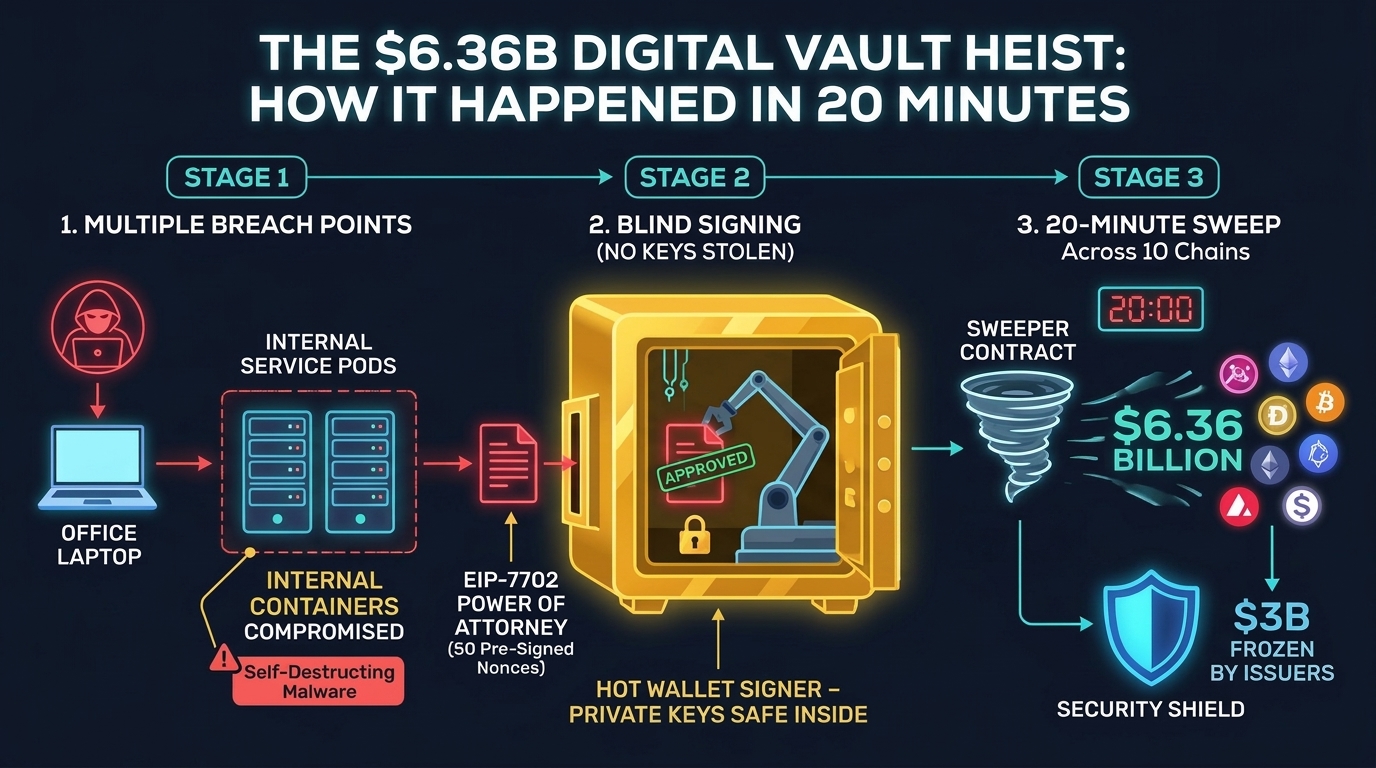
How Do You Empty an Unbreakable Vault Without Stealing the Key?
Imagine a bank builds an unbreakable steel vault. Nobody can drill through the door, and the secret stamp inside never leaves the room.
So how do thieves empty the vault in 20 minutes? They don't attack the vault door. Instead, they compromise the internal messenger clerk who slips paperwork through the slot, and they trick that clerk into sliding a Power of Attorney form under the stamp. Once the machine inside blindly stamps "APPROVED," the thieves control the account.
That's what just happened in the $6.36 billion Binance hot-wallet breach, attributed by the FBI, TRM Labs, and Chainalysis to North Korea's TraderTraitor unit:
- Zero Private Keys Were Stolen: The cryptography protecting the wallet keys wasn't broken. Every stolen dollar moved using genuine signatures generated by Binance's own hot-wallet signers.
- The Messenger Was Hijacked: Attackers infiltrated internal service containers that tell the signing server what to approve. Because the request came from an "already trusted" internal container, the signing server stamped it blindly.
- The
EIP-7702"Power of Attorney" Trick: On Ethereum (Hot Wallet 14), the attackers didn't submit thousands of slow withdrawal requests that fraud alarms would block. They used EIP-7702, queuing 50 pre-signed delegations across sequential nonces and firing them in 1 single transaction. That single stamp handed temporary "Power of Attorney" over the wallet to an automated Sweeper Contract, vacuuming funds across 10 blockchains at $5.3 million per second before human teams could pull the plug.
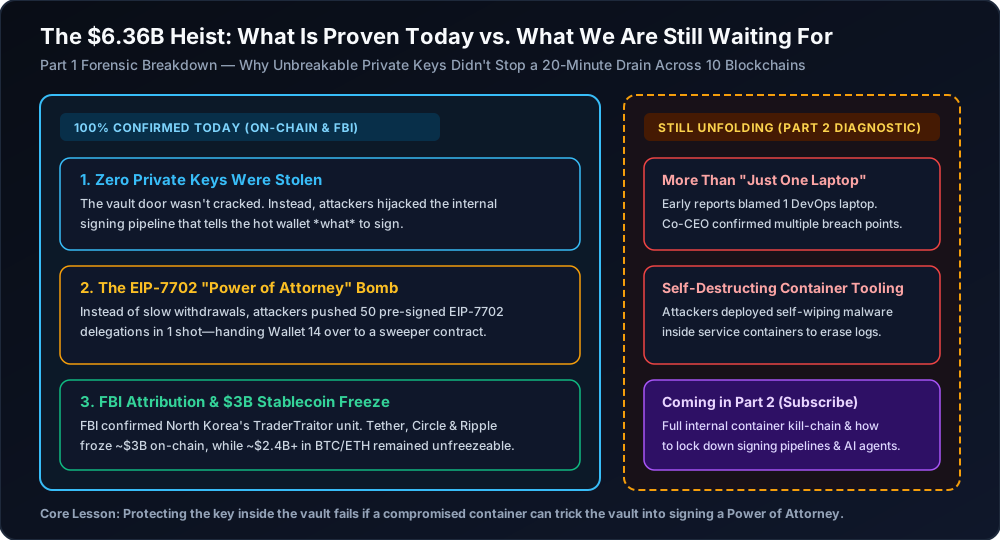
What Is Proven Today vs. What Still Doesn't Add Up
Right now, social media is repeating an early rumor that "one hacked DevOps laptop caused a $6.36B loss." To understand what actually failed, we have to separate what's 100% proven on the public blockchain today from what's still unfolding inside the investigation:
| Forensic Question | Status Today | What the Evidence Shows |
|---|---|---|
| 1. Scale & Speed | 100% Proven (On-Chain) | $6.36B drained across 10 blockchains (ETH, BTC, SOL, TRX, XRP, Arbitrum) in 20 minutes. |
| 2. Were Private Keys Stolen? | 100% Proven (Confirmed) | 0 keys leaked. Attackers hijacked the internal signing pipeline to generate valid signatures. |
| 3. How Was Ethereum Emptied? | 100% Proven (On-Chain) | 50 pre-signed EIP-7702 delegations fired in 1 transaction to an automated sweeper contract. |
| 4. How Much Was Recovered? | 100% Proven (On-Chain) | ~$3.0B frozen by Tether, Circle, and Ripple; ~$2.4B+ in BTC/ETH cannot be frozen by issuers. |
| 5. Was It Just One Laptop? | Still Unfolding (Part 2) | Early reports blamed 1 DevOps laptop, but Co-CEO Richard Teng confirmed multiple breach points. |
| 6. Why Is the Investigation Taking Time? | Still Unfolding (Part 2) | Attackers deployed self-destructing malware inside service pods to wipe logs during the drain. |
Three Wake-Up Calls for Every Tech & Security Leader
You don't need to run a crypto bank to get hit by this exact blind spot. Every company connecting internal microservices, cloud containers, or AI agents to high-stakes systems (payment gateways, cloud treasuries, production databases) faces the same trap:
- Never Let Your Vault "Sign Blind" Just Because a Request Is Internal: Most companies spend 99% of their security budget locking up the secret key and assume any command coming from an internal server container is safe. If your signing server only checks who sent the request instead of what the request actually does, one compromised container can empty the building.
- Block "Power of Attorney" Commands Automatically: A routine automated server should only ever be allowed to approve routine, capped transfers—never an account-wide delegation (
EIP-7702) or permission change without human hardware sign-off. - Stream Security Logs Outside the Container Instantly: Because the attackers used self-destructing malware that erased container footprints as the 20-minute heist unfolded, investigators had to reconstruct the breach from external traces. If your logs live inside the same container that gets hacked, the attacker will delete the evidence on the way out.
Coming Next in Part 2: The Full Internal Breach Diagnostic
Forensic investigators are currently reconstructing how TraderTraitor chained multiple internal breach points to reach the isolated signing containers, and how their self-destructing malware bypassed internal alerts.
Don't miss Part 2: As soon as the full internal post-mortem is released, we will publish Part 2 — The Complete Internal Kill-Chain & Defense Blueprint. Subscribe to the Logic42 Engineering Brief on Substack or follow the Logic42 LinkedIn Page so Part 2 lands directly in your inbox the moment it drops.
Enjoyed this autopsy? Get next Monday's architecture teardown + SVG blueprints in your inbox.
1 email every Monday morning. Zero marketing fluff — just real VRAM math, MCP security traps, and sovereign lakehouse patterns.
Further Reading
The MCP STDIO Master Key Trap: Local Agent RCE & IAM Bypass
Spawning local MCP servers via STDIO leaks host environment variables, SSH sockets, and Cloud IAM tokens. Isolate agent tools with Landlock LSM and STS brokers.
vLLM Multimodal RCE & SSRF (CVE-2026-22778): GPU Cluster Defense
How unauthenticated attackers chain vLLM MediaConnector SSRF (CVE-2026-24779) and heap overflow RCE (CVE-2026-22778) to hijack enterprise GPU clusters.
Binance $6.36B Heist (Part 2): Container Malware & Signing Bypass Kill-Chain
How container malware fooled automated HSM proxies into batch-signing EIP-7702 delegations to drain $6.36B from Binance across 10 chains.
RAG ACL Desynchronization: How Vector Indexes Leak Revoked Docs
Batch-synced vector indexes leak revoked SharePoint and Google Drive files for up to 24 hours. Pre-synthesis SpiceDB Zanzibar checks block stale chunks in 4.8ms.
See HiveOS Enterprise & Bea (Business Execution Assistant) in Action
HiveOS connects to 5,000+ workplace apps with client-side PII redaction, 3-model consensus verification, and 80%+ local SLM cost savings. Watch the 30-second Executive Overview and 3-minute Walkthrough on gethiveos.com, or download the 6-slide Product Brochure.
Auditing Runtime & Agentic Containment?
If your engineering teams are deploying autonomous tool loops, MCP servers, or evaluation sandboxes, our cyber practice conducts confidential architectural reviews to expose link-local leakage, SSRF vectors, and credential harvesting paths.
Debugging this pattern in your own stack? Ask a Principal Architect directly or request a free 48-hour architecture sanity check: