vLLM Multimodal RCE & SSRF (CVE-2026-22778): GPU Cluster Defense
How unauthenticated attackers chain vLLM MediaConnector SSRF (CVE-2026-24779) and heap overflow RCE (CVE-2026-22778) to hijack enterprise GPU clusters.
Author: Logic42 Sovereign Engineering Practice
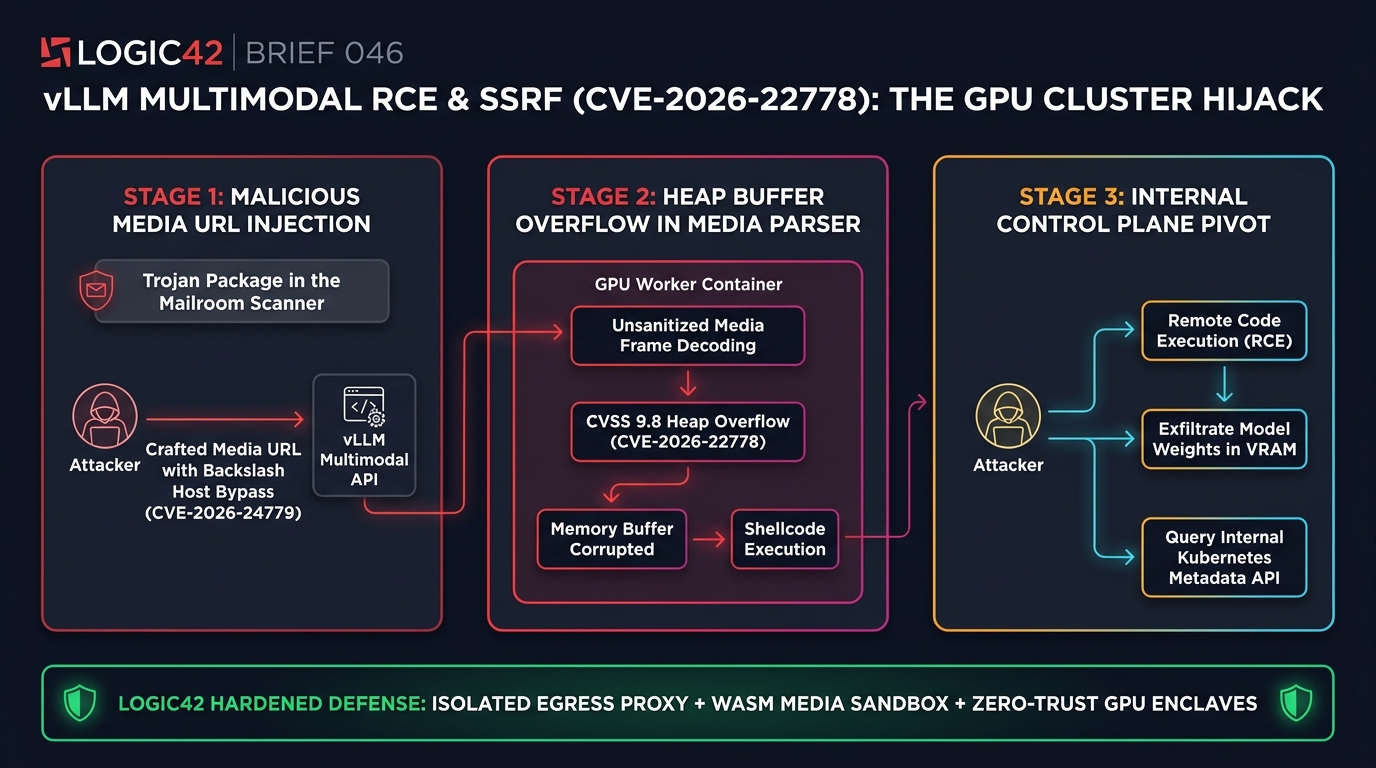
Imagine a high-security bank mailroom where an automated X-ray scanner inspects incoming parcels before they reach the executive floor. Instead of mailing a box, an attacker prints a barcoded label that tricks the scanner into fetching a rigged crate from the bank's internal loading dock, detonating inside the mailroom computer. That's the exact kill-chain behind CVE-2026-24779 and CVE-2026-22778, a critical (CVSS 9.8) vulnerability pair in vLLM that turns a crafted media URL into Remote Code Execution (RCE) on enterprise GPU clusters.
Why Multimodal Inference Pods Are High-Value Targets
When enterprise engineering teams deploy Vision-Language Models (VLMs) like Qwen2.5-VL, Pixtral, or Llama-3.2-Vision on self-hosted vLLM clusters, they typically focus security controls on prompt injection filters and API gateway bearer tokens. They don't audit what happens before the vision encoder runs, assuming standard media libraries can't compromise GPU hardware.
To support the OpenAI-compatible /v1/chat/completions multimodal specification, vLLM includes a built-in MediaConnector subsystem. Whenever a user or upstream agent submits a JSON payload containing an image_url or video_url field, the vLLM worker process fetches that remote file over HTTP, parses the binary container header (JPEG, PNG, WebP, MP4, or MKV), decodes the compressed frames in C++ memory, and copies the resulting pixel tensors directly into GPU High-Bandwidth Memory (HBM).
Because this media ingestion pipeline runs inside the same privileged container process that holds your model weights, Kubernetes service account credentials, and NVIDIA NCCL communication sockets, any memory corruption bug in the media parser immediately hands the attacker root-equivalent control over the GPU node.
Forensic Anatomy of the Two-Stage Exploit Chain
Security disclosures across the vLLM multimodal stack exposed how attackers chain URL-parsing discrepancies with native decoder buffer overflows to compromise inference nodes without authentication:
| Kill-Chain Stage | Vulnerability ID & Severity | Affected Component | Exploit Mechanism | Operational Impact on GPU Cluster |
|---|---|---|---|---|
| Stage 1: Host Allowlist Bypass & SSRF | CVE-2026-24779 (High / CVSS 8.6) | vllm.multimodal.media (MediaConnector) | Discrepancy between Python urllib.parse and urllib3 normalization of backslash (\) characters in URL authority segments (https://trusted.domain\@169.254.169.254/). | Bypasses --allowed-media-domains to scan internal Kubernetes services, cloud Instance Metadata Services (IMDS), or pull payloads from internal staging hosts. |
| Stage 2: Information Leak & Heap Overflow | CVE-2026-22778 (Critical / CVSS 9.8) | Multimodal video/image frame decoding pipeline | Malformed video stream dimensions and crafted chunk headers trigger an out-of-bounds heap write during frame buffer allocation before tensor conversion. | Overwrites adjacent heap structures inside the vLLM worker process, leaking ASLR memory offsets in error traces and executing arbitrary shellcode. |
| Stage 3: Template Thread Exhaustion | Jinja2 Multimodal DoS (High / CVSS 7.5) | Chat template renderer (apply_chat_template) | Deeply nested multimodal content arrays force quadratic string allocation inside synchronous tokenizer worker threads. | Locks the main asyncio event loop, causing cluster-wide Out-Of-Memory (OOM) crashes and health-check evictions. |

What Happens After an Attacker Lands Inside a GPU Worker Pod
Unlike a stateless web server compromise, an RCE inside a live GPU inference container gives an adversary simultaneous access to three crown-jewel assets that standard perimeter firewalls won't catch:
-
Live Customer Prompts and RAG Context in VRAM: By attaching to the local CUDA context or reading
/dev/nvidia*device memory, the attacker can dump active Key-Value (KV) caches containing unredacted financial records, legal contracts, and source code from every concurrent tenant on the node. -
Proprietary Fine-Tuned Model Weights: If your organization mounts decrypted LoRA adapters or full fine-tuned checkpoints from a shared POSIX filesystem (such as AWS FSx for Lustre or WEKA), the compromised pod can exfiltrate gigabytes of proprietary weights over outbound HTTPS.
-
Lateral Pivot via InfiniBand / RoCEv2 Fabrics: Multi-node inference clusters running Tensor Parallelism (
TP=8) or Pipeline Parallelism (PP=2) often expose unauthenticatedtorch.distributedTCPStore or Ray dashboard ports across the high-speed compute VLAN, allowing a single compromised pod to execute arbitrary Python pickles across every GPU server in the rack.
Five Hardened Engineering Controls for Production vLLM Clusters
Upgrading vLLM to the patched release (v0.18.1+) closes the immediate CVE signatures, but architectural defense requires stripping binary media fetching and parsing out of the GPU worker entirely:
-
1. Disable Direct Remote URL Fetching in vLLM: Never allow GPU inference pods to initiate outbound HTTP requests to arbitrary URLs. Launch vLLM with remote media fetching disabled and require upstream API gateways to pass only validated, pre-transcoded
data:image/jpeg;base64,...payloads or internal content-addressed blob IDs. -
2. Transcode All Media in an Isolated Wasm / gVisor CPU DMZ: Before any image or video reaches your inference tier, route it through a stateless, network-jailed CPU microservice running inside a gVisor (
runsc) or WebAssembly (Wasm) sandbox. Decode the untrusted binary, strip all EXIF/container metadata, validate dimensions (<= 2048x2048), and re-encode into a clean flat tensor or canonical bitmap. -
3. Enforce Default-Deny Egress with Cilium NetworkPolicies: Apply a strict Kubernetes
CiliumNetworkPolicyon all GPU worker namespaces that drops 100% of outbound internet traffic (0.0.0.0/0), blocks access to the cloud metadata IP (169.254.169.254/32), and restricts pod-to-pod traffic strictly to authenticated NCCL/RDMA peers. -
4. Strip Ambient Kubernetes Credentials & Mount Read-Only Filesystems: Set
automountServiceAccountToken: falseandreadOnlyRootFilesystem: trueon every vLLM Deployment spec so an attacker who achieves memory corruption cannot write binaries to disk or query the Kubernetes API server. -
5. Audit Your Inference Perimeter Against Sovereign Controls: Benchmark your cluster isolation against our AI Security & Workload Vulnerability Diagnostic and review our companion guide on AI Sandbox Escapes and MicroVM Containment.
How Does CVE-2026-24779 Bypass vLLM Domain Allowlists?
CVE-2026-24779 exploits a parser differential between how URL validation checks and underlying HTTP client libraries interpret backslashes (\) versus forward slashes (/) in URL authority strings. When an attacker submits https://trusted-cdn.com\@internal-service:8080/payload, the allowlist validator reads trusted-cdn.com as the host, while the HTTP client normalizes the backslash and routes the request to internal-service:8080, triggering Server-Side Request Forgery (SSRF).
Why Does CVE-2026-22778 Lead to Full GPU Cluster Compromise?
In standard vLLM deployments, multimodal image and video decoding executes inside the same OS process space that manages CUDA contexts and model weights. When CVE-2026-22778 overflows the heap buffer during media decoding, the attacker gains arbitrary code execution with full access to GPU VRAM, mounted model storage volumes, and inter-node distributed communication sockets.
Should Enterprise AI Gateways Allow Direct image_url Links?
No. Allowing end users to pass external URLs directly to GPU inference engines turns your cluster into an open proxy and exposes high-cost GPU nodes to parser exploits. Enterprise AI gateways must terminate external URLs in a hardened DMZ proxy, block RFC-1918 and link-local IP ranges, transcode media inside a disposable sandbox, and forward only sanitized tensor payloads to the GPU tier.
Enjoyed this autopsy? Get next Monday's architecture teardown + SVG blueprints in your inbox.
1 email every Monday morning. Zero marketing fluff — just real VRAM math, MCP security traps, and sovereign lakehouse patterns.
Further Reading
The MCP STDIO Master Key Trap: Local Agent RCE & IAM Bypass
Spawning local MCP servers via STDIO leaks host environment variables, SSH sockets, and Cloud IAM tokens. Isolate agent tools with Landlock LSM and STS brokers.
Binance $6.36B Heist (Part 2): Container Malware & Signing Bypass Kill-Chain
How container malware fooled automated HSM proxies into batch-signing EIP-7702 delegations to drain $6.36B from Binance across 10 chains.
Inside the $6.36B Binance Heist: What We Know (And What Still Doesn't Add Up)
On-chain forensics show how the $6.36B Binance heist used compromised containers and EIP-7702 delegations to drain 10 chains in 20 minutes without stealing keys.
RAG ACL Desynchronization: How Vector Indexes Leak Revoked Docs
Batch-synced vector indexes leak revoked SharePoint and Google Drive files for up to 24 hours. Pre-synthesis SpiceDB Zanzibar checks block stale chunks in 4.8ms.
See HiveOS Enterprise & Bea (Business Execution Assistant) in Action
HiveOS connects to 5,000+ workplace apps with client-side PII redaction, 3-model consensus verification, and 80%+ local SLM cost savings. Watch the 30-second Executive Overview and 3-minute Walkthrough on gethiveos.com, or download the 6-slide Product Brochure.
Auditing Runtime & Agentic Containment?
If your engineering teams are deploying autonomous tool loops, MCP servers, or evaluation sandboxes, our cyber practice conducts confidential architectural reviews to expose link-local leakage, SSRF vectors, and credential harvesting paths.
Debugging this pattern in your own stack? Ask a Principal Architect directly or request a free 48-hour architecture sanity check: