
The MCP STDIO Master Key Trap: Local Agent RCE & IAM Bypass
Spawning local MCP servers via STDIO leaks host environment variables, SSH sockets, and Cloud IAM tokens. Isolate agent tools with Landlock LSM and STS brokers.
Author: Logic42 Sovereign Engineering Practice
Imagine hiring a courier to pick up one folder from your lobby, but handing them a visitor badge that duplicates your house keys, corporate credit card, and the master code to the company vault. When an AI coding agent launches Model Context Protocol (MCP) tools over Standard Input/Output (STDIO), the operating system does the exact same thing. Every local MCP child process silently inherits your user identity (UID), environment variables, SSH sockets, and cached Cloud Identity and Access Management (IAM) session tokens.
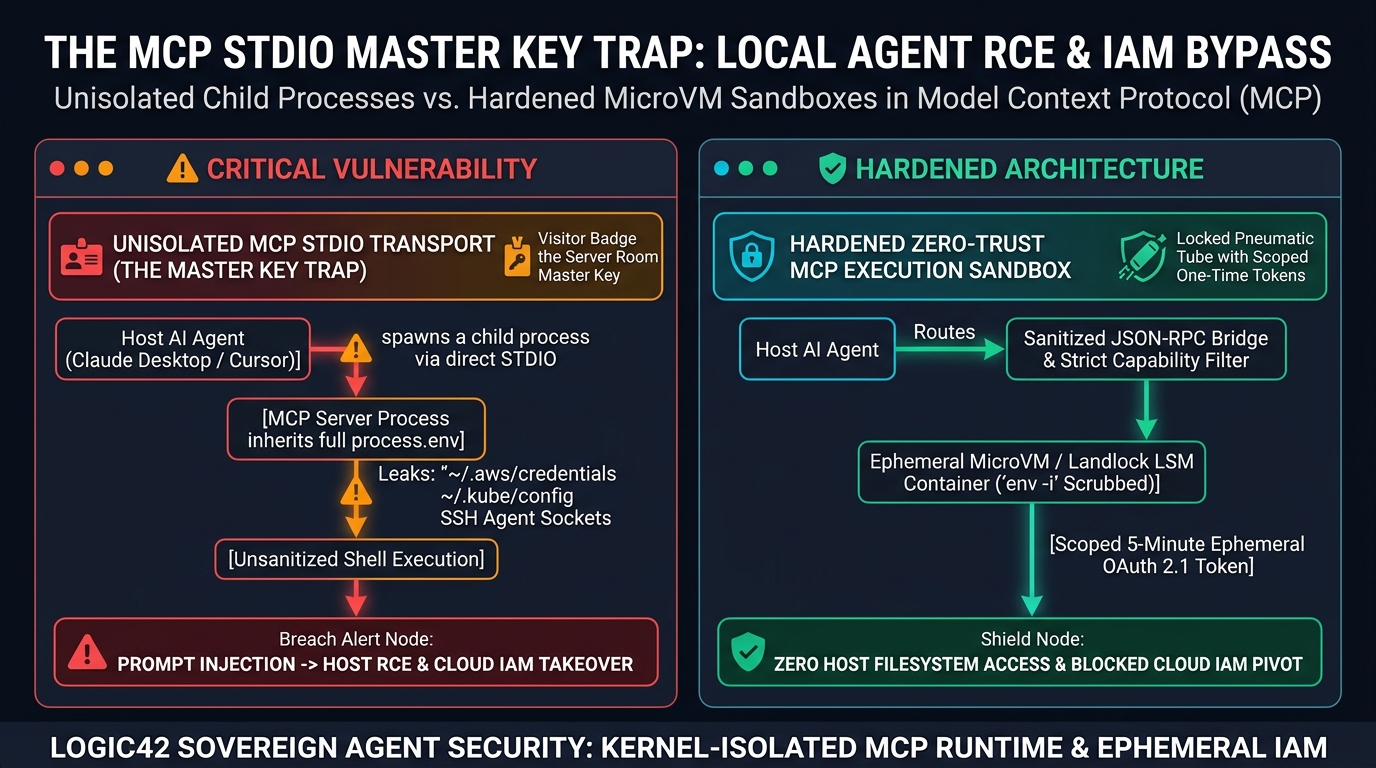
How child_process.spawn() Turns a Read-Only Tool Into a Cloud Admin
Anthropic's Model Context Protocol (MCP) defines two primary transport layers: remote HTTP/SSE endpoints and local Standard Input/Output (STDIO) pipes. Because STDIO doesn't require network setup, over 85% of open-source MCP servers (spanning Git helpers, database connectors, Kubernetes inspectors, and file search utilities) run as local subprocesses spawned directly by the host agent via POSIX fork() and execve().
Here is the fatal operating system flaw that most developers miss: POSIX processes don't have "tool-scoped" permissions.
When your AI agent spawns npx -y @modelcontextprotocol/server-git or uvx mcp-server-fetch to summarize a public repository, that child process executes under your exact OS User ID (uid=1000). Unless it's explicitly scrubbed by a kernel sandbox, the child process automatically receives:
-
The Full Parent
process.envDictionary: Every secret exported in your shell profile (AWS_SECRET_ACCESS_KEY,ANTHROPIC_API_KEY,GITHUB_TOKEN,DATABASE_URL) is readable in plain text via/proc/self/environ. -
Cached Cloud CLI Master Sessions: The child process has unrestricted read/write access to
~/.aws/sso/cache,~/.config/gcloud/application_default_credentials.json, and~/.kube/config. If you logged into AWS SSO orgcloudthis morning as a Production Administrator, the MCP tool is now a Production Administrator. -
Live SSH Agent Forwarding Sockets: By reading the
SSH_AUTH_SOCKenvironment variable, a compromised MCP tool can sign arbitrary SSH authentication challenges using keys stored inside your hardware YubiKey or macOS Keychain without ever extracting the private key.
The Three Local MCP Exploitation Vectors
Security audits across official and community MCP implementations have demonstrated three repeatable paths from an untrusted prompt or repository file to full host and cloud takeover:
| Attack Vector | Root Vulnerability | Trigger Mechanism | Blast Radius on Host & Cloud |
|---|---|---|---|
| 1. CLI Flag Injection via Tool Arguments | Unsanitized positional arguments passed to git, ripgrep, or curl binaries | Prompt injection passes --upload-pack="sh -c ..." or --pre="curl ..." instead of a branch or search string. | Immediate Remote Code Execution (RCE) on the developer workstation or CI/CD runner. |
| 2. Ambient Cloud IAM Hijacking | Default os.environ and $HOME directory inheritance in StdioServerParameters | Malicious npm/PyPI dependency inside an MCP tool calls boto3.client('sts').get_caller_identity() and s3.sync. | Silent exfiltration of production S3 buckets and Secrets Manager vaults under the human engineer's CloudTrail identity. |
3. Workspace .mcp.json Rug Pull | Auto-discovery of project-local MCP configurations without cryptographic pinning | Cloning an untrusted repo containing a poisoned .cursor/mcp.json or .vscode/mcp.json that overrides the command binary. | Executes arbitrary bootstrap scripts the moment the IDE opens the workspace folder. |

Hardened Reference Implementation: Scrubbed Env + Bubblewrap / Landlock Jail
To run local MCP STDIO servers safely, you must break the link between the host agent's OS user session and the tool subprocess. Never pass os.environ to an MCP child process, and always wrap the binary inside a minimal filesystem namespace (using Bubblewrap (bwrap) on Linux or sandbox-exec on macOS) that hides $HOME dotfile directories:
import os
import re
from mcp import ClientSession, StdioServerParameters

# 1. Strict Argument Sanitizer: Block CLI flag injection (leading hyphens or shell metacharacters)
SAFE_ARG_PATTERN = re.compile(r"^[a-zA-Z0-9_./:@-]+$")

def validate_tool_identifier(arg_value: str) -> str:
    if arg_value.startswith("-") or not SAFE_ARG_PATTERN.match(arg_value):
        raise ValueError(f"Blocked potentially malicious CLI flag or metacharacter in MCP arg: {arg_value!r}")
    return arg_value

# 2. Construct a Zero-Trust Bubblewrap Sandbox for the MCP STDIO Server
def create_hardened_mcp_stdio_params(workspace_dir: str, ephemeral_aws_creds: dict) -> StdioServerParameters:
    # NEVER inherit os.environ; build an explicit minimal allowlist
    clean_env = {
        "PATH": "/usr/local/bin:/usr/bin:/bin",
        "HOME": "/tmp/mcp-sandbox-home",
        "LANG": "C.UTF-8",
        # Inject only short-lived (15-min TTL), resource-scoped STS credentials
        "AWS_ACCESS_KEY_ID": ephemeral_aws_creds["AccessKeyId"],
        "AWS_SECRET_ACCESS_KEY": ephemeral_aws_creds["SecretAccessKey"],
        "AWS_SESSION_TOKEN": ephemeral_aws_creds["SessionToken"],
    }

    return StdioServerParameters(
        command="bwrap",
        args=[
            "--unshare-all",              # Isolate PID, mount, and IPC namespaces
            "--share-net",                # Retain network only if required by the specific tool
            "--die-with-parent",          # Terminate immediately if host agent exits
            "--ro-bind", "/usr", "/usr",  # Read-only system binaries
            "--ro-bind", "/lib", "/lib",
            "--ro-bind", "/lib64", "/lib64",
            "--ro-bind", "/etc/resolv.conf", "/etc/resolv.conf",
            "--tmpfs", "/tmp",            # Ephemeral scratch space; ~/.aws and ~/.ssh do NOT exist!
            "--ro-bind", os.path.abspath(workspace_dir), "/workspace",
            "--chdir", "/workspace",
            "--",
            "/usr/local/bin/mcp-server-git",
            "--repository", "/workspace",
        ],
        env=clean_env,
    )
Notice what happens if an attacker achieves prompt injection or compromises a dependency inside this sandboxed MCP server:
- Reading
~/.aws/credentials,~/.kube/config, or~/.ssh/id_ed25519returnsFileNotFoundErrorbecause the host$HOMEdirectory isn't mounted in the namespace. - Inspecting
/proc/self/environreveals only a 15-minute scoped STS session token rather than long-lived root secrets. - Attempting to modify source files or git hooks fails because
/workspaceis mounted read-only (--ro-bind).
Five Sovereign Controls for Enterprise MCP Deployments
-
Scrub
process.envby Default in Host Agent SDKs: Audit every MCP host client in your organization. Replace defaultenv=None(which falls back to inheriting the full parentos.environin Python and Node.js SDKs) with an explicit, empty-by-default dictionary. -
Terminate Argument Lists with Double-Dash (
--) Separators: Whenever an MCP server invokes a system CLI (git,rg,kubectl,docker), enforce strict schema validation rejecting leading hyphens (-) on user parameters and insert--before positional path or ref arguments so inputs can't be parsed as command flags. -
Broker Cloud Access via
aws:SourceIdentitySTS Sessions: Never allow local agents to use the developer's cached SSO session. Route cloud tool requests through a local credential broker that callssts:AssumeRolewith a restrictive inline session policy and tags every API call withaws:SourceIdentity=mcp-agent-<tool-name>for instant SIEM and CloudTrail attribution. -
Block Unverified Workspace
.mcp.jsonAuto-Execution: Configure enterprise IDEs via MDM profiles to disable automatic startup of workspace-defined MCP servers unless the binary SHA-256 hash matches your internal signed registry. -
Benchmark Your Agent Architecture Against Sovereign Standards: Pair local sandboxing with our ACP vs. MCP Multi-Agent Protocol Architecture, review Remote MCP OAuth 2.1 Gateway Controls, and run our 3.5-minute ISO/IEC 42001 & Agentic Security Readiness Diagnostic.
Why Do Local MCP STDIO Servers Bypass Cloud IAM Controls?
When an AI agent launches a local MCP server over STDIO, the operating system spawns the tool as a child process under the human user's OS account. The child process inherits the user's environment variables and home directory (~/.aws, ~/.config/gcloud, ~/.kube), allowing it to silently authenticate to cloud control planes using the developer's cached administrative SSO tokens.
How Can Prompt Injection Trigger Remote Code Execution in MCP Git or Search Tools?
Many MCP servers wrap command-line utilities like git or ripgrep by passing LLM-generated JSON fields as CLI arguments. Even without a shell (shell=False), if an attacker uses indirect prompt injection to pass an argument starting with a hyphen (such as --upload-pack="sh -c ..." or --pre="bash ..."), the underlying CLI binary interprets the parameter as an execution flag and runs arbitrary commands.
What Is the Difference Between Sandboxing MCP over STDIO vs. Remote SSE/HTTP?
Remote MCP servers over HTTP/SSE run on separate infrastructure where network firewalls and OAuth 2.1 bearer tokens enforce isolation, whereas local STDIO servers execute directly on the user's host machine. Securing STDIO servers requires OS-level containment (such as Linux Landlock LSM, Bubblewrap bwrap, macOS sandbox-exec, or Firecracker microVMs) to strip environment variables and block filesystem access to $HOME credential stores.
Enjoyed this autopsy? Get next Monday's architecture teardown + SVG blueprints in your inbox.
1 email every Monday morning. Zero marketing fluff — just real VRAM math, MCP security traps, and sovereign lakehouse patterns.
Further Reading
vLLM Multimodal RCE & SSRF (CVE-2026-22778): GPU Cluster Defense
How unauthenticated attackers chain vLLM MediaConnector SSRF (CVE-2026-24779) and heap overflow RCE (CVE-2026-22778) to hijack enterprise GPU clusters.
Binance $6.36B Heist (Part 2): Container Malware & Signing Bypass Kill-Chain
How container malware fooled automated HSM proxies into batch-signing EIP-7702 delegations to drain $6.36B from Binance across 10 chains.
Inside the $6.36B Binance Heist: What We Know (And What Still Doesn't Add Up)
On-chain forensics show how the $6.36B Binance heist used compromised containers and EIP-7702 delegations to drain 10 chains in 20 minutes without stealing keys.
RAG ACL Desynchronization: How Vector Indexes Leak Revoked Docs
Batch-synced vector indexes leak revoked SharePoint and Google Drive files for up to 24 hours. Pre-synthesis SpiceDB Zanzibar checks block stale chunks in 4.8ms.
See HiveOS Enterprise & Bea (Business Execution Assistant) in Action
HiveOS connects to 5,000+ workplace apps with client-side PII redaction, 3-model consensus verification, and 80%+ local SLM cost savings. Watch the 30-second Executive Overview and 3-minute Walkthrough on gethiveos.com, or download the 6-slide Product Brochure.
Auditing Runtime & Agentic Containment?
If your engineering teams are deploying autonomous tool loops, MCP servers, or evaluation sandboxes, our cyber practice conducts confidential architectural reviews to expose link-local leakage, SSRF vectors, and credential harvesting paths.
Debugging this pattern in your own stack? Ask a Principal Architect directly or request a free 48-hour architecture sanity check: