Inside the US FAA Ground Stop: How a TDM Router Flood Halted Flights
How an L3Harris TDM-to-fiber cutover router flooded the FAA FTI network with 1,000 connection requests every 5 seconds and grounded US aviation.
Author: Logic42 Engineering
Consider a utility crew replacing a single residential water meter in Texas, only for a faulty valve to send a high-pressure hydraulic shockwave backward through the municipal main until fire hydrants burst in Chicago and New York. That is the mechanical equivalent of the failure that forced the US Federal Aviation Administration (FAA) to issue a four-hour nationwide ground stop on Friday, November 13, 2026.
Starting at 3:54 p.m. EST (20:54 UTC), the FAA ordered an immediate coast-to-coast halt to all departing flights across the United States. It marked only the third nationwide ground stop in modern US aviation history, following the September 11, 2001 attacks and the January 2023 NOTAM (Notice to Air Missions) database outage. Over the next four hours and 21 minutes, air traffic controllers safely landed more than 3,500 airborne aircraft while 10,000 to 11,000 flights were delayed or canceled across American, Delta, United, and Southwest Airlines, stranding roughly 1.5 million passengers.
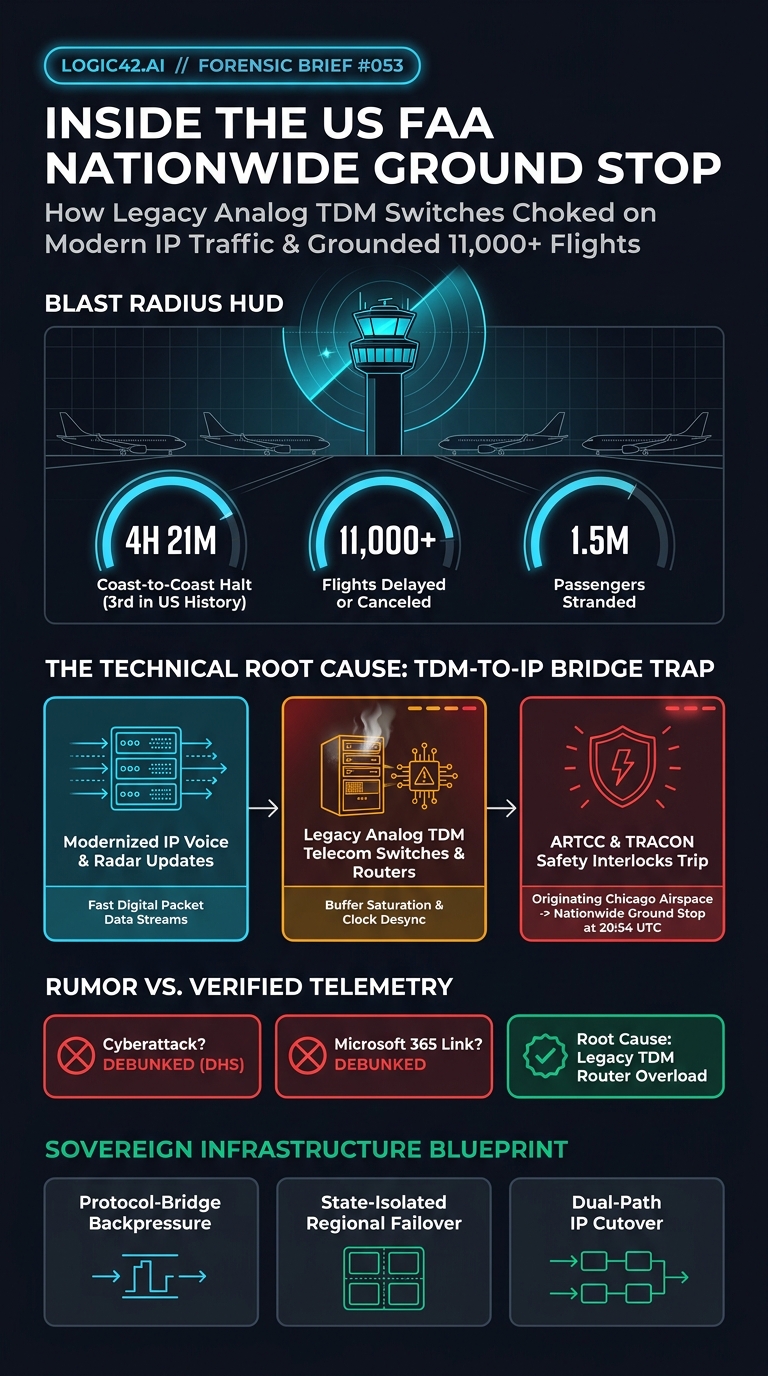
Because the aviation shutdown began less than 28 hours after Microsoft's 24-hour global Exchange Online and Defender XDR outage (EX1550543), social media immediately erupted with claims that Microsoft had crashed US air traffic control (ATC) or that a coordinated cyberattack was underway. Neither claim was true.
Confirmed FAA Telemetry vs Viral Speculation
Following Sunday, November 15, 2026 forensic disclosures from US Department of Transportation (DOT) Secretary Sean Duffy and the FAA, engineering and risk leaders can separate verified federal telemetry from weekend speculation.
| Claim or Observation | Forensic Status | Verified Source & Technical Reality |
|---|---|---|
| Coordinated cyberattack on US aviation | Debunked | DOT Secretary Sean Duffy and Department of Homeland Security (DHS) Secretary Markwayne Mullin confirmed zero malicious or cyber activity. |
| Cascading fallout from the Microsoft 365 outage | Debunked | Both DHS Secretary Mullin at the White House podium and Microsoft officially confirmed zero technical connection between M365 and the FAA ground stop. |
| Modern IP voice switches crashed in ATC towers | Debunked | Secretary Duffy explicitly noted that newly modernized Internet Protocol (IP) voice switches remained healthy; legacy switches choked on the packet flood. |
| L3Harris TDM-to-fiber cutover router fault | Confirmed (DOT / FAA) | During routine maintenance by prime contractor L3Harris migrating legacy analog Time-Division Multiplexing (TDM, 1970s fixed-slot circuit switching) copper lines to fiber in Arkansas and Texas, a replacement router malfunctioned. |
| 1,000+ connection requests every 4 to 5 seconds | Confirmed (DOT / FAA) | The misconfigured router flooded the FAA Telecommunications Infrastructure (FTI) backbone with over 1,000 connection requests every 4 to 5 seconds (~200–250/sec). |
En-route (ARTCC) and terminal (TRACON) radar desync | Confirmed (DOT / FAA) | Legacy switches at regional Air Route Traffic Control Centers (ARTCCs, which guide high-altitude cross-country flights via the En Route Automation Modernization, or ERAM, radar backbone) and Terminal Radar Approach Control (TRACON) airport-approach hubs starting in Chicago output inconsistent radar and voice data. |
| Contractor error vs hardware defect investigation | Under FAA Audit | The FAA and L3Harris are auditing whether the router flood stemmed from technician configuration error or a firmware/hardware defect inside the replacement unit. |
What Triggered the November 2026 US FAA Nationwide Ground Stop?
Per Sunday, November 15, 2026 DOT and FAA disclosures, the November 13 nationwide ground stop began during an L3Harris maintenance cutover inside the FAA Telecommunications Infrastructure (FTI), migrating legacy analog Time-Division Multiplexing (TDM) copper lines to fiber in Arkansas and Texas. A replacement router malfunctioned and flooded the network with 1,000+ connection requests every four to five seconds, overwhelming legacy switches across regional Air Route Traffic Control Centers (ARTCCs) and TRACON radar hubs.
In telecommunications architecture, Time-Division Multiplexing (TDM) is a deterministic, circuit-switched technology designed in the 1960s and 1970s that divides a physical line into fixed-bandwidth time slots. Modern fiber-optic Internet Protocol (IP) routers, by contrast, operate on high-throughput, bursty packet switching. Bridging the two without a strict rate-limiting bulkhead is one of the most dangerous failure modes in critical infrastructure.
The four-stage cascade inside the FAA's network followed a deterministic mechanical sequence:
-
The Remote Cutover Fault: Technicians working under prime telecom contractor L3Harris were executing a scheduled migration within the
FTInetwork, transitioning legacy analogTDMcircuits over to modern fiber links at remote facilities in Arkansas and Texas. -
The 250-Request-Per-Second Signaling Flood: During the cutover, a replacement router entered a runaway signaling loop. Instead of establishing a single steady session, it hammered adjacent nodes across the national backbone with more than 1,000 connection attempts every four to five seconds.
-
Legacy Switch Buffer Saturation: While modern IP switches located in upgraded facilities absorbed or ignored the signaling chatter, older legacy routers and
TDMmultiplexers across regionalARTCCfacilities (which runERAM, the En Route Automation Modernization platform that processes high-altitude cross-country flight tracks) and terminalTRACONairport-approach hubs couldn't drain their input buffers fast enough. Starting around Chicago'sO'HareandMidwayairspace at 3:36 p.m. EST, overloaded switches began dropping frames and outputting inconsistent radar and controller-to-pilot voice telemetry. -
The Nationwide Safety Interlock: You can't guess aircraft separation when radar scopes desynchronize. At 3:54 p.m. EST, the FAA pulled the master safety brake, halting all domestic departures nationwide until engineers isolated the offending router, drained the switch buffers, and verified telemetry stability at 8:15 p.m. EST.
Why Did Two Unrelated Mega-Outages Hit Within 36 Hours?
If you felt a sense of engineering whiplash watching 51 million Microsoft 365 desktops freeze on Thursday and 11,000 US flights halt on Friday, you weren't alone. We spent all of 2026 debating autonomous AI swarms and nation-state zero-days, only for basic network state machines to humble both commercial cloud computing and national aviation in the same 36-hour window.
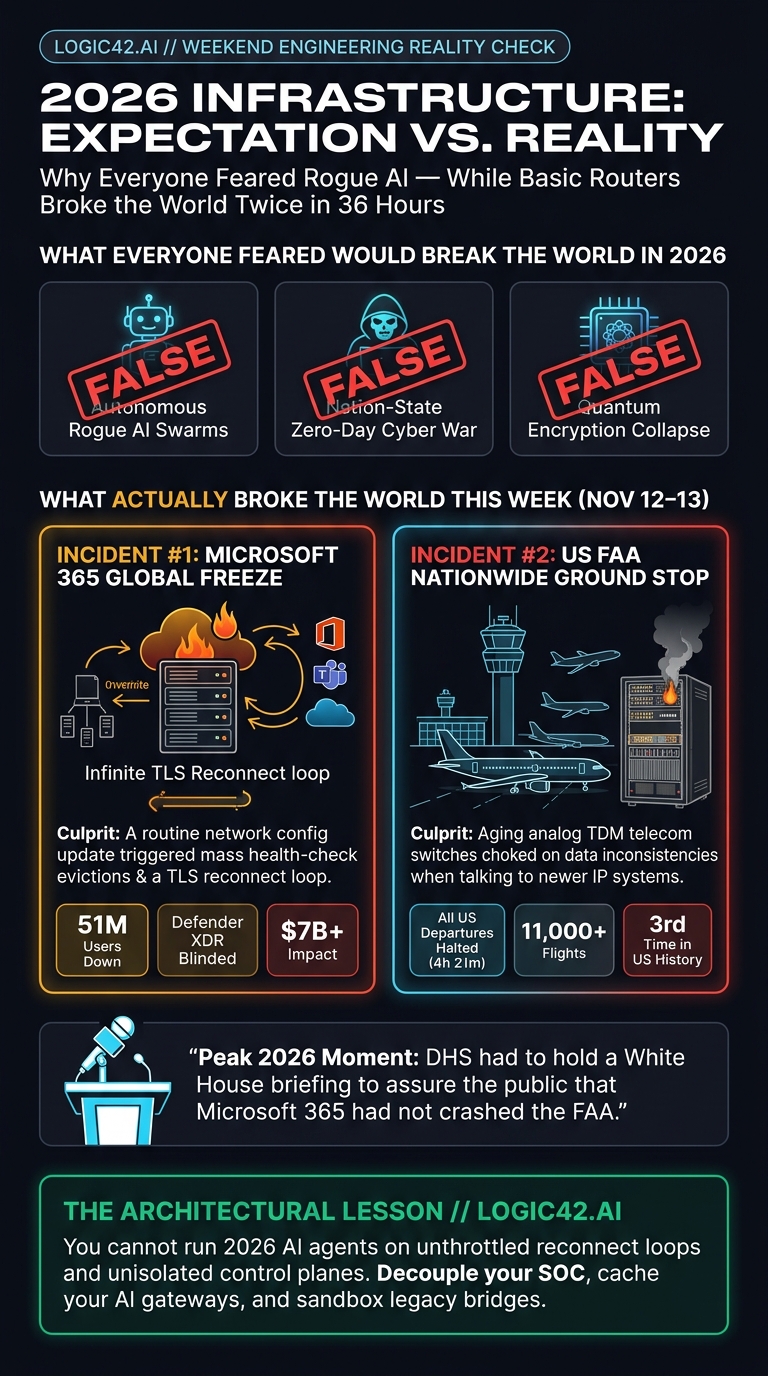
Although DHS confirmed the two incidents shared zero physical links, they exposed the same distributed-systems anti-pattern: unthrottled connection storms propagating across unpartitioned failure domains.
On Thursday, Microsoft's EX1550543 outage occurred because a network configuration bug caused 80% of Exchange Online servers to fail health checks, funneling millions of client reconnects into the surviving nodes until their Transport Layer Security (TLS) handshake processes locked up. On Friday, the FAA's FTI network locked up because a single cutover router in the Southwest was allowed to broadcast 250 connection requests per second across a flat national routing domain until legacy switches in Chicago choked. As we documented in our analysis of cross-region retry storms and quota cascades, any network that trusts internal nodes to behave without ingress rate limits is one bad config away from a fleet-wide outage.
Unisolated Legacy Cutover vs Bulkheaded Sovereign Architecture
Whether you're modernizing a national air-traffic backbone, a hospital clinical network, or a core banking mainframe bridge, replacing 1980s circuit-switched plumbing with modern IP and AI fabrics requires strict protocol bulkheads.
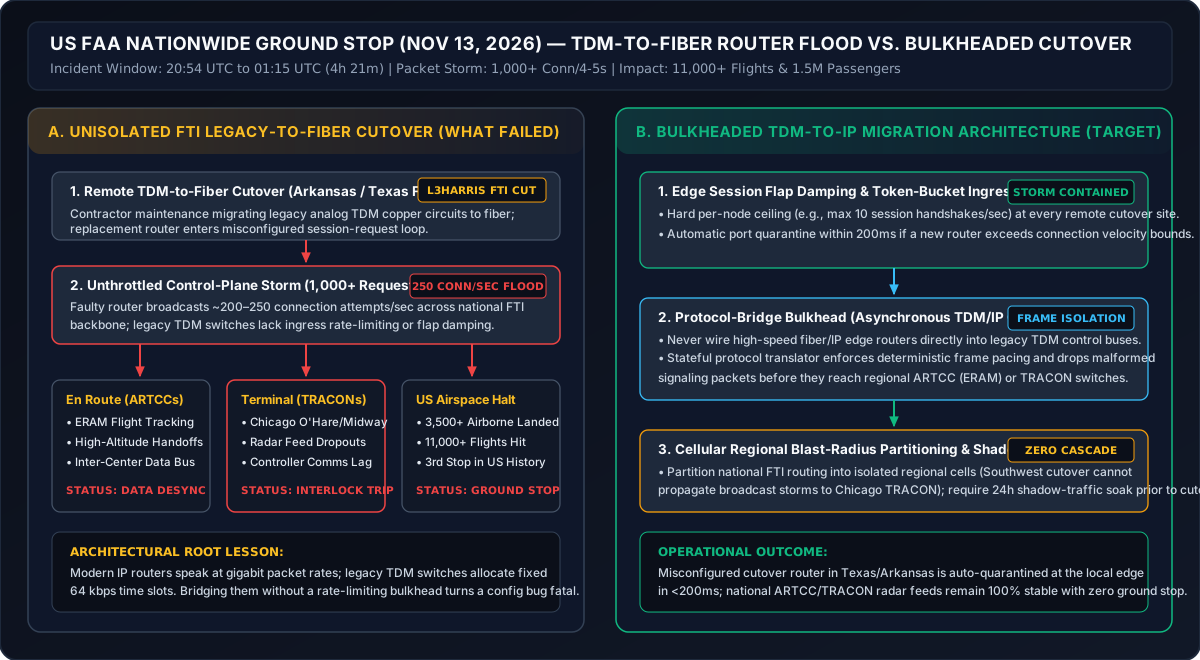
| Architectural Dimension | Unisolated Legacy-to-IP Cutover (FAA FTI Failure Mode) | Bulkheaded Critical-Infrastructure Pattern |
|---|---|---|
| Edge Connection Admission | Replacement router can inject 1,000+ connection requests every 4–5 seconds directly into the national backbone. | Hardware token-bucket ingress gate caps new session handshakes at <= 10/sec per edge port; auto-quarantines flapping nodes in < 200ms. |
| Legacy-to-Modern Protocol Bridge | High-speed fiber/IP routers wired directly into legacy TDM switches with tiny memory buffers and fixed time slots. | Asynchronous protocol-bridge bulkhead paces frame delivery to match legacy TDM clock rates and drops malformed control packets. |
| Geographic Blast-Radius Isolation | Flat national routing topology allows a maintenance fault in Arkansas/Texas to corrupt TRACON radar feeds in Chicago. | Cellular regional partitioning (isolating Fort Worth ZFW and Memphis ZME Southwest airspace centers from the Chicago ZAU center) with strict inter-region circuit breakers. |
| Cutover Validation & Rollback | Live in-band cutover during peak Friday afternoon departure windows without automated packet-velocity tripwires. | 24-hour out-of-band shadow traffic soak (dark fiber mirror) with automated hardware cutback on signaling anomalies. |
Enterprise architects modernizing hybrid cloud, operational technology (OT), or sovereign data pipelines can benchmark their blast-radius isolation against our ISO 27001 Infrastructure & Continuity Readiness Assessment.
How Can Infrastructure Leaders Modernize Legacy Networks Without Cascading Outages?
Any enterprise or public-sector agency migrating from legacy telecom, mainframe, or Supervisory Control and Data Acquisition (SCADA) industrial control substrates to modern IP and AI-driven control planes should enforce four non-negotiable engineering controls:
-
Enforce Hardware Session-Flap Damping at Every Edge Cutover Port: Never trust a newly provisioned router, switch, or gateway just because it sits inside your private wide-area network (
WAN). Configure ingress control-plane policing (CoPP) and session-flap damping on upstream aggregation switches so any node exceeding 10 connection requests per second is automatically quarantined at the local port before its traffic enters the core backbone. -
Insert Stateful Rate-Pacing Bulkheads Between IP and Legacy Buses: Modern IP interfaces burst at gigabit speeds, whereas legacy
TDMmultiplexers, industrial controllers, and mainframe gateways process fixed-width frames sequentially. Place an asynchronous protocol-translation proxy between the two layers that buffers bursts, strips duplicate handshake retries, and guarantees deterministic frame pacing. -
Partition National and Global WANs into Cellular Failure Domains: A maintenance window at a regional node in Arkansas or Texas should never be physically capable of saturating switch buffers in Chicago. Segment your backbone into cellular availability zones connected by rate-limited inter-zone gateways, and audit your autonomous agent and API gateway boundaries using our Enterprise AI Security & Resilience Assessment.
-
Mandate Out-of-Band Shadow Soaks Before Live Cutovers: Never cut a legacy circuit over to a new fiber router hot during peak operational hours. Run the new router in shadow mode (
dual-fed read-only telemetry) for at least 24 hours, verifying zero signaling storms, clock drift, or packet amplification before switching active traffic.
Modernizing decades-old infrastructure isn't optional, and Secretary Duffy's push to replace aging analog TDM circuits with modern fiber is directionally right. The lesson of Friday the 13th is that the most dangerous moment in any infrastructure lifecycle isn't when the whole network is old or when the whole network is new—it's the hybrid transition period when high-pressure modern routers are bolted directly onto legacy copper mains without a pressure-regulating bulkhead or circuit breaker between them.
Enjoyed this autopsy? Get next Monday's architecture teardown + SVG blueprints in your inbox.
1 email every Monday morning. Zero marketing fluff — just real VRAM math, MCP security traps, and sovereign lakehouse patterns.
Further Reading
Bleeding Llama (CVE-2026-7482): GGUF Memory Leak Defense
How the critical Bleeding Llama (CVE-2026-7482) heap over-read in Ollama's GGUF loader leaks live LLM prompts and API keys, and how to harden enclaves.
Inside Microsoft's $7B M365 Outage (EX1550543): What Failed
How a latent network capacity defect triggered automated Exchange Online health-check evictions, TLS handshake freezes, and Defender XDR blind spots.
The MCP STDIO Master Key Trap: Local Agent RCE & IAM Bypass
Spawning local MCP servers via STDIO leaks host environment variables, SSH sockets, and Cloud IAM tokens. Isolate agent tools with Landlock LSM and STS brokers.
vLLM Multimodal RCE & SSRF (CVE-2026-22778): GPU Cluster Defense
How unauthenticated attackers chain vLLM MediaConnector SSRF (CVE-2026-24779) and heap overflow RCE (CVE-2026-22778) to hijack enterprise GPU clusters.
See HiveOS Enterprise & Bea (Business Execution Assistant) in Action
HiveOS connects to 5,000+ workplace apps with client-side PII redaction, 3-model consensus verification, and 80%+ local SLM cost savings. Watch the 30-second Executive Overview and 3-minute Walkthrough on gethiveos.com, or download the 6-slide Product Brochure.
Auditing Runtime & Agentic Containment?
If your engineering teams are deploying autonomous tool loops, MCP servers, or evaluation sandboxes, our cyber practice conducts confidential architectural reviews to expose link-local leakage, SSRF vectors, and credential harvesting paths.
Debugging this pattern in your own stack? Ask a Principal Architect directly or request a free 48-hour architecture sanity check: