Bleeding Llama (CVE-2026-7482): GGUF Memory Leak Defense
How the critical Bleeding Llama (CVE-2026-7482) heap over-read in Ollama's GGUF loader leaks live LLM prompts and API keys, and how to harden enclaves.
Author: Logic42 Engineering
Consider a warehouse shipping clerk who reads a packing slip claiming a 10-inch box is 10 feet long, and blindly scoops up the next nine feet of confidential desk files, keys, and contracts to fill the crate before mailing it back to the sender. That is the exact memory-corruption mechanism behind "Bleeding Llama" (CVE-2026-7482, Common Vulnerability Scoring System CVSS 9.1), a critical heap out-of-bounds read vulnerability in self-hosted Large Language Model (LLM) infrastructure.
As enterprises repatriate AI workloads from public cloud APIs onto private Graphics Processing Unit (GPU) servers, local model runtimes, most notably Ollama and llama.cpp-based serving stacks using the GGUF (GPT-Generated Unified Format) binary file standard, have become core production infrastructure. However, Cloud Security Alliance (CSA) and threat-intelligence telemetry in 2026 revealed thousands of self-hosted model endpoints exposed on internal corporate networks and the public internet without authentication or control-plane isolation.
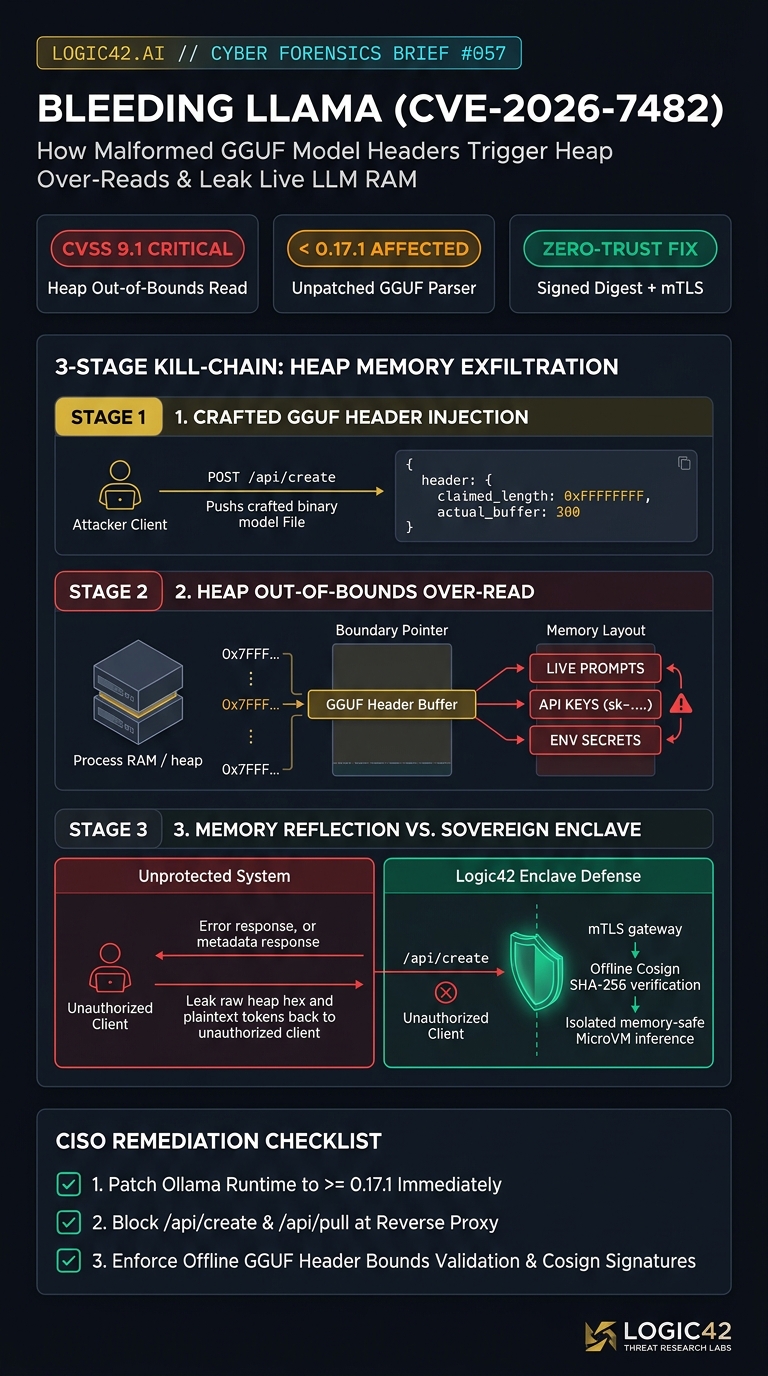
In Ollama versions prior to 0.17.1, an attacker who can reach the model management API can exploit a malformed GGUF file header to leak live server heap memory, exposing active user prompts, bearer tokens, and environment variables across tenants.
What Is the Bleeding Llama (CVE-2026-7482) Vulnerability in Ollama?
Bleeding Llama (CVE-2026-7482, CVSS 9.1) is a critical heap out-of-bounds read vulnerability (Common Weakness Enumeration CWE-125) in the GGUF binary model parser of Ollama versions prior to 0.17.1. By submitting a crafted GGUF file with mismatched metadata length headers to the /api/create endpoint, an unauthenticated attacker can force the server to read past allocated buffer boundaries and return adjacent process heap memory containing live prompts, API keys, and environment secrets.
Before evaluating your exposure, security and infrastructure teams should separate verified vulnerability mechanics from common misconceptions about self-hosted model weights:
| Security Question or Assumption | Forensic Reality | Technical Impact on Enterprise AI Clusters |
|---|---|---|
| "GGUF files are just passive math weights, unlike Python Pickle files" | False (Memory Layout Risk) | While GGUF avoids arbitrary Python pickle code execution, its binary header dictates memory allocation offsets that can trigger native heap over-reads (CWE-125) if unvalidated. |
"Only internet-facing Ollama servers on port 11434 are vulnerable" | False (Internal Lateral Vector) | Any internal microservice, compromised developer workstation, or Server-Side Request Forgery (SSRF) agent (like CVE-2026-22778 in vLLM) inside your Virtual Private Cloud (VPC) can trigger the leak. |
"Heap over-reads only crash the model server (DoS)" | False (Active Memory Exfiltration) | Instead of a simple Denial-of-Service (DoS) crash, the parser copies adjacent heap bytes into model metadata and error strings that are reflected back to the HTTP caller. |
"Upgrading Ollama to >= 0.17.1 patches the GGUF parser bounds check" | Confirmed (Mandatory Patch) | Version 0.17.1+ enforces strict end-of-file (EOF) and buffer-length validation across GGUF key-value metadata arrays before heap copying. |
How Does a Malformed GGUF Header Leak Live Process RAM?
A malformed GGUF header leaks live process Random-Access Memory (RAM) by exploiting a trust mismatch between the declared length prefix of a metadata field and the actual byte size of the uploaded binary payload. When the unpatched parser allocates or copies bytes based on the spoofed length integer without verifying buffer bounds, it sweeps adjacent heap pages, where active inference prompts and credentials reside, directly into the HTTP response.
The three-stage kill-chain inside an unhardened inference server unfolds deterministically:
-
Stage 1: Crafted GGUF Header Injection: The GGUF specification begins with a magic number (
0x46554747), a version integer, a tensor count, and a metadata Key-Value (KV) count. Each metadata string or array prefixes its payload with a 64-bit length integer (uint64). The attacker crafts a truncated GGUF stub where a metadata string header declares a length of65,536 bytes, while the uploaded file terminates after128 bytes, and POSTs it to/api/blobsand/api/create. -
Stage 2: Heap Out-of-Bounds Over-Read (
CWE-125): In unpatched runtimes (< 0.17.1), the GGUF header parser reads the declareduint64length and copies memory sequentially without enforcing a hard boundary check against the actual slice capacity. Because the Go and C/C++ runtime heap reuses freed memory pages from recent HTTP requests, the over-read crosses directly into adjacent heap allocations holding live/v1/chat/completionsJSON prompts, Retrieval-Augmented Generation (RAG) context chunks, and cloud Identity and Access Management (IAM) environment variables. -
Stage 3: Reflection via Metadata & Error Responses: When the malformed model registration fails or is queried via
/api/show, the leaked heap bytes captured inside the oversized metadata string are serialized into the JSON response body and returned directly to the attacker.
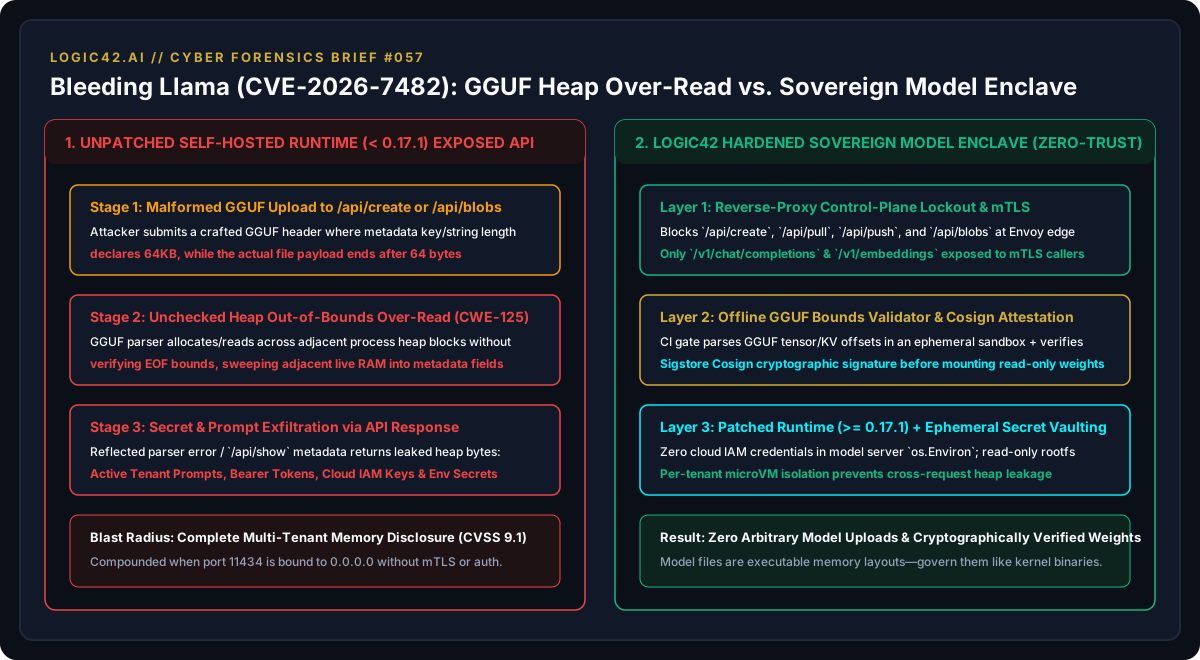
Exposed Self-Hosted Runtime vs Logic42 Sovereign Model Enclave
As we highlighted in our analysis of the air-gapped GPU fallacy and the Model Context Protocol (MCP) Standard Input/Output (STDIO) master key trap, running open-weight models on your own hardware doesn't make them sovereign if the model control plane is left wide open. Securing model ingestion requires mutual Transport Layer Security (mTLS) at the edge and isolated Continuous Integration (CI) validation before weights ever touch a GPU node.
| Defense Layer | Unhardened Self-Hosted Deployment | Logic42 Hardened Sovereign Enclave |
|---|---|---|
| Control-Plane API Exposure | Port 11434 bound to 0.0.0.0; /api/create, /api/pull, and /api/delete reachable by any network caller. | Reverse proxy (Envoy) blocks all /api/create, /api/blobs, and /api/pull routes; exposes only mTLS-authenticated inference endpoints. |
| Model Artifact Ingestion | Runtime parses untrusted GGUF files uploaded dynamically over HTTP at serving time. | Immutable Read-Only Mounts: Models are validated offline in an isolated CI sandbox, signed with Sigstore Cosign, and mounted read-only (ro). |
| Process Memory & Secret Hygiene | Long-lived AWS/GCP keys and database passwords injected directly into model server os.Environ. | Zero credentials in model worker environment; ephemeral secrets stay inside an upstream token vault proxy. |
| Multi-Tenant Heap Isolation | Shared process heap serves multiple business units simultaneously without memory scrubbing. | Per-sensitivity microVM isolation + patched runtime (>= 0.17.1) with strict GGUF bounds checking. |
How Should CISOs Harden Self-Hosted Ollama and GGUF Infrastructure?
Chief Information Security Officers (CISOs) and platform teams should harden self-hosted Ollama and GGUF infrastructure by immediately upgrading Ollama to version 0.17.1 or higher, blocking administrative model-mutation endpoints (/api/create, /api/pull, /api/blobs) at the reverse-proxy perimeter, and enforcing offline cryptographic signature verification (Cosign) with read-only volume mounts for all production model weights.
Execute this four-point remediation checklist across every self-hosted GPU node and developer workstation:
-
Upgrade Ollama Runtimes to
>= 0.17.1Across All Nodes and Endpoints: Audit both production Kubernetes GPU clusters and developer laptops (where local Ollama instances are frequently bound to0.0.0.0:11434on corporate Wi-Fi/VPNs). Upgrade immediately to0.17.1+, which enforces strict slice bounds checking across GGUF header and tensor offset parsers. -
Sever Model-Management Routes from Inference Routes at the Gateway: Production inference callers don't need to create, pull, or upload binary model blobs. Configure your Envoy or NGINX ingress gateway so only
/v1/chat/completionsand/v1/embeddingsare routable, and lock the local Ollama daemon toOLLAMA_HOST=127.0.0.1:11434behindmTLS. -
Enforce Offline GGUF Structural Verification and Read-Only Model Volumes: Treat GGUF model files like kernel binaries. Validate GGUF header offsets and
SHA-256digests inside an ephemeral, network-isolatedCIcontainer before mounting the verified weights into production pods as a read-only filesystem (readOnlyRootFilesystem: true). -
Strip Secrets from Inference Worker Process Memory: Even if a zero-day memory disclosure occurs in a native C++/CUDA kernel, an attacker can't steal credentials that aren't in the process heap. Keep cloud IAM keys, database connection strings, and API secrets inside an upstream gateway proxy, and benchmark your full adversarial defense posture with our Enterprise AI Security & Adversarial Red-Team Audit and ISO/IEC 27001 Sovereign Cloud Security Diagnostic.
A warehouse clerk should never let a customer's packing slip dictate how deep into the back office they reach. By patching your GGUF parsers, locking /api/create behind a zero-trust gateway, and mounting cryptographically verified weights read-only, you ensure your self-hosted LLMs return only the tokens they were authorized to generate.
Enjoyed this autopsy? Get next Monday's architecture teardown + SVG blueprints in your inbox.
1 email every Monday morning. Zero marketing fluff — just real VRAM math, MCP security traps, and sovereign lakehouse patterns.
Further Reading
Inside the US FAA Ground Stop: How a TDM Router Flood Halted Flights
How an L3Harris TDM-to-fiber cutover router flooded the FAA FTI network with 1,000 connection requests every 5 seconds and grounded US aviation.
Inside Microsoft's $7B M365 Outage (EX1550543): What Failed
How a latent network capacity defect triggered automated Exchange Online health-check evictions, TLS handshake freezes, and Defender XDR blind spots.
The MCP STDIO Master Key Trap: Local Agent RCE & IAM Bypass
Spawning local MCP servers via STDIO leaks host environment variables, SSH sockets, and Cloud IAM tokens. Isolate agent tools with Landlock LSM and STS brokers.
vLLM Multimodal RCE & SSRF (CVE-2026-22778): GPU Cluster Defense
How unauthenticated attackers chain vLLM MediaConnector SSRF (CVE-2026-24779) and heap overflow RCE (CVE-2026-22778) to hijack enterprise GPU clusters.
See HiveOS Enterprise & Bea (Business Execution Assistant) in Action
HiveOS connects to 5,000+ workplace apps with client-side PII redaction, 3-model consensus verification, and 80%+ local SLM cost savings. Watch the 30-second Executive Overview and 3-minute Walkthrough on gethiveos.com, or download the 6-slide Product Brochure.
Auditing Runtime & Agentic Containment?
If your engineering teams are deploying autonomous tool loops, MCP servers, or evaluation sandboxes, our cyber practice conducts confidential architectural reviews to expose link-local leakage, SSRF vectors, and credential harvesting paths.
Debugging this pattern in your own stack? Ask a Principal Architect directly or request a free 48-hour architecture sanity check: