
Nvidia Halts Malaysia & SG AI Servers: ASEAN GPU Freeze Fix
Nvidia halted Dell and Supermicro AI server shipments to Malaysia, Singapore, Thailand, and Indonesia under US BIS rules. Build compliant ASEAN GPU capacity.
Author: Logic42 Sovereign Engineering Practice
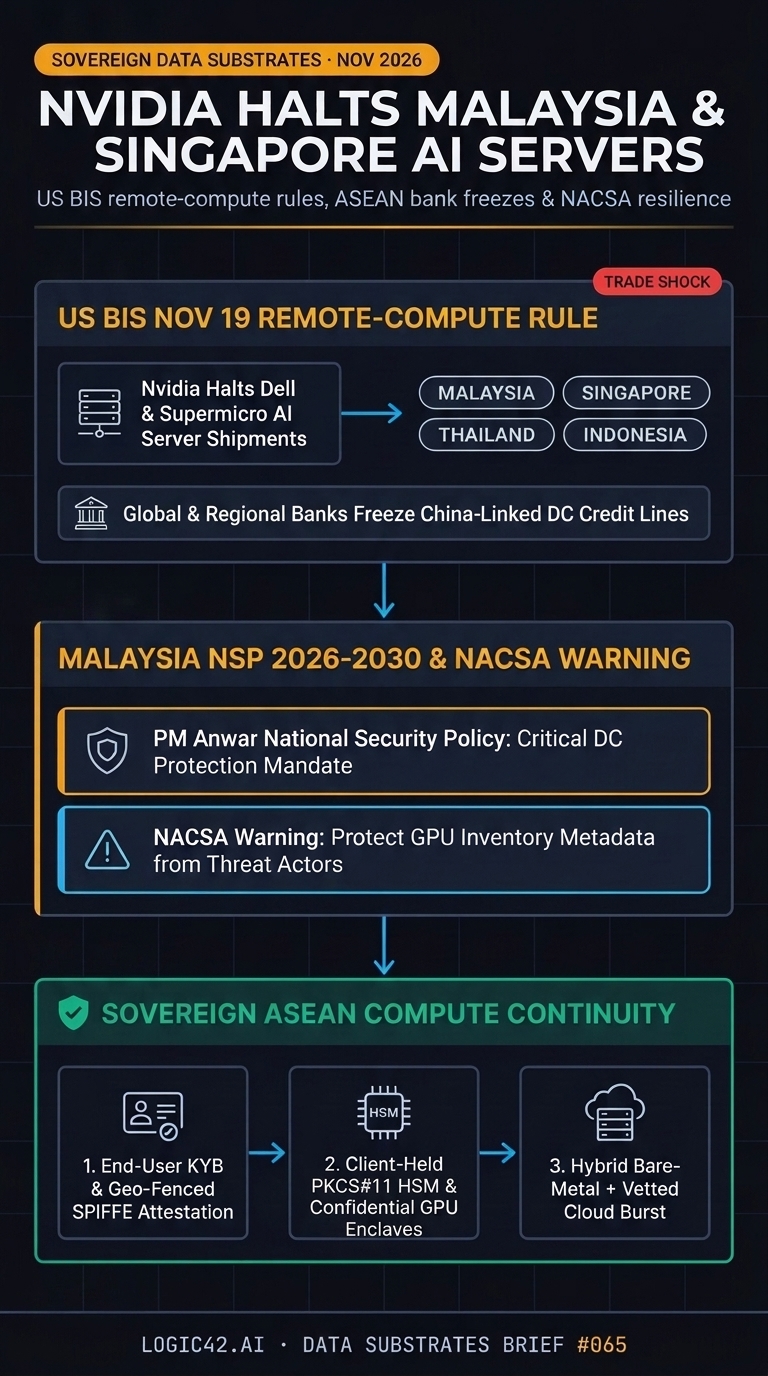
Picture a customs officer freezing armored cargo ships at Port Klang while commercial banks lock your construction escrow account until every warehouse tenant proves who holds the keys. Between November 19 and November 27, 2026, Artificial Intelligence (AI) infrastructure across the Association of Southeast Asian Nations (ASEAN) hit that exact choke point. Nvidia halted Dell and Supermicro AI server shipments to Malaysia, Singapore (SG), Thailand, and Indonesia just as Prime Minister Anwar Ibrahim launched Malaysia's 2026–2030 data-center security policy.
The United States Export Rule That Froze Regional Deliveries
Export compliance, not factory bottlenecks, triggered this supply halt. Effective November 19, 2026, the United States (US) Department of Commerce Bureau of Industry and Security (BIS) enacted interim final rules closing remote-compute loopholes that previously let restricted Chinese AI firms rent high-density Nvidia clusters hosted outside China. Days later, on November 26 and November 27, Nvidia directed major Original Equipment Manufacturer (OEM) server partners including Dell Technologies and Supermicro to halt pending AI server shipments destined for Malaysia, Singapore, Thailand, and Indonesia while federal licensing terms settle.
Shipments paused rapidly. Global and regional commercial banks responded in lockstep, freezing major project credit lines tied to China-linked AI data-center builds across the region. Until lenders verify that Graphics Processing Unit (GPU) tenants aren't violating transboundary US BIS access limits, unverified multi-tenant colocation deals can't pass bank underwriting committees.
This freeze compounds the compliance requirements analyzed in Malaysia's RM2B (Malaysian Ringgit) Sovereign AI Cloud Brief. Previously, operators treated Ministry of Investment, Trade and Industry (MITI) serial manifests and Malaysian Communications and Multimedia Commission (MCMC) residency guidelines as paperwork tasks. Today, lacking verifiable tenant attestation stalls both incoming physical servers and billion-dollar construction debt.
Overlapping Export Controls and NACSA Rules Across ASEAN Data Centers
If you architect enterprise AI or manage cloud procurement in Kuala Lumpur or Singapore, you're navigating two overlapping pressures. External export controls dictate whether Dell and Supermicro racks even clear customs, while domestic security guidance from Malaysia's National Cyber Security Agency (NACSA) restricts how you store and expose hardware inventory metadata inside the country.
| Pressure Vector | Triggering Event (Nov 19–27, 2026) | Immediate Infrastructure & Capital Impact | Required Architectural Engineering Control |
|---|---|---|---|
| US BIS Remote-Compute Enforcement | Interim final rules close overseas GPU rental loopholes effective Nov 19 | Nvidia halts pending Dell and Supermicro AI server shipments to Malaysia, Singapore, Thailand, and Indonesia | Deploy cryptographic Know-Your-Business (KYB) workload identity and geo-fenced Application Programming Interface (API) ingress gates |
| Global Bank Credit Freeze | Lenders audit China-affiliated ASEAN AI infrastructure borrowers | Major regional data-center credit facilities paused mid-build pending tenant compliance reviews | Deliver tamper-evident tenant lineage and escrow-grade audit ledgers before equipment financing closes |
| Malaysia National Security Policy (2026–2030) | Launched Nov 26 by Prime Minister Datuk Seri Anwar Ibrahim | Places cybersecurity, critical data centers, and technological resilience at the center of national security | Enforce client-held Hardware Security Module (HSM) keys and Malaysia-only vector storage residency |
| NACSA Metadata Exposure Warning | National Cyber Security Agency cautions rapidly expanding data centers | Warns against publishing unencrypted GPU inventory reports attackers can weaponize to target clusters | Encrypt hardware chassis manifests so regulators inspect verified proofs without public cluster leakage |
Financing stalled across non-compliant builds, while sovereign domestic projects remain viable when their architecture separates verified enterprise demand from opaque spot rentals. On November 26, 2026, NACSA issued an operational advisory alongside the National Security Policy launch. Although regulators require operators to track advanced silicon, publishing granular GPU inventory reports creates targeting data for cyber and physical threat actors.
Converging Cloud Burst Economics and Bare-Metal Residency
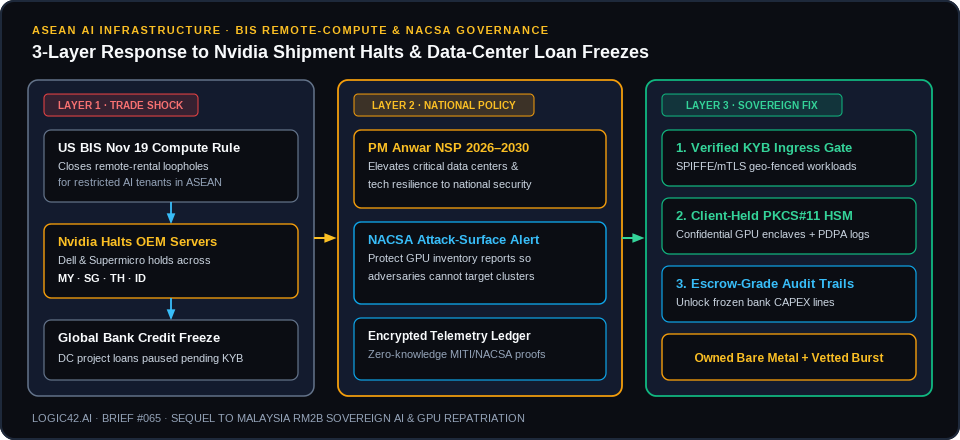
You can't build a multi-year AI roadmap around unvetted neocloud (specialized GPU cloud provider) capacity when export licensing rules can suspend OEM rack deliveries within a single week. Even if a broker holds racks inside Johor or Cyberjaya, shared multi-tenant GPU fabric mixes unrelated corporate workloads onto identical InfiniBand switches without hardware-enforced jurisdictional proofs. Because bank underwriters and BIS auditors can't separate vetted domestic enterprises from restricted remote renters on that shared switch fabric, they freeze project loans and pause server shipments across the neocloud operator.
Meanwhile, relying blindly on zero-commit public cloud endpoints burns operating budget at scale, as we proved in our benchmark analysis of Bare-Metal GPU Repatriation and Cloud Inference Total Cost of Ownership (TCO). Production engineering teams can't rely on opaque regional brokers for committed capacity. Instead, it's safer to pair dedicated compliant domestic infrastructure for steady-state traffic with pre-vetted, legally segregated burst endpoints so neither export holds nor capital freezes interrupt production Service Level Agreements (SLAs).
Five Controls to Unblock AI Compute and Protect Cluster Metadata
Whether you run regulated financial workloads in Kuala Lumpur or cross-border enterprise Software-as-a-Service (SaaS) from Singapore, implement five engineering controls to satisfy bank underwriting and regulatory audits:
-
Gate Every Inference API Call with KYB and Workload Identity: Bind every training and inference API request to Secure Production Identity Framework for Everyone (SPIFFE) workload certificates paired with verified corporate KYB attributes, proving to OEMs and BIS auditors via mutual Transport Layer Security (mTLS) that no restricted jurisdiction touches your cluster.
-
Isolate Root Keys Inside Client-Held Cryptographic Modules: Keep decryption keys under sovereign tenant custody using dedicated Public-Key Cryptography Standards #11 (PKCS#11) HSMs inside Tier-4 facilities so neither colocation landlords nor third-party cloud managers can read model weights or prompts.
-
Encrypt and Access-Control NACSA and MITI Hardware Manifests: Store GPU serial telemetry, rack topology, and chassis manifests inside permissioned zero-knowledge audit ledgers rather than shared spreadsheets or public transparency portals, honoring NACSA's warning against exposing cluster maps.
-
Benchmark Statutory Privacy Readiness Before Signing Colocation Leases: Validate cross-border prompt filtering, Personally Identifiable Information (PII) redaction, and immutable logging against the Malaysia Personal Data Protection Act (PDPA) 2010 & Amendment Act 2024 Compliance Audit before signing data-center contracts.
-
Stress-Test Hybrid Repatriation Against Shipment Delays: Model how multi-month OEM server delays reshape break-even cost per million tokens using the Private GPU Repatriation vs. Cloud Inference Total Cost of Ownership (TCO) Calculator to determine bankable hardware mixes before licensing terms shift.
Why Did Nvidia Halt Dell and Supermicro AI Server Shipments to Malaysia and Singapore?
Following United States Department of Commerce Bureau of Industry and Security (BIS) interim final rules effective November 19, 2026 closing loopholes that allowed restricted foreign firms to rent overseas Graphics Processing Unit (GPU) capacity, Nvidia instructed Dell Technologies and Supermicro to halt pending Artificial Intelligence (AI) server shipments to Malaysia, Singapore, Thailand, and Indonesia. Unclear initial licensing guidelines and heightened export scrutiny prompted immediate shipment pauses and a parallel bank financing freeze.
How Do Malaysia's National Security Policy and NACSA Affect Local Data Centers?
Malaysia's National Security Policy (2026–2030), launched on November 26, 2026, elevates critical data centers and cybersecurity resilience to top national security priorities. Malaysia's National Cyber Security Agency (NACSA) also warned operators that rapid data-center growth widens attack surfaces, urging teams to safeguard Graphics Processing Unit (GPU) inventory reports so threat actors can't map or target high-value clusters.
Enjoyed this autopsy? Get next Monday's architecture teardown + SVG blueprints in your inbox.
1 email every Monday morning. Zero marketing fluff — just real VRAM math, MCP security traps, and sovereign lakehouse patterns.
Further Reading
Malaysia's RM2B Sovereign AI Cloud & Chip Export Guardrails
Malaysia's RM2B Sovereign AI Cloud and US BIS chip export rules reshape ASEAN compute. Architect PDPA-compliant enclaves with HSM custody and access manifests.
The Postgres Agent Checkpoint Cliff: Fixing MVCC Bloat
Why writing autonomous AI agent checkpoints and traces into a single PostgreSQL database triggers MVCC dead-tuple stalls, and how to split OLTP from ClickHouse.
pgvector HNSW Memory Cliffs: WAL Bloat & Iterative Scans
Fix PostgreSQL pgvector 0.8+ HNSW maintenance_work_mem disk spills, 4.2x WAL bloat, and empty multi-tenant filtered queries via halfvec and iterative scans.
Multi-Head Latent Attention (MLA): 93% KV Cache Compression
Multi-Head Latent Attention (MLA) compresses Transformer KV caches by 93.3% via low-rank joint projection and decoupled RoPE, multiplying GPU batch sizes by 5.6x.
See HiveOS Enterprise & Bea (Business Execution Assistant) in Action
HiveOS connects to 5,000+ workplace apps with client-side PII redaction, 3-model consensus verification, and 80%+ local SLM cost savings. Watch the 30-second Executive Overview and 3-minute Walkthrough on gethiveos.com, or download the 6-slide Product Brochure.
Engineering Sovereign Data Boundaries?
Whether you are navigating cross-border CLOUD Act liability, implementing confidential compute enclaves, or eliminating vector decay, our data practice designs hardened substrates with client-held cryptographic custody.
Debugging this pattern in your own stack? Ask a Principal Architect directly or request a free 48-hour architecture sanity check: